Given John Adams's liabilities -- his prickly personality, several career setbacks, and the inconvenient fact that his presidency was shoehorned between that of eminent Virginians -- it is hardly surprising that his revival came so late -- 200 years after his retirement from public life. I'd argue that it is not justifiable to give all the credit to David McCullough and HBO. It is true that Adams needed people to plead his case before the bar of public opinion, but there was a good case to champion because of the man himself. Adams himself deserves the fame that Americans now accord him because of his decisive response to the challenging times in which he lived, as well as because of his good character, hard work, intelligent writing, ability to judge character, and vision for our nation. Let's examine these half-dozen elements in more detail.
 |
| birthplace of Abigail Smith Adams |
I cannot help but add the "accident" of a great marriage to those of time and place. The Adamses were exceedingly fortunate to have found and married one another.
 |
| Adams, like Jefferson, read Plutarch's Lives in the original Greek |
Adams knew that fame could be fickle, and he knew not to confuse fame with celebrity. He would be appalled by today's celebrity culture that has confused celebrities with heroes. Adams would have scoffed at the way people seek to break into 24/7 media coverage with 15 seconds of insipid notoriety.
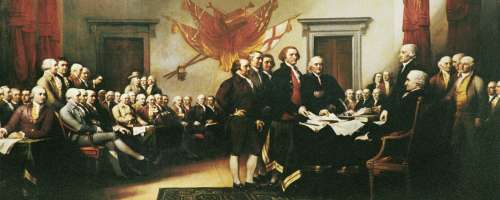 |
| John Trumbull's "Declaration of Independence," in the U.S. Capitol Rotunda, captures not the Fourth of July, but the presentation of the document to the Second Continental Congress on July 2nd, after legal separation from Britain had been achieved. Adams, appropriately, is the delegate in the middle of the picture -- on the left among the five founders who are submitting the Declaration of Independence to the chairman. Jefferson is the tallest of the group, and Franklin is on the right. |
4. Master stylist Adams was a serious student of the English language, and his attention to the ancient liberal art of rhetoric helped him become a forceful writer. Writing, he admitted, was a self-imposed discipline. "I have a great Deal of Leisure, which I chiefly employ in Scribbling, that my Mind may not stand still or run back like my Fortune," he once wrote. He became one of the most prolific and quotable of the founding fathers, spitting out quips ready-made for Bartlett's. Some of the best quotations from America's original "greatest generation" came from Adams's quill. A good example: "Facts are stubborn things," uttered by the young attorney when he courageously defended the British soldiers on trial for the Boston Massacre in 1770. Years later, contemplating his frustrations with the do-nothing Continental Congress, he supposedly complained (revealing a wit worthy of comparison with Mark Twain's): "In my many years I have come to a conclusion that one useless man is called a disgrace, two are called a law firm, and three or more are called a congress."
 |
| One Great Founding Mother: Abigail Adams |
In addition, the famous Adams-Jefferson correspondence, resumed after more than a decade of chilliness between the second and third presidents, offers insights into the religious, philosophical, and historical dimensions of the American founding.
Also notable are the letter exchanges between John Adams and his good friend, Dr. Benjamin Rush. The correspondence of these two minds of the Enlightenment tended to probe the power of the irrational in human affairs [Joseph Ellis, Founding Brothers, 215].
5. Judge of character Adams also deserves fame because he was an estimable judge of character. He pushed for George Washington to serve as the commander of the Continental army, persuaded Thomas Jefferson to write the Declaration of Independence, and nominated John Marshall to be chief justice of the United States. Not bad calls, these.
6. The American idea Finally, Adams richly deserves fame as a patriot because he got the American idea right. There is a good reason to call him our greatest philosopher president. For one thing, he was no woolly thinker seduced by the gauzy utopian schemes of French salons. Rather he held to a clear vision of what citizens of the new republic must be to thrive in a hostile world of fallen human beings.
Here it is worth saying a word about Adams's religious beliefs, which were complex and deserve more space than I can here devote to the topic. Privately, Adams was not an orthodox Christian, as we understand the term today. Theologically he was not a Trinitarian. He was a Unitarian who yet called himself a Christian and "followed" Christ. Students are confused by the fluidity of meaning, but I point out that Adams followed Christ in much the same way that Buddhists follow the Buddha (understood to be a man and not a god). In his public life Adams was like a flying buttress: supportive of more orthodoxly Christian churches but content to be outside of them. He believed in Providence, which mostly consisted of the laws under which God had created the world (so the human duty, if the goal was to prosper, was to learn these laws and act in accordance with them). Nor did Adams have any doubt that religion was necessary to the survival of the new republic. As he famously put it, "We have no government armed with power capable of contending with human passions unbridled by morality and religion. Avarice, ambition, revenge, or gallantry, would break the strongest cords of our Constitution as a whale goes through a net. Our Constitution was made only for a moral and religious people. It is wholly inadequate to the government of any other" [Adams to the Military, October 11, 1798].
Adams got the American idea right in other key ways. When we look at the spectrum of ideas among the founders, he took the via media, convinced that the center must hold. On the one hand, he distanced himself from radical revolutionaries like Thomas Paine and his cousin Sam Adams, rejecting anything like pure democracy. "Remember democracy never lasts long," Adams advised John Taylor in 1814. "It soon wastes, exhausts, and murders itself. There never was a democracy yet that did not commit suicide." On the other hand, his energetic temperament as well as his grounding in history and first principles led him away from the more pacific instincts of founders like John Dickinson. When the time came to move decisively for independence, Adams had already thought it through and was able to shape the course of events.
A keen student of history and political theory, Adams also understood the nature of republican government. It was not just anti-monarchical, nor just a democracy expressed through elected representatives. Properly understood, a republic was a form of government that balanced the three historically dominant classes of power: rule by the one (monarchy), rule by the few (aristocracy), and rule by the many (democracy). The tensions among these three groups is what Adams and others exploited to articulate the separation of powers. Thus the monarchic impulse would find expression in the Presidency; the aristocratic impulse, in the Senate and Supreme Court; the democratic impulse, in the House. Power was further attenuated in a federated polity that did not over-concentrate power in the national capital but respected civil society's "little platoons" found at the local level as well as the traditional prerogatives of villages, townships, counties, and states. Above all, power must never accrete to one ruler. Human nature was too corruptible to trust any man or woman with too much power. "They define a republic to be a government of laws, and not of men," wrote Adams in Novanglus No. 7 (March 6, 1775).
Finally, Adams got the American idea right by articulating a wise conception of happiness. He brooded quite a lot on human flourishing. Perhaps his broadest utterance on the topic is found in Thoughts on Government: "We ought to consider what is the end of government before we determine which is the best form," wrote Adams. "Upon this point all speculative politicians will agree that the happiness of society is the end of government, as all divines and moral philosophers will agree that the happiness of the individual is the end of man.... All sober inquirers after truth, ancient and modern, pagan and Christian, have declared that the happiness of man, as well as his dignity, consists in virtue" [Thoughts on Government, 1776].
This statement strikes modern sensibilities as too Puritanical. Nowadays we only think about happiness as a private good. And over time, that private good has tended to degenerate into narcissism, into the calculus of I-me-mine. Today we pursue happiness in power, profit, pleasure, prestige, preeminence, progress, and pride in getting our way.
But Adams held to a deeper understanding of happiness that sought to integrate its public and private dimensions. Although Americans today have lost sight of "public happiness," it was much on the minds of the founders when they deliberated over what qualities of citizenship Americans should possess, and what kind of republic America should be. Allow me to elaborate.
Adams's notion of private happiness was informed by Aristotle and Cicero, who believed that well-being was inseparable from virtue. Most fundamentally, we must obey our informed conscience. If you have a bad conscience, you cannot be happy. If you are a slave to your passions and drives, you cannot be happy. Adams expressed this stern idea when he defined happiness as the ability to do what one ought. Where there is no virtue, there is no happiness. And as we have already seen, virtue for Adams was inseparable from religion. Performing the rituals that are pleasing to God -- being in right relation to God -- is essential to human flourishing.
Adams' notion of public happiness was also informed by ancient traditions of our Western heritage: the civic republican tradition that emphasized duties, and the natural rights tradition that emphasized (what else?) rights. The former stretched back to ancient Greece and Rome, while the latter was traceable to the European Middle Ages. Adams managed to balance both of these living traditions -- the civic republican tradition that stressed each person's duties to community, and the natural rights tradition that underscored the inalienable rights that each person enjoys before the state. If there is too much emphasis on duties, the citizen lives unhappily in an authoritarian state. If there is too much emphasis on rights, the citizen lives unhappily in anarchy or licentiousness, or both. If the proper balance could be struck -- if the behavior and habits of citizens reflected the proper balance of rights and duties, then individuals had the chance to live integrated, and thus relatively happy, lives in community.
In sum, happiness for Adams was inseparable from religion, virtue, education, civic participation, and -- and marrying a good wife. He was fortunate to have a peerless spouse in Abigail. In the end, perhaps it was her excellent influence that helped make John Adams worthy of the fame that he craved, and that posterity has finally bestowed upon him.
* * *
This essay is the fifth and last in a series on John Adams. The Adams series served as the basis for my talk accompanying the exhibition, John Adams Unbound, organized by the Boston Public Library and the American Library Association. The talk was given at the Loutit District Library, Grand Haven, Michigan, on June 30, 2011.
This Adams series is posted on July 2 because he thought that was the day our country's independence should be pondered and celebrated.
For more on presidents and leadership, see http://www.allpresidents.org/.


