Showing posts with label West. Show all posts

Thursday, September 29, 2016

Tonsor #12 -- Conservatism, Liberalism, Reaction

View of Washington, DC, on the approach to National.
September 17, 1987, was the 200th anniversary of the U.S. Constitution. That morning I was on a jet bound for Washington, DC, to see one of the world's great charters of ordered liberty.

The descent was turbulent. The view from the left side of the plane offered a welcome distraction. On the approach to National I could look east onto the Washington Monument, Capitol Hill, and neoclassical buildings on either side of the Mall. The White House was barely visible, but the Lincoln and Jefferson memorials were vivid and close. This first visit to the nation's capital made me feel like Jimmy Stewart in Mr. Smith Goes to Washington. Besides being infected with a corny kind of enthusiasm for historical sites, I was truly stirred by the monuments of civic republicanism.

But something else was stirring, too. Looking out at nation's capital, I thought the bleached monuments made the city look like a colony of the ancient Roman Empire. The scene reminded me of Stephen Tonsor's words: "Do not become corrupted by the Imperial City, Mr. Whitney. It's where scholars go to die."

In his autobiography, Edward Gibbon recounted his first trip to Rome where he experienced his "Capitoline vision." He ascended steps that overlooked the ruins of ancient Forum, musing as barefooted friars sang Vespers in the Temple of Jupiter. Suddenly he conceived the project to write what the world would later know as The Decline and Fall of the Roman Empire (1776).

My view from the plane did not inspire a correspondingly ambitious project. But I was working hard to understand what Tonsor had said one week before, after our first History 416 class. It was the conversation that left me scratching my head, yet I felt it mattered. What did my professor mean when he said that both "liberal conservatives" and "reactionaries" were his kind of people? How did three quite different -isms -- liberalism, conservatism, reactionaryism -- fit together in one man's head? I sensed that the answer would help me understand not only Tonsor's view of modernity, but also his notions of civilizational decline, cultural decadence, and imperial decay.

*     *     *

On the flight's descent, I found my imagination taking off. I was embarking on a journey that would lead me into territory for which my map had only the broadest contours, and not very accurate contours at that. So the key at the start of the journey was to take Tonsor at his word. No ideologue, the man said that he embraced life's complexities. He contained multitudes.[1]

1. In time I would understand that the conservative in Tonsor was grounded in the West's Judeo-Christian, Greco-Roman patrimony. Our civilization's first order had been informed by that synthesis during the Middle Ages. You can see it in the way St. Thomas Aquinas baptized and then went beyond the teachings of Aristotle. It's why the civilization Aquinas helped build was called "Christendom." Significantly Tonsor, a man of the modern age, did not cling to the forms of bygone Christendom. He would later tell me that a book like James J. Walsh's The Thirteenth, Greatest of Centuries was too nostalgic for his tastes. "The good old days," he like to say, "were not all that good."[2] So it was not the forms but rather the essence of the Judeo-Christian, Greco-Roman synthesis that inspired him -- its ethical precepts, religious insights, and spiritual comforts in a world wondrously made by its Creator. In essence, then, the conservatives were the guardians of civilization, men and women alive to Tocqueville's habits of the heart that are formed in families, religious communities, civil society, and local politics.

2. In time I would understand that the liberal in Tonsor celebrated the spirit of liberty in human nature. That spirit was always present in the West but emerged quite forcefully in the Enlightenment and challenged Christendom directly. (The Renaissance had challenged Christendom indirectly.) Our civilization succeeded in absorbing many of the resulting intellectual, moral, and spiritual tensions between Christendom and the Enlightenment, but these binary sources of authority led to the de facto renaming of our civilization. Henceforward we would be "the West" or "Western civilization" instead of Christendom. The Enlightenment was epitomized by Thomas Jefferson, whose newly articulated natural right to the pursuit of happiness would prove to be one of the most potent concepts to emerge from the so-called Age of Reason. The pursuit of happiness would justify the efforts of individuals to free themselves from "oppressive authority, outworn customs, arbitrary rules, unfair regulations, and tyrannical taboos." The process of liberation was good -- to a point -- so long as the pursuit was properly ordered to man's imperfect and imperfectible nature. Tonsor was no utopian.

Allow me to pause to emphasize Tonsor's argument that, in a healthy civilization, the liberal type who struggles to expand the empire of freedom must be balanced by the conservative type who is the guardian of the civilization's institutions and teachings. They are complementary types, these two -- the liberal reformer and conservative guardian -- and both are needed in productive tension. Indeed, it was that productive tension that gave rise to the dynamism of the West that we identify with modernity. Tonsor was teaching me to see modernity as successive experiments in freedom -- which sometimes turned out to be excessive experiments in freedom that had to be tested and sifted in light of our older Judeo-Christian patrimony.

3. In time I would understand that the reactionary in Tonsor required me to abandon the security of my Merriam-Webster preconceptions. Reaction, I would learn, was not a temporal concept -- it was not the politics of nostalgia that sought to turn back the clock to some mythic golden age. It was impossible to go back to anything. Rather, reaction was a philosophical or political or perhaps even a sociological concept at the center of what Tonsor called the "West's inner history."

Aristotle, son of the physician Nichomachus 
I had difficulty grasping Tonsor's unconventional notion of the reactionary, but my road-to-Damascus epiphany came when I could see the idea through his eyes as an Aristotelian.[3] If one sees the reactionary as a kind of physician in the Aristotelian mold, then the type makes sense.[4] The Aristotelian physician viewed diseases in terms of excesses or defects of elements in the body. Applied to politics, we see that the reactionary is an Aristotelian-like physician who seeks to restore the balance between the change element and the continuity element in a culture. Reaction is thus the cure for any disease of excess or defect in the body politic. It applied to the excess of liberalism (too much change) and to the excess of conservatism (too much continuity). When confronting liberals, the reactionary sought to reintroduce order in a society whose abuse of liberty had led to widespread disorder, anarchy, and licentiousness; thus the reactionary, seeing liberty abused, fought for order restored. When confronting conservatives, the reactionary sought to enliven the patient with an injection of reform that a dynamic society needs to stay healthy; otherwise the patient does not thrive.

Conservatism. Liberalism. Reaction. These three elements made sense in dynamic relation to one another and as part of the organic development of our civilization. Tonsor adopted the role of the Aristotelian physician. To preserve the West's humane order, the reactionary in him sought a balance between the liberal push for innovation and the conservative temperament for preservation. Thus the civilizational task of the reactionary-liberal-conservative to balance change and continuity was in no way ideological. From generation to generation the ideal is always evolving, always developing out of the tension between innovation and conservation. In his ethical critique of modernity, Tonsor's task was to discern the degree to which change and continuity were in right relation to one another.

I knew that it would take time fully to digest the meaning of these three concepts and their relation to one another. Tonsor's thought was not always easy to understand. His personal interactions were not always easy to navigate either, and in fact could get in the way of understanding his thought. As his colleague, fellow historian John Willson, observed, "Steve was often an enigma to me."[5] Willson's observation reminds me of a passage from Charles Dickens's A Tale of Two Cities: "A wonderful fact to reflect upon, that every human creature is constituted to be that profound secret and mystery to every other. A solemn consideration, when I enter a great city by night, that every one of those darkly clustered houses encloses its own secret; that every room in every one of them encloses its own secret; that every beating heart in the hundreds of thousands of breasts there, is, in some of its imaginings, a secret to the heart nearest it!"[6]

*     *     *

With the plane's descent, the nation's civic monuments disappeared from view, one by one. Then came the bump of the wheels skidding on concrete followed by the rapid deceleration that pushed me forward in my seat. Soon I would be afoot in the Imperial City.

________________________

[1] Stephen J. Tonsor, "The Conservative Search for Identity," in Equality, Decadence, and Modernity, ed. Gregory L. Schneider (Wilmington, DE: ISI Books, 2005), p. 247.
[2] Bernard Tonsor interview with GW, Jerseyville, IL, July 1, 2014.
[3] Ann Tonsor Zeddies correspondence with GW, January 26, 2015.
[4] Aristotle's father, Nichomachus, was the court physician to the king of Macedon.
[5] John Willson correspondence with GW, November 8, 2016.
[6] My thanks to Winston Elliott for this passage by Dickens.

Saturday, May 21, 2011

World History - after 1500 everything changes

iPod -- postmodern chic
Around 1500 A.D. the world changed. It began to change in more ways and with more intensity than at any previous time in history. Today in the U.S. most people take it for granted that life and culture are supposed to change, to progress. Americans like the Next Big Thing to come along, eagerly anticipating the medical, technological, and automotive advances that make material life better.

But our modern civilization is not the norm. Change for its own sake was not universally embraced by our ancestors or other civilizations. Most early civilizations were so conservative that their rulers suppressed change. Ancient Egypt's religion, governance, and art remained essentially static for some 3,000 years -- a staggering length of time spanning almost 3/5's of all humankind's experience with civilization. China's worldview, bureaucratic elite, and linguistic continuity allowed dynasty after dynasty to govern relatively unaltered for thousands of years, until 1911 -- a still more staggering stretch that spanned almost 4/5's of all humankind's experience with civilization.

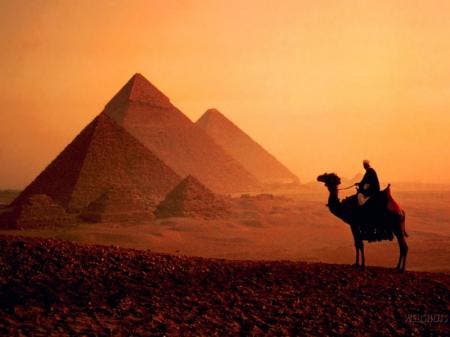
These pyramids at Giza were already "older than dirt" -- 2,200 years old -- when Alexander the Great conquered Egypt and was crowned pharaoh
As civilizations go, Romanesque and Gothic Christendom -- the foundation of modern Western civilization -- developed relatively late. It grew up in the western part of the Eurasian landmass on the ruins of the western Roman Empire. During most of the Middle Ages, Europe's leaders accommodated change, but usually only reluctantly. Century after century, the three social orders wanted life to go on much as it had for their ancestors. In this respect, medieval Europe was not much different from Egypt, China, and other great civilizations of premodern times.

Noteworthy (because it is the exception that proves the rule) is the one ancient civilization that embraced change, classical Greece. From Thales of Miletus to Ptolemy I, the Greek spirit was relatively open to new ideas. Ptolemy I's example is particularly striking because he ruled Egypt -- already a 3,000 year-old civilization when he arrived; the pyramids he toured were more than 2,000 years old. Ptolemy brought an entirely new spirit to the land of the Nile. At Alexandria, this Hellenistic ruler (1) commissioned the world's then-largest library that housed 700,000 papyri and humankind's first think tank; (2) engineered a harbor to hold 1,200 ships, and (3) erected a lighthouse that guided ships from as far away as 30 miles. In all these projects, Ptolemy exuded Hellenism's embrace of the world. That spirit would powerfully reemerge in the European Renaissance some 1,700 years later.

What Made the West Different?

In a word, it was modernity. But the origins of modernity need to be unpacked to make any sense.

The Renaissance is the name we give to an era in Western civilization lasting from the 15th to the 16th centuries, when new winds began to stir. Blowing across the western Eurasian landmass, these winds made Europe ripe for transformation. What happened in the late Middle Ages to make the West diverge in fundamental ways from its own past and from other civilizations? Why was it Europe that initiated the changes that would transform all humankind? Many factors came into play.

1. The most fundamental factor of all was the nature of the civilization itself. Western Christendom was a cultural mix that brought together (a) Judeo-Christian spiritual aspirations; (b) Greco-Roman philosophical quests including the Hellenistic spirit noted above; and (c) Anglo-Saxon-Germanic political arrangements. The rich elements from these diverse civilizations mixed, reacted, clashed, and catalyzed a new cultural chemistry. This new cultural chemistry matured into the seedbed that would nourish the most powerful civilization on earth. Christopher Dawson explores the West's seedbed in Understanding Europe, as does Russell Kirk in The Roots of American Order. Thomas Jefferson celebrated the Saxon ingredient in the remarkable second paragraph of A Summary View of the Rights of British America.
Mont St. Michel -- an organic expression of Gothic civilization

2. The tension and competition that arose within Christendom's numerous nations nurtured societies that tolerated diversity (and as we saw above, classical Greek civilization was a particularly important element in the mix). European society was more tolerant of boundary transgressions and paradigm shifts than societies in the past and in other civilizations had been. Because of history and geography, Europe had more competing states and institutions than any comparable place on earth. If a man's idea did not resonate in the Church, then perhaps it found a home in the state, and vice versa. If the prince of one state did not like an idea, then the prince of a nearby state might. Thus, the freedom to experiment and change became more normative in the West -- more so than anywhere else on the planet. Think of Columbus of Genoa (Italy), whose idea of sailing west he tested with the monarchs of Portugal and England before landing a commitment from the Spanish monarchs of Aragon and Castile. Also think of the Renaissance humanist Erasmus, who was equally at home in Paris, Louvain, Cambridge, and Basel. The social openness to new ideas (even to the point of boundary transgressions and paradigm shifts) explains why so many revolutions -- commercial, religious, scientific, intellectual, industrial, political -- could take root in the West after 1500.

Kuhn's important study of paradigm shifts
3. Frustration can be a source of historical change. A powerful trigger of modernity was Europeans' frustrated desire to trade with the East. In American history classes I bring in a pepper shaker and joke that this is what started it all. Europeans wanted Asian pepper. But in the late Middle Ages, Muslims made overland trade between Europe and Asia increasingly difficult. After centuries of lagging behind Muslims, Europeans weren't going to take it any more. In the fifteenth century they finally had the combination of technology, capital, curiosity, confidence, missionizing zeal, and competitive drive to seek alternative routes to India and the Orient, bypassing Muslim middlemen who had monopolized traditional land routes. Having to sail thousands of miles around Africa to India and back spurred advances in nautical technology. Early successes engendered a can-do spirit. So the voyages of discovery would contribute to the transformation, first in Europe's port cities, banking centers, and dynastic houses, then throughout the broader culture.

4. In the case of Europe's domination of the Western Hemisphere, epidemiology reveals a critical factor. Europeans had numerous herd animals; the Indians did not. Such animals migrated throughout Europe after the retreat of Pleistocene glaciers, finding the climate and food supply amenable to their survival. Europeans followed the animals -- pigs, horses, cattle, sheep, and goats serving as their roving Walmart -- and domesticated them. Because of these herd animals, Europeans built up immunities to the diseases that would ravage large populations of (biologically speaking) defenseless Indians. Using contemporary accounts and historical analysis, historians estimate that 50-90 percent of aboriginal Americans died as a result of smallpox, cholera, typhus, and other diseases that large numbers of Europeans had developed antibodies to. In Guns, Germs, and Steel, Jared Diamond writes persuasively of Europe's grain crops and herd animals making a difference in the rise of human inequality in the modern age.

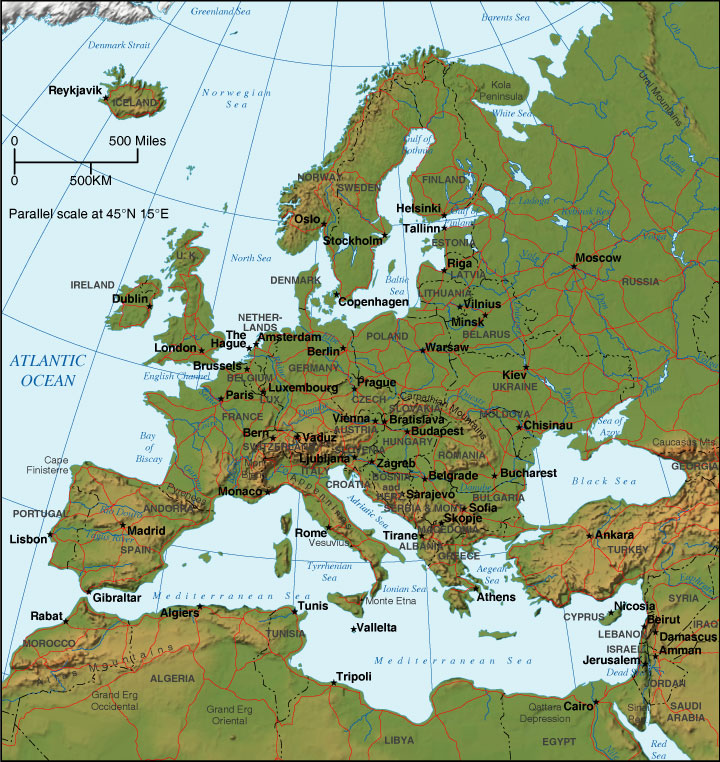
5. Europe's geography is not often emphasized, but it was another important ingredient in the rise of the West over the Rest. Geographically, Europe was always something apart -- not just apart from Muslims, Indians, and Chinese to the east. Geomorphically, too, Europe was different from the rest of the Eurasian landmass of which it is an extension. To see why, look at the globe. The western fifth of the great Eurasian landmass (from about 30 degrees latitude east to the Prime Meridian) starts to break up into numerous peninsulas and islands that are separated by relatively narrow seas, channels, bays, and straits. Europe has a highly irregular coastline in which sizable bodies of water penetrate well into the interior of the continent. Think of the Aegean, Adriatic, North, and Baltic seas, as well as the English Channel and Dardanelles-Bosporus. Furthermore, large rivers -- the Rhine, Rhone, Danube, etc. -- make communication between the interior and salt water ports easy.
Europe, the westernmost extension of Eurasia, is broken into numerous peninsulas and islands. No comparable landmass on earth is so interpenetrated by water.
European geography with all its peninsulas and islands (not to mention mountain ranges) also encouraged the formation of numerous competing states in relatively close quarters. It's why Italy has a peninsula to itself, as do Greece and Denmark. It's why Spain and Portugal are identified with the Iberian Peninsula. It's why Norway and Sweden are identified with the Scandinavian Peninsula. It's why the United Kingdom is an island unto itself. It's why the Irish aspire to be the sole occupants of their own island. As noted above, these numerous island and peninsular nations also set the stage for leaders to compete with one another in an international arena. The monarchs and princes who tried to outdo one another were another catalyst of change.

I do not subscribe to geographic determinism, but the numerous peninsulas and islands practically guaranteed that Europeans would be a water people. European geography encouraged people to meet their needs by communicating and trading with each other over the narrow bodies of water that separated them.


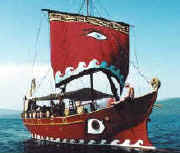
ancient Greek transport ship

No comparable land mass on earth is so interpenetrated by water as is Europe -- not Africa, not Asia, not Australia, not South America, nor North America -- all of which have smoother coastlines ... though there is one faint comparison in my part of the world. The eastern part of North America presents a geography somewhat similar to that of Europe, with the Chesapeake Bay, Delaware Bay, Hudson River, St. Lawrence River, Great Lakes, and Chicago portage to the Mississippi all affording access deep into the interior of the continent. One hundred years ago, Michigan school children were taught that the Great Lakes amounted to a kind of Mediterranean Sea in the heart of North America.

The Industrial Revolution transformed the West's economy, society, and landscape. Humankind had never experienced any similar transformation. The Industrial Revolution powered the West over the Rest.
6. Risk-taking leaders also played a critical role, for they had the imagination to see new possibilities in the voyages of discovery, accumulation of capital, and advances in technology. Collectively they built up the military capacity of the West to subdue the Rest. Fundamental to the process was the new attitude toward change itself. As the West's leaders embraced the new attitude toward change, they set off a chain of events that would have more far-reaching effects on humankind than anything since the Neolithic Revolution. With explosive energy, the West began increasing its wealth in a commercial revolution, enlarging its understanding of nature in the scientific revolution, empowering its manipulation of physical processes in the Industrial Revolution, retooling its thinking in the Enlightenment, and dominating the rest of the world through westernization. However it spread -- whether by adoption or by force -- westernization led to the globe's transformation. Like it or not, it's the feature story of the modern age. 

7. At this point we arrive at another factor, this one more speculative than the others. It involves the development of the European imagination. All the coastlines in the westernmost part of Eurasia encouraged Europeans to build boats, feed themselves from the riches of the sea, and trade with neighboring lands. But I believe it did more. I believe it accustomed people to look not just inward to the interior but outward on the open water. Gazing out at the open sea, a people's imagination will play on the infinite possibilities of the distant horizon (actually 17 miles out). The broad horizon becomes the basic unit of the imagination. This experience is unlike that of the original riverine civilizations -- Sumer, Egypt, India, China -- where peoples made their living from the earth and looked to a small hinterland for material security.

Psychologically, a distant horizon on the open sea incites wonder and restlessness. What's out there? Who's out there? What are people doing on the other side? Isn't this why we are attracted to sea coasts? We are suspended in wonder before the other, the infinite. Our mind, daydreaming, is mesmerized by the rhythmic surf. Here in the Great Lakes State we have this experience when we go to the sand dunes on Lake Michigan on a clear day and look west toward Chicago and Wisconsin. Looking out over Lake Michigan makes me think about Europeans through the ages. More than any other peoples on earth, Europeans are Homo viator, sojourners.

on a Greek ship, c. 530 B.C.
A geography and a culture that support sojourning will also encourage a people to embrace change. But -- change to what end?

Three Paradigmatic Stories

There are three great stories that Western culture has absorbed to define our restlessness, curiosity, and sense of wonder. One is from a Greek epic poem, one is from a Roman epic poem, and one is from Hebrew sacred scripture.

Replica of Odysseus's ship
In Homer's Odyssey, Odysseus cannot rest until he builds a boat to sail back home, to Ithaca, the place that for him is the source of what is true, good, and beautiful.

In Virgil's Aeneid, Aeneas leaves a Troy devastated by war, sails west on the Mediterranean, and founds a new people and a new city, Rome -- in the imagination of many, a symbolically significant home called the "Eternal City."

In the Exodus, Moses leads the Hebrews to the Promised Land, the land of milk and honey -- a journey that in part retraces the steps of Abraham and the Patriarchs, a journey that leads them back toward Eden where the first humans knew perfect truth, goodness, beauty, and love.

Pilgrims sojourn, they seek change -- sometimes with a changeless end in mind.

We Continue to Search for Eden

After 1500 A.D. these three stories became paradigmatic in the Western imagination. They symbolize European restlessness, the quest for something better. I'd allow that the perennial human search is for the true, the good, and the beautiful.

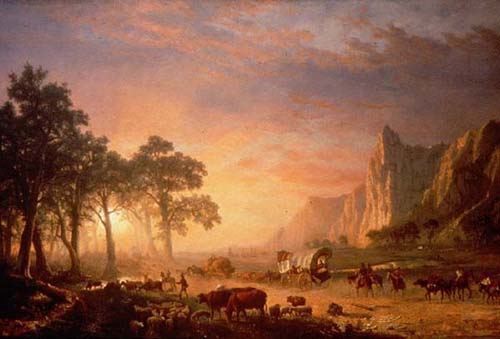
Albert Bierstadt, Oregon Trail
Our American experience with immigrants and on the frontier are latter-day iterations of this ageless impulse to sojourn West to find a better life. As a people we have enshrined our places of natural beauty and sublimity in a peerless collection of parks. We Americans restlessly continue the search for Eden.