Showing posts with label Washington. Show all posts

Saturday, August 5, 2017

Tonsor: Intellectual History: Is a "Liberal Conservative" an Oxymoron?

Winslow Homer, "The Fog Warning" (1885)
After the trip to Washington, DC, where I thrilled at seeing the U.S. Constitution in a bicentennial celebration at the National Archives, I returned to Ann Arbor intellectually stimulated by the experience and eager to resume my history apprenticeship. There was snap in the morning air when I set out to meet Tonsor during office hours. I spied him crossing the Diag in front of the Undergraduate Library (aptly called "the UGLI" because it looked like an IBM punch card). It was the first time I saw him wearing a hat. It looked reminiscent of a boater's hat from a Winslow Homer painting -- or the hat worn by the Paddington Bear. Yes, that student I'd met the first day of class had spoken perceptively: there was something ursine about Tonsor.

As our paths converged, I hailed my professor. He said hello in that expectant way of his, and then caught me up about the latest Trollope novel he was reading. When we reached the fourth floor of Haven Hall, there was a young man waiting outside his office; he was wearing a Red Wings cap. Tonsor greeted the undergraduate, showed him into the office, and put his hat down on the table. I remained standing outside the office, and what I saw next was unlike any interaction I'd ever witnessed between a professor and his student -- or between any two people. The student sat down but did not remove his cap. Tonsor also sat down and, annoyed that the student did not have the manners to remove his cap, put his hat back on his head. It was a ridiculous scene: The professor sitting stock still with his boater's hat on, staring down a hapless student whose felony was to keep his Red Wings cap on. Finally the chastised student got the hint and took his cap off, at which point Tonsor took his hat back off, and the two began conversing as if nothing had happened. It was very strange. If my professor had lived in the Middle Ages, he no doubt would have been called Stephen the Irascible. When my turn came to go into his office, I made sure to remove my ivy cap before crossing the threshold!

Rendering of the Undergraduate Library (UGLI)
"Come in, Mr. Whitney. You have not yet told me about your trip to Washington."

"The organizers kept us busy," I said, taking a seat where Red Wing boy had just been dressed down. "The highlight was seeing the Constitution on its 200th birthday, and the Declaration of Independence, too. Your lecture on liberalism was in my head as I walked around Washington, DC, taking in the sights of the 'Imperial City.' I also thought about something you said after the first class, when you referred to yourself as a 'liberal conservative.'[1] I need help understanding what that means because it seems like an oxymoron."

"This is true," said Tonsor. "It's an important question, and we don't have time to do it justice before class starts. But consistent with the sound practice of intellectual history, we can at least start with definitions in their historical context. There is not one liberalism but many, and its American permutations differ in significant respects from the liberalisms found elsewhere, or that developed previously. So one has to qualify what one means by 'liberal' and 'liberalism.'

"The same must be said of 'conservative.' There are many hyphenated conservatives nowadays -- traditionalist, economic, anti-communist, evangelical, neocon. Moreover, the American permutations differ in significant particulars from conservative thought elsewhere, or that developed previously. One has to specify what one means by 'conservative.'

"To define the term, 'liberal conservative,' I start with the observation that modern man lives with tensions, paradoxes, and contradictions -- oppositions that arise from our civilization's conflicting sources of intellectual and moral authority. In our shorthand way, we call those conflicting sources Christendom, the Enlightenment, and Romanticism. As you know from class, they have a complex and overlapping relationship to one another, something like that of a child to a parent. They are continually clashing, continually generating conflicting ideas and discourse in our public affairs. As a result, the liberal conservative must be discerning. For he believes in freedom as well as in order. He believes in individualism as well as in community. He believes in the equality of all men as well as in hierarchy, natural aristocracy, and excellence. He believes in private enterprise, competition, and the market mechanism as well as in those human, moral, and cultural values that cannot be defined by the competition of interests in the marketplace.[2] These contradictions bring to mind the Walt Whitman verse which I recited to your class: 'Do I contradict myself? / Very well then I contradict myself, / (I am large. I contain multitudes).'[3] No thriving society has ever existed that has not embraced the dynamic tensions that exist among opposing sets of values. Personally speaking, I will even say this: My behavior would be less honorable and my world more impoverished were I to abandon any one of these contradictory ideals."[4]

My synapses were lighting up like the Las Vegas Strip. If I understood him correctly, then Tonsor was blowing up all my preconceived notions. Not only was he stretching my understanding of what a liberal and a conservative were; but he was also, unexpectedly, grafting the one onto the other the way a gardener creates a new subspecies. Often the result is a new plant that is stronger than the originals. Before I started reading his work and listening to his lectures, I had little idea that Tonsor's liberal-conservative pairing could be so fresh, so undoctrinaire, so creative in approach -- and I wondered how widely known this remarkable teaching was. I would later learn that Russell Kirk, in his influential The Conservative Mind (1953), would devote a section of his book to a prominent group of thinkers he called "liberal conservatives" -- foremost among them Tocqueville -- and the type would prove highly influential in Tonsor's intellectual development.[5]


Stephen Tonsor (left) and Russell Kirk in 1977, courtesy of Annette Kirk
But to extend the biological metaphor, it seemed that Tonsor lived in an estuary of ambiguity; he was anchored neither to land nor to sea, but inhabited the richness that is found where salt water mixes with fresh, feasting in an ecosystem where nature most flourishes. It struck me how this strain of thought repositioned conservatism. It had nothing to do with the popular conception of of stalwarts fighting a rearguard action to defend the status quo, or promoting a politics of nostalgia that would return Americans to some golden age. Not at all. Rather, at the true heart of the conservative body of thought was the willingness to embrace the tensions, paradoxes, and contradictions of the human experience -- life as it really is experienced -- and subject it to critical analysis in light of abiding principles.

Tonsor continued speaking and my neurons continued lighting up. "Going all the way back to Aristotle," he said, "you see the development, in free societies, of the liberal-conservative pattern of thought. It was passed on, generation after generation, within a remnant. Then in the modern age, the liberal conservative emerged out of a powerful genealogy that includes Burke, John Adams, Tocqueville, John Stuart Mill, Lord Acton, and Jacob Burckhardt.

When George H. Nash's classic treatment of
postwar conservatism came out in 1976,
Tonsor earned a spot on the dust jacket
as one of the nation's top 25
conservative thought leaders.
His photograph is in the lower left corner.
"Now, you may ask yourself: What is peculiarly conservative about the liberal conservative? Well, much of conservative thought is derived from the West's religion, from Christendom. The conservative is a tough-minded realist who understands that human beings are imperfect and imperfectible; that they are usually self-interested and often irrational. He thus values the historic reality of those statesmen, charters, and institutions that act as a check on man's libido dominandi which --"

Tonsor saw my brow furrow. "Libido dominandi comes from St. Augustine. It refers to man's disordered love of overreaching power. The liberal conservative is conservative in his belief that freedom is not enough. Freedom is only viable if it is ordered -- ordered by virtue. Virtue promotes order in the soul and order in the society. Although freedom and virtue are in inner tension, they complement each other. The more a man can govern himself by an interior law, the less he needs the government to impose an exterior law. Thus freedom thrives, paradoxically, when it grows out of a tolerable order. Let me be clear on this point: freedom is not freedom if separated from order.

"You may also ask yourself: What is peculiarly liberal about the liberal conservative? Well, the liberal -- at any rate, the classical nineteenth-century liberal -- derives much of his thought from both the Enlightenment and Romanticism. Think of the French physiocrats, Adam Smith, Friedrich von Hayek, and Milton Friedman. This type, the classical liberal, appreciates the spirit of freedom in man's nature, the restlessness to throw off oppression and improve his estate. Historically the classical liberal often had to struggle against the ancien regime and thus was a bit more eager for social, economic, and political reform than is his conservative friend. As John Cardinal Newman acknowledged, 'In a higher world it is otherwise, but here below to live is to change, and to aim for perfection is to have changed often.'[6]

"Newman's words suggest that the liberal believes freedom itself is as much a part of human nature as it is of the divine economy. Said his sometime friend, Lord Acton, 'Liberty is so holy a thing that God was forced to permit evil that it might exist.'[7] He understands that liberty is a worthy civilizational goal that has been hard won and easily lost. That's why he celebrates the organic growth of ordered liberty through time-tested constitutions, institutions, and laws. And it is why he frowns on revolutionary fixes and the do-your-own-thing behavior that soon results in anarchy or licentiousness. It is a faux freedom that cannot last.

"To tie these definitions together with your recent visit to Washington, DC, I would say that the liberal conservative today climbs onto the shoulders of giants -- of Aristotle, Burke, John Adams, Tocqueville, John Stuart Mill, Lord Acton, Jacob Burckhardt, Jacques Maritain, and John Courtney Murray -- thinkers who were alive to politics as a form of conversation, of rational deliberation. Our American constitutions -- both written and unwritten, and at the state and federal levels -- seek to maintain a political order in which citizens can agree to disagree in a community of civil discourse, arguing and deliberating over the questions of how we shall order our lives together -- without resorting to civil war.[8]

"The liberal conservative thus values the virtue of prudence. He supports the prudent statesmen who can keep our state and federal constitutions balanced on a tightrope. On the one side is a government strong enough to enforce the rule of law as well as smother any incitement to mob rule; on the other side is a government weak enough that it cannot become its own self-interested, devouring tyrant -- because the governors will surely devour a people's freedom if given opportunity to do so. This perennial challenge in the human condition is what the framers of the U.S. Constitution debated. Their success is without parallel in world history. Indeed, at risk of oversimplifying because they possessed an extraordinary range of views, the founders turned out to be a great generation of liberal conservatives."

Tonsor slapped his knees to indicate that office hours were up -- we had to walk across the Diag to our class in East Engineering. But I was dazzled by my professor's lambent intellect. He had just given me the rudiments of an interpretive method by which to order a conservative political philosophy and the practice of intellectual history. I would eventually coin a term for Tonsor's method: "the hermeneutic of dynamic tension." He was teaching me about the unresolved opposites (in ideas, values, beliefs, institutions) that were nevertheless held together in the force fields of culture.

When we got settled in class, I noticed three words still on the blackboard: "Learn or die."

____________________

Notes

[1] Stephen J. Tonsor to Henry Regnery, August 17, 1987, p. 2; letter in GW's private possession, courtesy of Alfred S. Regnery.

[2] Stephen J. Tonsor, "Why I Am a Republican and a Conservative," in Equality, Decadence, and Modernity, ed. Gregory L. Schneider (Wilmington, DE: ISI Books, 2005), p. 235.

[3] Stephen J. Tonsor, "The Conservative Search for Identity," in Equality, Decadence, and Modernity, ed. Gregory L. Schneider (Wilmington, DE: ISI Books, 2005), p. 247.

[4] Tonsor, "Why I Am a Republican and a Conservative," in Equality, p. 235.

[5] Tonsor began adulthood as a war veteran and Truman Democrat. (See "Why I Am a Republican and a Conservative, in Equality, pp. 231-32; also my first of two interviews with his brother, Bernard Tonsor, July 1, 2014, in Jerseyville, IL.) So when did he begin defining himself as a "liberal conservative"? The seed was likely planted in high school when, thinking he was bound for the seminary, he was introduced to Aristotle's Golden Mean through the synthesizing works of Thomas Aquinas. When he resumed undergraduate study after World War II, he took philosophy courses that confirmed him as an Aristotelian thinker for the rest of his life. (GW correspondence with Ann Tonsor Zeddies, January 26, 2015.) The seed was watered when his dissertation advisor, Joseph Ward Swain, encouraged Tonsor to read Lord Acton in the late 1940s or early 1950s. Acton was "at the center of [his] world." ("Joseph Ward Swain," Equality, p. 316.) The seed was no doubt fertilized when Gertrude Himmelfarb's seminal study, Lord Acton: A Study in Conscience and Politics, was published in 1952 by the University of Chicago Press. But germination seems to have occurred when Tonsor encountered the work of Russell Kirk in 1953. He was employed by the U.S. Forest Service as a fire lookout in the Sawtooth Mountains of Idaho, and he describes the remarkable experience of discovering The Conservative Mind on a mountaintop. (See "Joseph Ward Swain," Equality, p. 316; "Why I Too Am Not a Neoconservative," Equality, p. 303; "Russell Kirk," Equality, pp. 317-20; and "Conservative Pluralism: The Foundation and the Academy," pp. 1-2, no date, typed lecture in GW's possession, courtesy of Alfred Regnery). Tonsor describes the effect The Conservative Mind had on him using a powerful figure of speech: "I dipped my hand in the holy-water fount of Russell Kirk and said, 'Home at last!'" Tonsor tells us that it was when reading Kirk's important book in 1953 that he discovered he was already a conservative: "The event," he later reported, "was not a conversion experience, but a moment of self-revelation" ("Why I Too Am Not a Neoconservative," Equality, p. 303). It is not a stretch to think that he already was defining himself as a "liberal conservative" around this same time. Further evidence is that in graduate school he was a great admirer of Tocqueville, who is explicitly treated by Kirk, in The Conservative Mind, as a liberal conservative. So the process of changing from a Truman Democrat to a liberal conservative probably occurred due to numerous influences between about 1949 and 1954. His later letters to Henry Regnery reveal that he continued to refer to himself as a liberal conservative as late as 1987 (Tonsor to Regnery, August 17, 1987, p. 2; letter in GW's possession, courtesy of Alfred Regnery).

[6] John Henry Newman, An Essay on the Development of Christian Doctrine (1845), chapter 1, section 1, part 7.

[7] Acton quoted in Tonsor, “The Conservative Search for Identity,” in Equality, p. 256.

[8] Matthew Rose, "The Liberalism of Richard John Neuhaus," National Affairs, issue no. 28 (summer 2016); at URL http://www.nationalaffairs.com/publications/detail/the-liberalism-of-richard-john-neuhaus, accessed October 24, 2016.


Thursday, September 29, 2016

Tonsor #12 -- Conservatism, Liberalism, Reaction

View of Washington, DC, on the approach to National.
September 17, 1987, was the 200th anniversary of the U.S. Constitution. That morning I was on a jet bound for Washington, DC, to see one of the world's great charters of ordered liberty.

The descent was turbulent. The view from the left side of the plane offered a welcome distraction. On the approach to National I could look east onto the Washington Monument, Capitol Hill, and neoclassical buildings on either side of the Mall. The White House was barely visible, but the Lincoln and Jefferson memorials were vivid and close. This first visit to the nation's capital made me feel like Jimmy Stewart in Mr. Smith Goes to Washington. Besides being infected with a corny kind of enthusiasm for historical sites, I was truly stirred by the monuments of civic republicanism.

But something else was stirring, too. Looking out at nation's capital, I thought the bleached monuments made the city look like a colony of the ancient Roman Empire. The scene reminded me of Stephen Tonsor's words: "Do not become corrupted by the Imperial City, Mr. Whitney. It's where scholars go to die."

In his autobiography, Edward Gibbon recounted his first trip to Rome where he experienced his "Capitoline vision." He ascended steps that overlooked the ruins of ancient Forum, musing as barefooted friars sang Vespers in the Temple of Jupiter. Suddenly he conceived the project to write what the world would later know as The Decline and Fall of the Roman Empire (1776).

My view from the plane did not inspire a correspondingly ambitious project. But I was working hard to understand what Tonsor had said one week before, after our first History 416 class. It was the conversation that left me scratching my head, yet I felt it mattered. What did my professor mean when he said that both "liberal conservatives" and "reactionaries" were his kind of people? How did three quite different -isms -- liberalism, conservatism, reactionaryism -- fit together in one man's head? I sensed that the answer would help me understand not only Tonsor's view of modernity, but also his notions of civilizational decline, cultural decadence, and imperial decay.

*     *     *

On the flight's descent, I found my imagination taking off. I was embarking on a journey that would lead me into territory for which my map had only the broadest contours, and not very accurate contours at that. So the key at the start of the journey was to take Tonsor at his word. No ideologue, the man said that he embraced life's complexities. He contained multitudes.[1]

1. In time I would understand that the conservative in Tonsor was grounded in the West's Judeo-Christian, Greco-Roman patrimony. Our civilization's first order had been informed by that synthesis during the Middle Ages. You can see it in the way St. Thomas Aquinas baptized and then went beyond the teachings of Aristotle. It's why the civilization Aquinas helped build was called "Christendom." Significantly Tonsor, a man of the modern age, did not cling to the forms of bygone Christendom. He would later tell me that a book like James J. Walsh's The Thirteenth, Greatest of Centuries was too nostalgic for his tastes. "The good old days," he like to say, "were not all that good."[2] So it was not the forms but rather the essence of the Judeo-Christian, Greco-Roman synthesis that inspired him -- its ethical precepts, religious insights, and spiritual comforts in a world wondrously made by its Creator. In essence, then, the conservatives were the guardians of civilization, men and women alive to Tocqueville's habits of the heart that are formed in families, religious communities, civil society, and local politics.

2. In time I would understand that the liberal in Tonsor celebrated the spirit of liberty in human nature. That spirit was always present in the West but emerged quite forcefully in the Enlightenment and challenged Christendom directly. (The Renaissance had challenged Christendom indirectly.) Our civilization succeeded in absorbing many of the resulting intellectual, moral, and spiritual tensions between Christendom and the Enlightenment, but these binary sources of authority led to the de facto renaming of our civilization. Henceforward we would be "the West" or "Western civilization" instead of Christendom. The Enlightenment was epitomized by Thomas Jefferson, whose newly articulated natural right to the pursuit of happiness would prove to be one of the most potent concepts to emerge from the so-called Age of Reason. The pursuit of happiness would justify the efforts of individuals to free themselves from "oppressive authority, outworn customs, arbitrary rules, unfair regulations, and tyrannical taboos." The process of liberation was good -- to a point -- so long as the pursuit was properly ordered to man's imperfect and imperfectible nature. Tonsor was no utopian.

Allow me to pause to emphasize Tonsor's argument that, in a healthy civilization, the liberal type who struggles to expand the empire of freedom must be balanced by the conservative type who is the guardian of the civilization's institutions and teachings. They are complementary types, these two -- the liberal reformer and conservative guardian -- and both are needed in productive tension. Indeed, it was that productive tension that gave rise to the dynamism of the West that we identify with modernity. Tonsor was teaching me to see modernity as successive experiments in freedom -- which sometimes turned out to be excessive experiments in freedom that had to be tested and sifted in light of our older Judeo-Christian patrimony.

3. In time I would understand that the reactionary in Tonsor required me to abandon the security of my Merriam-Webster preconceptions. Reaction, I would learn, was not a temporal concept -- it was not the politics of nostalgia that sought to turn back the clock to some mythic golden age. It was impossible to go back to anything. Rather, reaction was a philosophical or political or perhaps even a sociological concept at the center of what Tonsor called the "West's inner history."

Aristotle, son of the physician Nichomachus 
I had difficulty grasping Tonsor's unconventional notion of the reactionary, but my road-to-Damascus epiphany came when I could see the idea through his eyes as an Aristotelian.[3] If one sees the reactionary as a kind of physician in the Aristotelian mold, then the type makes sense.[4] The Aristotelian physician viewed diseases in terms of excesses or defects of elements in the body. Applied to politics, we see that the reactionary is an Aristotelian-like physician who seeks to restore the balance between the change element and the continuity element in a culture. Reaction is thus the cure for any disease of excess or defect in the body politic. It applied to the excess of liberalism (too much change) and to the excess of conservatism (too much continuity). When confronting liberals, the reactionary sought to reintroduce order in a society whose abuse of liberty had led to widespread disorder, anarchy, and licentiousness; thus the reactionary, seeing liberty abused, fought for order restored. When confronting conservatives, the reactionary sought to enliven the patient with an injection of reform that a dynamic society needs to stay healthy; otherwise the patient does not thrive.

Conservatism. Liberalism. Reaction. These three elements made sense in dynamic relation to one another and as part of the organic development of our civilization. Tonsor adopted the role of the Aristotelian physician. To preserve the West's humane order, the reactionary in him sought a balance between the liberal push for innovation and the conservative temperament for preservation. Thus the civilizational task of the reactionary-liberal-conservative to balance change and continuity was in no way ideological. From generation to generation the ideal is always evolving, always developing out of the tension between innovation and conservation. In his ethical critique of modernity, Tonsor's task was to discern the degree to which change and continuity were in right relation to one another.

I knew that it would take time fully to digest the meaning of these three concepts and their relation to one another. Tonsor's thought was not always easy to understand. His personal interactions were not always easy to navigate either, and in fact could get in the way of understanding his thought. As his colleague, fellow historian John Willson, observed, "Steve was often an enigma to me."[5] Willson's observation reminds me of a passage from Charles Dickens's A Tale of Two Cities: "A wonderful fact to reflect upon, that every human creature is constituted to be that profound secret and mystery to every other. A solemn consideration, when I enter a great city by night, that every one of those darkly clustered houses encloses its own secret; that every room in every one of them encloses its own secret; that every beating heart in the hundreds of thousands of breasts there, is, in some of its imaginings, a secret to the heart nearest it!"[6]

*     *     *

With the plane's descent, the nation's civic monuments disappeared from view, one by one. Then came the bump of the wheels skidding on concrete followed by the rapid deceleration that pushed me forward in my seat. Soon I would be afoot in the Imperial City.

________________________

[1] Stephen J. Tonsor, "The Conservative Search for Identity," in Equality, Decadence, and Modernity, ed. Gregory L. Schneider (Wilmington, DE: ISI Books, 2005), p. 247.
[2] Bernard Tonsor interview with GW, Jerseyville, IL, July 1, 2014.
[3] Ann Tonsor Zeddies correspondence with GW, January 26, 2015.
[4] Aristotle's father, Nichomachus, was the court physician to the king of Macedon.
[5] John Willson correspondence with GW, November 8, 2016.
[6] My thanks to Winston Elliott for this passage by Dickens.

Friday, May 20, 2011

American Founding -- Top Ten

The professor in me is always curious to discover what a class finds most memorable -- what nuggets will they carry with them long after our course together ends? By way of review, I surveyed my OLLI class at Aquinas College during the last meeting (May 19, 2011), asking them what they most enjoyed learning in "The Amazing American Revolution." More than 50 students participated in polishing these nuggets.

10. Don't believe everything you hear on cable TV. Most commentators don't know the founding well at all. To get a better grasp of what Gordon Wood calls "the most important event in American history, bar none," it's useful to correct some misconceptions.
        
    Misinformation began early in the republic's history. This painting is typical in that it depicts the founders as unified statesmen possessing calm resolve. Yet at the conclusion of the Constitutional Convention, 16 delegates would not even sign the document they had debated. This 1856 painting by Junius Brutus Stearns -- titled "Washington as a Statesman" -- shows the General addressing the Constitutional Convention. It is at the Virginia Museum of Fine Arts, Richmond. By the way, Washington spoke only once at the Convention, toward the end of the deliberations.
    
  • Despite assertions to the contrary by some cable TV commentators and pols, the founders were a diverse lot when it came to religion, philosophy, and politics. That's why the question -- What would the founders do? -- is tricky. True, they shared the conviction that King George III and Lord North had violated the English constitution to an unconscionable degree. Applying the principles of the 1688 Glorious Revolution, they agreed to throw off the British Crown (though some were willing to crown George Washington in his stead). They also subscribed to the idea of "ordered liberty" more than we do. Beyond that, the founders could not even agree on what the American republic should look like. 16 of the delegates to the Constitutional convention refused to sign the document. Splitting up into Federalists and Antifederalists, most of the former championed a commercial republic (Hamilton); many of the latter, an agrarian republic (Jefferson).... You could hardly find two more diverse leaders than John Dickinson and Sam Adams. The intellectual antipathy between John Adams and Tom Paine was palpable.... Perhaps it was precisely the tensions among them that led the founders to become the greatest generation of statesmen ever.

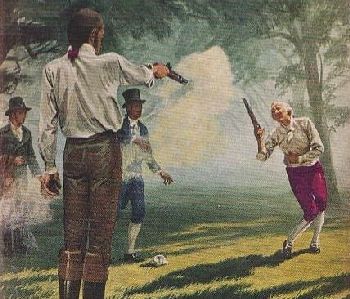
    The most famous duel in American history: Aaron Burr, our sitting vice president, killed Alexander Hamilton, our first treasury secretary, in Weehawken, NJ, on July 11, 1804.
  • It is mistaken to think that the founders basically got along well with one another. Some wore white hats; some wore black hats. Like the rest of us, they nursed resentments, held grudges, and had knock-down-drag-outs. Recall: a sitting vice president shot and killed the first secretary of the treasury in a duel. George and Martha Washington felt personally betrayed by Jefferson.... Then there's John Adams, who had a plethora of apparent foibles. He could not stand Thomas Paine. He poked fun of John Dickinson for hiding behind the skirts of his Quaker wife and mother-in-law. He envied the credit George Washington, Benjamin Franklin, and Thomas Jefferson received for the founding. By the Election of 1800, Adams and Jefferson were not even on speaking terms. Each of these "statesmen" had mobilized partisan newspapers to write such scurrilous things about the other that it is a miracle they ever restored their friendship. The campaign rhetoric in 1800 was much more vicious than anything you see today, even on cable TV.
  • 
    Ever wonder how Gouverneur Morris lost his left leg?
    
  • It is also mistaken to think that all the founders were buckled-shoe Puritans in their private lives. Several of our statesmen were not "family values" people at all. Luther Martin was such a lush that historians like Gordon Lloyd joke that it would be more accurate to call him "Luther Martini." Gouverneur Morris's many affairs on both sides of the Atlantic -- including sharing Talleyrand's mistress -- gives new meaning to the idea of (to use his words in the Preamble) "domestic tranquility." While Treasury secretary, Alexander Hamilton had a notorious affair with the financially desperate Maria Reynolds, making him vulnerable to bribery. (As Hamilton himself later confessed, "I took the bill out of my pocket and gave it to her. Some conversation ensued from which it was quickly apparent that other than pecuniary consolation would be acceptable").... In his Autobiography Benjamin Franklin admitted he frequently visited prostitutes; moreover, he was not very considerate of his wife Deborah, abandoning her for long periods of time; and he refused to reconcile with his son when he declared with the Tories. George Washington was still flirting with Sally Fairfax after his engagement to Martha. Washington's famous will, in which he released his slaves (the only founder to do so), certainly betrays mixed motives upon closer inspection. Thomas Jefferson was not only accused of sleeping with his teenage slave, Sally Hemings, but also with trying to seduce his neighbor's wife, Betsy Walker. The sins and peccadillos of our founders would fill an Everest of People magazines.... But that's okay. It is important to see the founders as they were. They were not marble statues, cold and unapproachable and inaccessible. When we bring them down from Mt. Olympus, when we see them as they were, warts and all, we can respect them all the more as flawed humans who nevertheless accomplished much good.... Plus, we can identify with them. If these flawed human beings were capable of such heroic personal sacrifice in the service of a greater good, then perhaps we really can follow in their footsteps and expect better from ourselves.

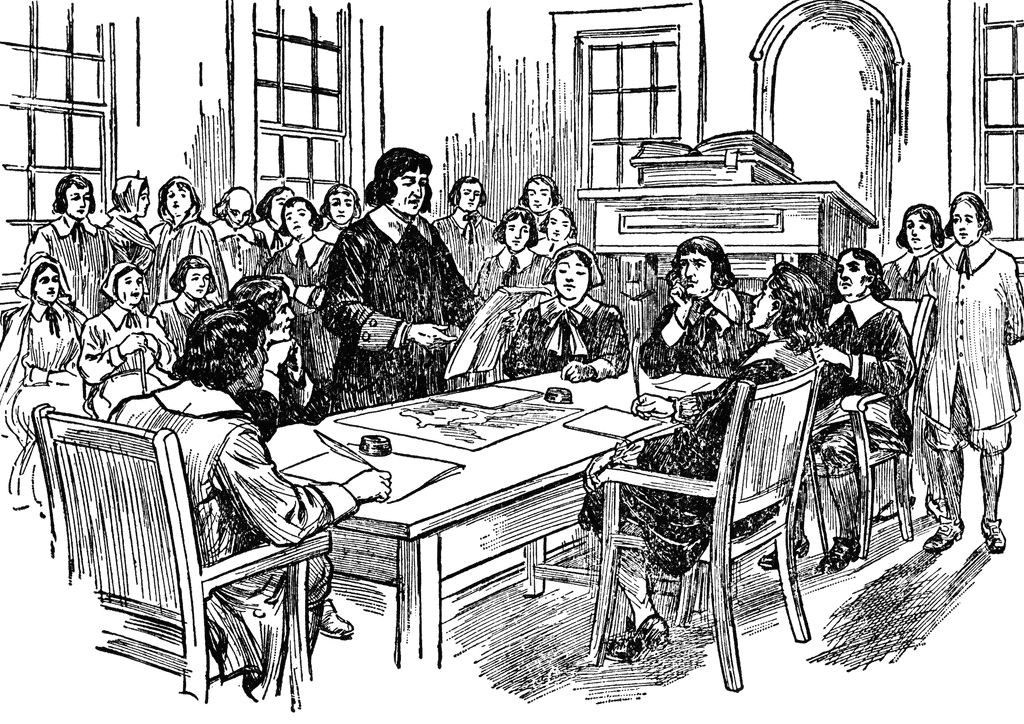
    Politically, America was founded as a constitutional republic. But direct democracy was practiced in early New England town meetings. This illustration is from a civil government text used in the early 20th century.
  • It is misleading to assert that America was founded as a democracy. That statement is only partially true. Constitutionally, America was founded as a republic. The populist element in our early history was situational. Ad hoc direct democracy arose on the Mayflower, in New England town meetings, and along the frontier. Moreover, our civil society, marketplace, and militias were democratically organized. The democratic principle in our culture would spill inexorably over into politics during the Progressive Era a hundred years after the founding. But the national government would not change significantly until many decades after the founding generation had passed. Strictly speaking, the national frame of government that came out of Philadelphia in 1787 was republican. A republican constitution by definition balances rule by the one (presidency), with rule by the few (Senate and Supreme Court), with rule by the many (House). America was founded as a constitutional republic. 

  • I sometimes hear it said, erroneously, that America was the world's first republic. Actually there were numerous republics that preceded America. Ancient Carthage was a prominent republic that contended with Rome for control of the Mediterranean. Ancient Rome was a republic for almost 500 years. Medieval Venice was a republic for more than 1,000 years. Prior to the American Revolution, in the 17th century, the Dutch formed a powerful commercial republic, and Britain experimented with republicanism under Cromwell. It is more accurate to say that we were the modern world's first constitutional republic.

    Charles Carroll of Carrollton (Maryland) was the only Catholic signer of the Declaration of Independence and the last surviving signer of the document. He was educated in Europe by the Jesuits. This serene oil painting, by Thomas Sully in 1834, fails to convey all the suffering Carroll and his family endured both as Catholics and as nation founders. Bradley Birzer's authoritative biography, American Cicero, brings to life one of the most fascinating statesman of the founding era.
  • "America is a Protestant nation" -- a largely true statement at the time of the founding, but one that needs qualifying. Most citizens were indeed Protestant, but two percent of the population was Catholic and heterodox faiths abounded, as did people who professed no faith at all. In British North America there were numerous Quaker settlements, for example, and many of our foremost founders were either Unitarian (John Adams) or Deists (Jefferson, Franklin, Paine). Only once in his public life did George Washington speak the name of Jesus. (He was nominally Anglican.) Only one of the nine most prominent founders, John Jay, was a devout, orthodox, church-going Protestant during the revolutionary period. During one particularly tense session at the Constitutional Convention, Benjamin Franklin suggested that the delegates pray, to which Alexander Hamilton quipped that Americans had no need of foreign intervention. There is no question that most American settlers were Protestant, and that most of the founders were Protestant. But it is also accurate to say that a small number of prominent founders were like flying buttresses -- supportive of the church but happy outside of it.

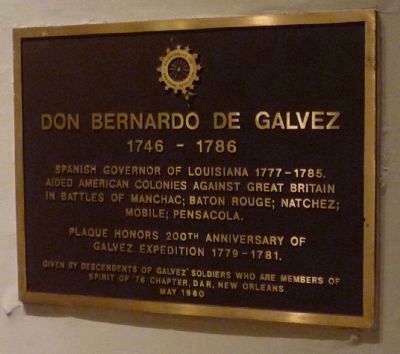
    Texas vaqueros helped win the American Revolution. This historical plaque in New Orleans commemorates the role of Spanish Governor Bernardo de Galvez in defeating the British. Galvez fed Spanish and American armies with cattle from Franciscan ranches around San Antonio, in the Spanish province of Texas.
  • When speaking of the War for Independence, it is misleading to concentrate solely on the upper East Coast between, say, Fort Ticonderoga and Yorktown. To do so is to neglect other critically important theaters in the Western Hemisphere. Historically, Boston and New York publishing houses tended to focus on their own region to the neglect of (1) the Carolinas, which saw some of the heaviest fighting in the war; (2) the Caribbean, where the French navy kept most of the Royal navy pinned down; (3) the West, where George Rogers Clark subdued Britain's Indian allies, even in far-off places around Fort Detroit; (4) the Southwest, where Spanish Governor Bernardo de Galvez kept the Gulf Coast and Mississippi River cleared of the British, with even Spanish vaqueros in Texas playing a logistical role. Each theater contributed to the successful quest of the Americans who sought independence. It's not just an East Coast thing.

      Also:

  • July 4th, 1776, is not technically Independence Day. As John Adams pointed out, July 2nd was the day when the Second Continental Congress voted on Richard Henry Lee's resolution (introduced on June 7, 1776) to separate from Great Britain. July 4th was the day the Congress voted to adopt the Declaration of Independence, setting forth the rationale for the break with Britain. It was intended for both for domestic and international consumption.

  • George Washington was a great man, but he was not a great battlefield general -- certainly no Alexander the Great, Julius Caesar, or Napoleon Bonaparte. In fact, GW lost more battles than he won. His strength lay in his ability to hold a ragtag army together, his example of sacrifice, his intelligence gathering, his holding an international alliance together, and his ability to walk away from power. That is why he was great and it is why we honor him. (Even his enemy, King George III, remarked that Washington's ability to walk away from power made him "the greatest man in the world.")

    A set of George Washington's dentures, obviously not made of wood. 
  • George Washington did not have wooden teeth. His dentures were made of slave teeth set in ivory that were stained by tea, so they eventually looked like wood. They caused him much difficulty (stories about which prompts laughter at the expense of the Father of our Country).

  • It is not true that democracies (and, by extension, representative democracies) do not go to war against one another. The German philosopher Immanuel Kant foreshadowed the "democratic peace theory" in his essay, "Perpetual Peace" (1795). Kant reasoned that a majority of the people would never vote to go to war, unless in self-defense. Therefore, if all nations were constitutional republics, international warfare would end, because there would be no aggressors. It's a bad theory refuted by history. Numerous times a body of people or their representatives have elected to go to war against each other: Athens vs. Sparta; Rome vs. Carthage; Great Britain vs. the U.S. in the War of 1812; the North vs. the South in the Civil War, and both, by the way, were the largest two democracies in the world at the time. 


9. The American War for Independence was both a civil war and a world war. It began as a civil war. A formerly united empire consisting of Englishmen loyal to the Crown split up when about 1/3rd of the colonists in British North America decided they had put up with too many abuses for too long. They justified their violent breakout in the Declaration of Independence, citing some two-dozen specific abuses.... Within three years the conflict morphed into a world war, and here the larger global context is important. England and France had fought four wars in the hundred years leading up to the American Revolution. They had scrapped in Europe, the Indian Ocean, the Caribbean, and North America.... In 1754 a young George Washington precipitated the fourth of these wars in a glen in southwestern Pennsylvania. Britain eventually won the Seven Years War, but at a high price -- literally. The American Revolution grew out of the tensions that arose when Britain, financially strapped, taxed colonials without their consent to ease the crushing debt of empire. Patriot resistance led to the War for Independence, but Britain would end up fighting not just 13 of their former colonies, but also France, Spain, and Netherlands, all of which had scores to settle with the British.... After Saratoga, France came in on the American side hoping to humiliate the British after their own humiliation in the Seven Years War. Although France got the satisfaction of seeing Britain humiliated, her war debts, in turn, would lead to the calling of the Estates General and the outbreak of the French Revolution.... Out of the chaos of the 1790s rose Napoleon, whose wars in turn led to financial troubles that would open up the opportunity for Americans to purchase Louisiana, recently purchased by the French from Spain.... The American revolt is further linked to her former allies through the Haitian slaves who unsuccessfully attempted to break away from France and found the New World's second republic, and to all the South American republics that successfully broke away from Spain. It's all linked -- like that old toy, the barrel of monkeys. The American founding is better understood when seen in all its complex linkage to the broader world.

The neoclassical painter, John Trumbull, actually took part in the scene above, titled "The Death of General Warren at the Battle of Bunker Hill, June 17, 1775." The painting hangs at the Boston Museum of Fine Arts.


8. The casualty rate of the Revolutionary War was much higher than anyone today realizes -- second highest of all our wars. In the Civil War, America lost almost 2 percent of her population. In the Revolutionary War (which was also a civil war), America lost almost 1 percent of her population. Out of a population of 2.5 million, the Americans lost close to 25,000 people by mortal wounds, subsequent infections, and disease.... By contrast, in World War II and the War of 1812, the U.S. lost about 1/3rd of 1 percent of her population. In World War I we lost about 1/10th of 1 percent of our population. In Vietnam we lost an even lower percentage of our population.

It was once common to depict George Washington sporting a Roman toga, symbolic of the old high Roman virtues -- labor, pietas, dignitas, gravitas, and fatum. This period piece from the 1840s, by Horatio Greenough, is part of the Smithsonian collection.
7. The American founders were latter-day Roman republicans. Many could read Latin, were classically educated, and consciously identified with some of the leading republicans of ancient Rome. They especially valued the civic virtue of the ancient Romans that made men capable of great sacrifice for others and for the community.
    
    Cincinnatus put down his plow and took up his sword when he was called to lead Rome against tyrants. In this sculpture (in Cincinnati, OH), the republican leader is handing the fasces, symbol of constitutional authority in Rome, back to the republic's legitimate authorities. Fasces are a common symbol of republican power -- and also the origin of the word "fascist." Fasces are depicted in the U.S. House of Representatives on each side of the rostrum. 
    
  • George Washington was alternately regarded as a Cincinnatus (for laying down his sword and returning to his plow) or Fabius the Delayer (for patiently avoiding a military catastrophe with the British). He also was a great fan of Joseph Addison's play, Cato, which he had performed again and again for his men. In both sculpture and painting, contemporaries frequently portrayed GW in a toga.
  • John Adams, an attorney, looked back to the greatest lawyer of ancient times, the Roman republican Cicero, for inspiration. 
  • Alexander Hamilton signed his Federalist papers with the name of the early Roman republican, Publius. There is evidence that he signed early papers "Julius Caesar."
  • James Madison signed his Federalist papers with the name of the early Roman republican, Publius.
  • John Jay signed his Federalist papers with the name of the early Roman republican, Publius.
  • In fact, when debating the merits of the Constitution, most of the Federalists and Antifederalists used Roman noms de plume.  
  • Nathan Hale's last words -- "I regret that I have but one life to lose for my country" -- were likely based on words from Joseph Addison's play, Cato.
  • In this famous sculpture of George Washington by Houdon (in the Virginia Capitol in Richmond), the General and first President of the United States rests his left hand on the fasces, symbol of Roman republican power. Fasces were composed of a bundle of rods around an axe. Compare Washington's pose with that of Cincinnatus, above, who is handing the fasces (power) back to legitimate public authorities.
  • It was fashionable for earlier generations of Americans to have Roman names. Did you notice the painting of the Constitutional Convention of 1787 at the top of the page? The artist's name is Junius Brutus Stearns (1810-1885).

6. The American Revolution and founding should be chronologically and spatially s-t-r-e-t-c-h-e-d, seen as (1) beginning much earlier, (2) including more Indian battles in the West, and (3) ending much later than the conventional wisdom suggests. Following Longfellow's famous poem, we tend to put the start of the Revolution at April 19, 1775, when Lexington and Concord flared up. We conventionally mark the end of the Revolution at either the Battle of Yorktown in 1781 or the Peace of Paris in 1783. But John Adams claimed the American Revolution began much earlier, in a Boston courtroom in February 1761, when James Otis delivered a speech asserting that Americans had the right to interpret English constitutional principles and rights differently from British politicians back home. In fact, according to Adams, many Patriot Americans had already declared their independence from the mother country in their minds and hearts before a shot was fired.... But to mean anything, ideas on parchment had to be backed by victories on battlefields. Americans simply had to wear down the British will to keep them in the empire.... We tend to overlook the importance of the Indian battles. Successfully confronting Indian unrest among the Iroquois, Shawnee, Cherokee, and Miami was critical to the struggle for independence. Many Indian battles, even as late as Fallen Timbers (1794) and Tippecanoe (1811), were due to British agitation of her Indian allies who continued to harass American settlers in the West.... As for an ending date, Jefferson called the Election of 1800 the Second American Revolution. And the War of 1812 was widely perceived to be the Second War for Independence because it was not until the conclusion of that conflict that the British seemed truly resigned to having lost her 13 North American colonies.
In 1794 the Battle of Fallen Timbers took place outside of present-day Toledo, OH. It should be seen in the context of the War for Independence and American Revolution.

5. The American founders, a minority of the population, were gutsy. Given similar circumstances today, we would probably be either Loyalists or fence-sitters. I'd wager that most of us today would not be treasonous but play it safe. Americans in 1776 were, after all, part of the greatest empire on earth. We enjoyed more rights and liberties than any other people. Why risk it all?... John Adams observed that 1/3 of the population was Patriot, 1/3 was Loyalist, and 1/3 was opportunistic or neutral. We are not as animated by constitutional ideals and historic precedents as much as they were. Maybe some of us would tip our hat to the most conservative founder, John Dickinson. But probably not. The War for Independence was a vicious civil war here at home. Even non-combatants paid dearly. We'd seek convenience and try to avoid the pain.... American Patriots were fighting the superpower of the day, against the greatest army on earth and the greatest navy on the seas. The odds of winning were slim. There was much to lose if you committed high treason against the Crown, not least of which was life and limb. Most people are not willing to risk their all.... The American Revolution almost didn't happen. On several occasions, it was almost aborted. That's why I title my course, "The Amazing American Revolution." It is amazing that the founders pulled it off.

4. In its street plan, Washington, DC, is one of the great Baroque (and broke) cities of the world. Architecturally, it looks like a latter-day outpost of Rome. In plan, L'Enfant, Ellicott, and the McMillan Commission all reinforced the classical and baroque motifs. Even as late as the 1930s, FDR's Washington seemed to be competing to become the Third Rome (as were Hitler's Berlin, Mussolini's Rome, and to some extent even Stalin's Moscow).
L'Enfant's street plan for the new capital city appealed to the Baroque imagination.

3. George III was every bit the revolutionary that George Washington was. The king was a revolutionizing tyrant, destroying the English constitution and denying the ancient rights of Englishmen to colonial subjects. His tyranny was as revolutionary as George Washington's principled resistance was. Perhaps the American founding could best be described with the Burkean phrase, "a revolution not made, but prevented." For the revolutionary impulse was largely kept within bounds when compared to the later French Revolution or Russian Revolution. As the historian John Willson suggests, maybe this is the true achievement of the American founders, to form a more perfect union without turning the world upside down.

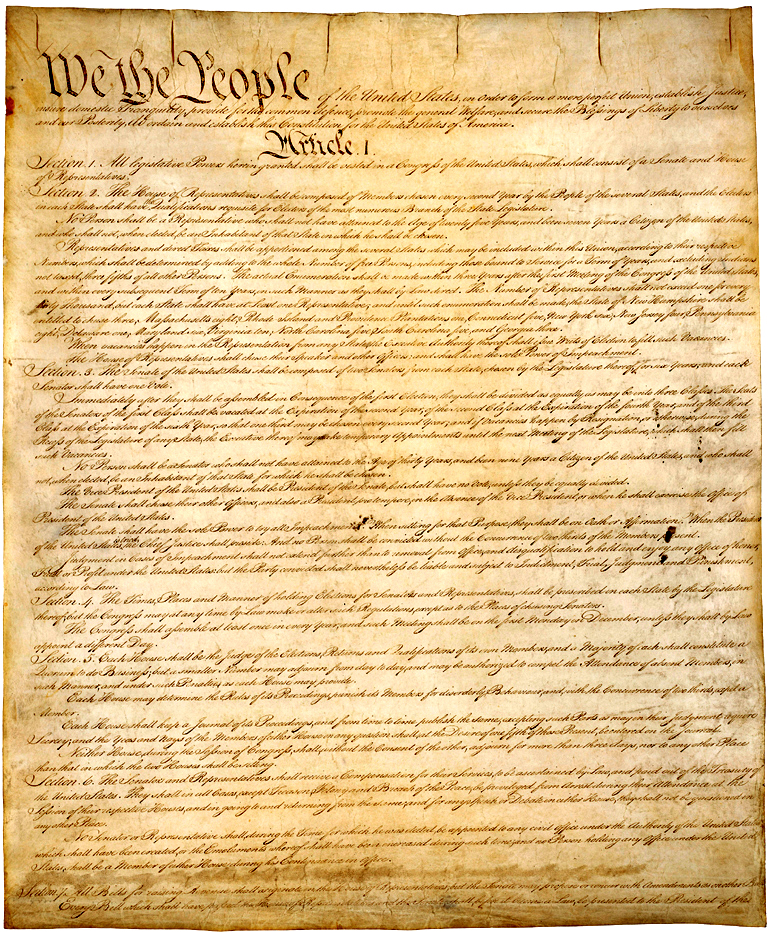
2. The founders' understanding of freedom was different from ours. They did not think it was the right to do whatever you wanted. They were not libertarians. The founders' understanding of freedom merged two intellectual streams of thought. One was the civic republican tradition, an inheritance of classical, Renaissance, and English Whig thought; it emphasized the citizens' duties to the commonwealth and engendered the habit of putting service before self. The other was the natural rights tradition, influenced by William of Occam, John Locke, and the Enlightenment; it emphasized the government's duty to the individual, especially to protect one's God-given right to life, liberty, property, and pursuit of happiness. Taken together, both the republican and liberal streams of thought recognize that freedom comprises rights and duties.... Further, freedom must be ordered to be secured; otherwise it can devolve into licentiousness and/or anarchy, as Polybius, Sallust, Livy, and Tacitus taught when meditating on the Roman experience.... Gouverneur Morris's 52-word Preamble to the U.S. Constitution offers a sublime lesson in the five conditions that must obtain before a people can be truly free. Every American should know this wonderful little lesson in political philosophy.

The first page of the U.S. Constitution containing Gouverneur Morris's 52-word Preamble, one of the most sublime lessons in political philosophy ever crafted.
1. The founders spoke of our nation's happiness. They were concerned about posterity -- about our happiness. Of all the state papers ever produced, one of the most famous is the Declaration of Independence. And of all the phrases Jefferson ever penned, surely one of the most appealing to modern sensibilities is "the pursuit of happiness." That line has played a part in shaping the modern world. Yet most Americans today are not familiar with older conceptions of happiness. The founders would not have confused happiness with power, profit, prestige, pleasure, or pride in getting our way. What does the pursuit of happiness entail? To the founders, above all it meant reconciling the public duties of our civic republican tradition with the private rights of our natural law tradition. But the private sense of happiness does not end there. At the end of Sophocles' play, Antigone, the chorus instructs us in the happiness we seek. The main ingredient of happiness is wisdom. How do we become wise? For most of us, punishment and suffering pound out our foolishness. They school us until we learn the lessons needed to live the good life. Experience teaches that wisdom mostly comes from keeping a clear conscience, worshiping God rightly, and learning from mistakes, our own and others'. If we are mindful of these things, we have a shot at being happy. We are smart about "the pursuit of happiness." For we know that, absent wisdom, there is no happiness.

*     *     *

Final thoughts in the final class

There were several honorable mentions cited by the class, nuggets that almost made it into the Top Ten. For example, they enjoyed learning about the critical moment in American history that occurred in Newburgh, New York, on the Ides of March 1783, when George Washington saved the new republic from impatient, angry officers who wanted him to lead a junta against the Confederated Congress.

One woman in class was fascinated by how rifling a gun barrel was a technological leap over smooth-bore muskets, increasing the lethal velocity of a lead ball. In a related vein, a man seized on Nathaniel Greene's brilliant strategy at Cowpens and Guildford Courthouse.

Of course, they enjoyed all the people stories -- of Nathan Hale's bravery in the face of death, of Molly Pitcher manning the cannon after her husband collapsed, of Abigail Adams watching the early battles with her children, of Ethan Allen and his Green Mountain Boys in the Grants, of John Paul Jones's daring-do off the coast of Scotland, etc. There is never enough time for all the interesting people stories, but they are what make history come alive in any class.

Bottom line: Time will tell, future historians will ratify, whether America is the greatest republic ever founded. A little perspective is in order. Our republic has existed less than 240 years. Chinese dynasties passed the baton for some 4,000 years. Egyptian civilization lasted some 3,000 years. The Venetian Republic lasted more than 1,000 years. The Roman republic lasted some 500 years. A fraction of that age, our American nation is a relative new-comer to the world stage. Are we up to the awesome task of continuing it? As Benjamin Franklin told the woman outside the Pennsylvania State House in 1787, the founders bequeathed to the American people a republic. Now it is up to us to keep it.

The United States Capitol is freighted with architectural significance, marrying the eternal heavens with earthly ambition and achievement. Reminiscent of St. Peter's and (further back) the Roman Pantheon, the circular dome symbolizes the eternal first principles of a constitutional republic in which the people are sovereign under the rule of law. The rectangular floor plan that rises from the foundation symbolizes our nation's connection to bedrock, rich soil, and vast natural resources, a geographic grounding reinforced by the structure's orientation along the four cardinal directions.

*     *     *

For more about the American founding, please see my other essays on this blog along with the many links to additional works.

For more about leadership, please visit the Hauenstein Center for Presidential Studies http://www.allpresidents.org/.

Sunday, February 13, 2011

American Founding (1): Who Cares?

Why haven't there been more blockbuster movies about the American founding and Revolution? There were heroes, there were villains, and there was war. Yet moviegoers are likely to know more about Troy, the Spartan 300, and Roman gladiators than they do about George Washington, Alexander Hamilton, and the American Revolution.

One reason the American founding lacks entertainment value is that it was more about what did not happen, than what did. As historian John Willson astutely observes, "most of what is really important about the American Founding lies in how a potentially harmful revolution was contained. It was not entirely averted, but it was contained and directed to the ends of limited government and the practice of liberties that had long existed in most American provinces." (There will be more on the proper interpretation of the American founding in the next essay.)

Perhaps because the American Revolution does not attract much attention in Hollywood or among the makers of video games, most young people are uninformed or misinformed about it. Surveys by the Intercollegiate Studies Institute (http://www.isi.org/) show that few college freshmen grasp the significance of the American founding. Informal surveys that I administer to my own classes confirm this finding. Many college students are not particularly curious about the source of their freedom. They don't fully embrace what the American founding means for themselves or for humankind. It's sort of like gravity: just there.

Most of our youth, I've discovered, cannot say why George Washington was a rare leader worthy of our esteem. They cannot identify the most significant passages of the Declaration of Independence or U.S. Constitution. (For comic relief, see the clip of Barney Fife trying to recite the Preamble of the Constitution here.) There is no way they could explain why Thomas Jefferson called the Federalist Papers "the best commentary on the principles of government which ever was written."

Few students have encountered the idea that King George III was arguably more of a rebel than George Washington. Beyond a few vague slogans about freedom and equality, most students are neither conversant with the ideas that animated the Founders, nor the principles by which they sought to govern, nor the succession of events that made independence possible, nor the incredible difficulties involved in founding the new republic, nor the tensions that were left unresolved in 1787 and bequeathed to later generations (e.g., constitutional interpretation, state vs. national sovereignty, and, tragically, the scandal of slavery).

Not only are most American students uninformed about the founding; they are misinformed as well. Most think the Constitution's framers were democrats; they are not aware that the delegates of 1787 loathed or feared direct rule by the many. Most students also fail to understand the founders' view of freedom, especially the notion that it must be ordered so that it does not devolve into licentious behavior or anarchy. Most students don't always appreciate that every right has a corresponding duty. And most are under the mistaken notion that there was everywhere a "wall of separation" between church and state from the get-go.

Do Americans not sufficiently value the founding as it actually happened? Has it been hijacked by ideologues? Does this help explain how uninformed and misinformed students are?

My aim in asking such a question is not to heap scorn on students. I do not blame our youth for what they have not been taught. I cannot hold them accountable for what they do not know when they reach my classroom, only for what they know when they leave it.

Truth is, the students starting my history classes probably know about as much as the leaders who represent them. It is our elected leaders who have no excuse when they are uninspired, uninformed, or misinformed about the founding. How ironic that Minnesota Congresswoman Michele Bachmann, the Tea Party leader in Congress -- a political movement that consciously identifies with the American Founding -- claimed in a stump speech that New Hampshire was the state famous for Lexington, Concord, and the "shot heard round the world"! It was not her first gaffe regarding basic American history.

As a college professor, my charge is to turn students on to history. It is to help them discover the amazing story of the American founding -- their founding -- and to inspire them to learn about it for the rest of their lives.

Maybe along the way some of our nation's leaders will also be inspired to get our story right.


Monday, January 31, 2011

Alexander "the Great" Hamilton: The Indispensible Aide

The following talk, based on the New-York Historical Society's exhibit of Alexander Hamilton, was delivered on August 1, 2006.

Given the esteem in which I hold my colleagues from Aquinas College and Calvin College, I am proud to conclude this series on Alexander Hamilton -- based on the exhibit by the New-York Historical Society, organized by the Hauenstein Center for Presidential Studies, and hosted by Spring Lake District Library.

Who is this man with the sharp eyes and chiseled nose on our $10 bill?

Jason Duncan opened three weeks ago with an overview of Hamilton’s “strange and amazing life.” He “overcame huge odds” (proving that truth is stranger than fiction). “None of the Founding Fathers came from such unpromising origins.” He was born illegitimate, was orphaned by age 12, and grew up on a couple of Caribbean island that enriched themselves on rum sugar cane and the sweat of the slave’s brow. Who would have expected anything great on the American stage? Indeed, “three years before the outbreak of the American Revolution, Hamilton was an illegitimate orphan working in the Virgin Islands as a merchant’s clerk." His break came when he was sent as a teenager to New York to attend what would become an Ivy League university, Columbia. He performed brilliantly in every endeavor thereafter -- well, just about every endeavor. He did not fare so well in his duel with Aaron Burr.

John Pinhiero spoke two weeks ago of one of the great divides in American thought and culture: the Hamiltonian versus the Jeffersonian answer to the question: How shall we then live together. There are two very different ways of ordering freedom in a republic.

Jim Bratt spoke last week about Hamilton’s religious outlook, placing it in the perspective of more general intellectual, moral, and spiritual currents in the eighteenth century, the Enlightenment and Great Awakening.

A fascinating figure, Hamilton. He always ranks among the top five Founding Fathers; is arguably the foremost political figure in American history who never attained the presidency; and is perennially recognized as our nation's first economist.

In the course of this series, we have been exposed to extreme views of Hamilton -- ranging from the flatteringly positive to the scurrilously negative. Much of the negative press about Hamilton was his own fault. In the struggle to put forth his vision for the new republic, he made as many political enemies as any Founder did. Among his most vocal critics was John Adams, who referred to Hamilton as "the foreigner" and called him "the most restless, impatient, artful, indefatigable, and unprincipled intriguer in the United States, if not the world." Adams, never one to fall into the error of understatement, was even more complimentary when he called Hamilton, “the bastard son of a Scottish peddler.”

Jefferson did not like Hamilton either -- in fact, couldn't stand him. They were outright political enemies by the time they were serving together in Washington's cabinet.

It didn't boost Hamilton's reputation that he became the most notorious adulterer among the Founders. His own letters reveal that he carried on with Maria Reynolds in a seedy affair that had the approval of her husband -- but only to blackmail the treasury secretary in a weak moment.

Nor did his death at the age of 49 commend him. There was still so much that his demons of ambition were prodding him to accomplish. But Hamilton had the worst kind of enemy, a mortal enemy. The former treasury secretary suffered the most spectacular death of any of the Founders, shot by the vice president of the United States in a duel. He then lingered for 31 agonizing hours before mercifully dying. The same pistol that killed Alexander had previously killed his son Phillip -- also in a duel. Too weird.

On the positive side, we think of Alexander "the Great" Hamilton as a war hero at the Battle of Yorktown; as the principal author of the Federalist Papers; and as the trusted aide to George Washington for two decades, first during the War for Independence where he demonstrated how precocious he was (he was only 20 years old when he was promoted to colonel on Washington’s staff), then during Washington’s presidency, where he served officially as the Treasury secretary, but unofficially became a rival to Jefferson who was at State. (That may have been the longest sentence I've ever composed.) Hamilton was able to exercise considerable influence over Washington's policies, but the two men had a stormy father-son-like relationship.

The title of this talk, by the way, is a play on the title sometimes used for George Washington -- “the Indispensable Man” to America’s founding. Hamilton, we know, was Washington’s indispensable aide. This evening I’d like to talk not so much about how Hamilton was Washington’s aide, as how he is ours. After all, the America he helped create is our America. That’s why the exhibit is subtitled, “The Man Who Made Modern America.” Hamilton “left behind ideas and institutions that have lasted for centuries.” Whether we like Hamilton or not, if we have not grappled with him, we have not really grappled with the origins of modern America.

"In this exhibition, we wanted to show the startling degree to which, of all the founders, Hamilton had the most modern ideas--the power of the press, the need for a strong federal government and a strong treasury, a national banking system, a stock market and trade, and a mixed economy, not one only focused on farming…."

"It's phenomenal that this man, who died in his forties, could have had so many ideas that would become true for the America that we know today," says James Basker, president of the Gilder Lehrman Institute and professor of English at Columbia University.

Now let’s take a look at three areas where Hamilton is indispensable to our understanding of modern America (with due acknowledgment to James Basker, Forrest McDonald, Ron Chernow, and other Hamilton scholars).

A. FOUNDER OF THE AMERICAN POLITICAL ORDER

Alexander Hamilton made – and continues to make – two great contributions to our American understanding of political order:

1. At the Constitutional Convention of 1787, as the dominant mind on the Committee of Style along with Gouvernor Morris, Hamilton helped shaped the Preamble with its incisive argument for ordered liberty.

2. After the convention, he wrote some 50 of the Federalist papers, expounding on the meaning of the Constitution and arguing for its ratification.

Where did his ideas come from? Many came from his years of military service. Hamilton, who rose to the rank of colonel in the Continental Army, watched as General Washington and his officers struggled to keep the army clothed, fed, and armed. Under the Articles of Confederation, the loosely organized confederation of states could not raise taxes. The army was dependent on the individual generosity of the thirteen legislatures.

"Hamilton saw that a decentralized government was helpless and incompetent at doing what needed to be done," says Basker.

Hamilton's army experience helped shape his ideas about the need for a strong centralized government. In his spare time, he read the works of European thinkers and economists--Adam Smith, Samuel Von Pufendorf, and Malachy Postlethwayt. Already in the late 1770s he began toying with the idea of revising the Articles of Confederation. But war's end, he had outlined a plan for a federal government with strong central powers. But for his plan to work, the Articles would have to be dramatically revised or discarded. Not uncharacteristically, he wrote the resolution calling for the Constitutional Convention.

Hamilton got his chance when he became one of the three New York delegates to the Constitutional Convention of 1787. He argued for a concentration of power in the national government – for senators and a national governor who would serve for life, based on good governing. His ideas received no support and had little influence on the other delegates. But Hamilton served on the Committee of Style and influenced the ideas and language of the Preamble.

Compare the early draft: “We the People of the States of New-Hampshire, Massachusetts, Rhode-Island….”

[Hold up the $10 bill and reference the words, "We the People." ]

With the final version: “We, the People of the United States, in order to
- form a more perfect union,
- establish justice,
- insure domestic tranquility,
- provide for the common defence,
- promote the general welfare, and
- secure the blessings of liberty to ourselves and our posterity
do ordain and establish this Constitution for the United States of America.”

These 52 words are the work of a genius who understood the political philosophy of ordered liberty. Ironically, a majority of Americans in 1787 did not want to be governed by the document.

If adopting the Declaration of Independence was the supreme Jeffersonian moment in American history, with its emphasis on liberty; then ratifying the Constitution with its Preamble was the supreme Hamiltonian moment in American history, with its argument for ordered liberty.

Take a step back and think about what Hamilton’s efforts mean to the human condition…. [See my Afterword in The American Cause]

Although they did not share Hamilton's federalist vision, the delegates had trouble devising a constitution. They disagreed on states' rights, representation, and slavery. With the existing government bankrupt and on the verge of collapse, a compromise had to be reached. After the other two New York delegates left in anger--they opposed any federalist provisions--Hamilton stayed behind and signed the final draft of the Constitution as an individual. Like other delegates, he recognized that the document, while imperfect, stood the chance of being ratified by the states.
"The most important thing Hamilton did was after the Constitution had been adopted by the convention, but before it was ratified. That was the real fight," says Basker.

Hamilton returned to New York, a strongly antifederalist state, to lobby for the Constitution. Hoping to turn the tide in favor of ratification, Hamilton, along with John Jay and James Madison, wrote The Federalist, a series of essays. Hamilton wrote more than two-thirds of the eighty-five essays, which were published in New York newspapers in 1787 and 1788 under the nom de plume "Publius." In the first essay, Hamilton wrote, "The vigor of government is essential to the security of liberty." Newspapers throughout the colonies began reprinting the essays, and little by little, opposition eroded. The thirteen colonies approved the Constitution.

B. FOUNDER OF THE MODERN U.S. ECONOMY

Hamilton's experiences in St. Croix also influenced his economic visions. He took the view that for the new republic to survive and flourish, the economy needed to be divided between agriculture and manufacturing. "As a pre-adolescent, Hamilton saw that on the islands, they manufactured nothing for themselves; they had to import everything," says Basker. "During the Revolution, any supplies needed by the colonies, guns or uniforms or anything manufactured, needed to be acquired from the French or Dutch or had to be taken from captured British supplies. So he knew that America would have to have its own manufacturing or it would always be dependent on other countries."

This was in contrast to Jefferson's hope for a republic of free-holding yeoman farmers, and would lead to political skirmishes between the rivals.

[Hold up the $10 bill and point to the image of the Treasury Building.]

As the first treasury secretary, Hamilton inherited a bankrupt nation. The war debt was crushing. In 1790, he published his "Reports on Public Credit," a plan to assume domestic and foreign debt, pay off federal war bonds, and create a national mechanism for collecting taxes.

James Madison and Thomas Jefferson vehemently opposed Hamilton's plan. The Virginians saw it as unfair to their state. Opposition arose from other quarters as well. To break the deadlock, Hamilton turned to back room politicking and cut a deal with Jefferson. The southern states would vote in favor of his plan in exchange for Hamilton's support in favor of moving the nation's capital from New York to a site on the Potomac River.

Hamilton also secured the establishment of a federal bank and a federal mint. Against long odds, he had placed the nascent United States on solid ground fiscally. Exhausted from the political battles, Hamilton retired from Washington's cabinet in 1795. He may have retired, but his ideas did not. [See my Afterword in The American Cause.]

[Tell the story of the Jeffersonian and Hamiltonian bragging for their man's rightful place in American history.]

C. FOUNDER OF REALIST U.S. FOREIGN POLICY

Even though Washington asked Hamilton to head up Treasury, he was too self confident, assertive, and patriotic to restrict his efforts to domestic fiscal affairs. Indeed, a few years into the Washington administration, “the Treasury Department had … been more active internationally than had the State Department…. [Hamilton] understood European affairs better than did his counterpart in the State Department.” With his boss’s blessings, Hamilton debated Jefferson over foreign policy (which must have irritated Jefferson no end), and offered indispensable philosophical counsel and policy recommendations to the commander in chief when it came to foreign affairs.

Hamilton’s view of foreign affairs was shaped by four elements:
1. his realistic view of human nature (he has been called Machiavellian);
2. he was an astute student of history (he knew how difficult it was for republics to survive and left posterity some great lessons of history in the Federalist papers);
3. he participated directly, for more than a decade, in one of the world’s most significant revolutions and in a war for independence against the world’s then-greatest superpower; and
4. he observed the excesses of the French Revolution, which broke out the same year the Washington administration began.

As Treasury secretary, Hamilton was justified in his desire to help shape U.S. foreign policy by six factors:
1. the new republic’s small army and navy were paid for by the Treasury. Early in Washington’s first administration, there were Indian wars to deal with;
2. the new republic was becoming buried by crushing debt and needed to seek credit abroad;
3. revenues had to be raised by taxing international commerce;
4. a commercial treaty with Great Britain was desired by Washington, and Hamilton was in accord;
5. the Whiskey Rebellion: Knox went away on personal business at the moment when the new republic needed him most!
6. Washington explicitly asked Hamilton for an alternate opinion to Jefferson’s when it came to the Proclamation of Neutrality (1793). Hamilton thought that Jefferson had “a womanish attachment to France and a womanish resentment against Great Britain.”

The outbreak of the French revolution coincided with the beginning of Washington's first administration, but by 1793 warfare had engulfed Europe, pitting Great Britain, Prussia, Austria, and Spain against the new French Republic. In the cabinet Jefferson opposed any expression of neutrality while Hamilton supported it. Washington eventually sided with the latter and issued a proclamation of neutrality that barred American ships from supplying war matériel to either side.

Forrest McDonald writes: “In the face of war in Europe, [Hamilton] saw neutrality as the great desideratum, but not because, having known war, he cherished peace. Rather, he understood that war, in the emotional and ideological climate of the United States in the 1790s, would divide the nation against itself and sap the strength of its infant national government. Every year of peace, conversely, would allow the country to grow stronger and its government to become more stable. As a matter of policy, he therefore regarded war as acceptable only if the alternative was national disgrace or the sacrifice of vital national interests, and only if the American people could be counted on to support the war with some measure of solidarity.”

You see these sentiments resurface three years later in Washington’s Farewell Address of 1796, where the out-going president urges Americans to avoid alliances that are not in the nation’s interest. Try to set a good republican example and be friendly to all to the extent possible. There are obvious lessons for today.

CONCLUSION

Hamilton had a vision. He believed the United States could become the world’s greatest nation ever. He foresaw us becoming a “republican empire”: at home, republican; abroad, first among the nations, with a commercial and military reach able to rival that of any other "superpower" (in Hamilton’s day, Britain and France). He thought our commercial and military reach should be proportionate to the nation’s vital interests. As our vital interests grow, we become richer, stronger, and – more subject to temptation. The temptation is to become imperial at home, dictatorial even. To Hamilton, it was necessary to avoid this temptation at all costs. No previous republic had ever quite succeeded in doing so. Ancient Rome came the closest. But Rome succumbed to imperial designs at home as its military conquered distant lands. In the United States, there would be a tension between the freedom of a republic, and the reach of a global empire. It would take time to grow the new republic. In the 1790s, to use Hamilton’s words to Washington, we were “a Hercules in the cradle.” Hamilton warned: “’Tis as great an error for a nation to overrate as to underrate itself.” Again, useful words for us to remember today.

How different Hamilton’s pragmatic vision is from Jefferson’s idealistic vision.