Showing posts with label Lincoln. Show all posts

Thursday, August 31, 2017

Tonsor: Intellectual History: Equality

I.

After we began the walk back to campus, the mood settled and Tonsor broached a topic related to the one we had probed over lunch. "You'd be interested in a book I'm working on, Mr. Whitney. It's about equality. Remarkably, there has been no systematic historical exploration of the idea of equality in recent times. This, despite the ridiculous overproduction of monographs! Yet historians have failed to provide an account of the development of the idea of equality. I argue that this notion -- equality -- has provided the key signature of the modern world. No idea has played a larger role in the history of the past two or three centuries than that of equality."[1]

"When it comes to equality," I said, "it seems everyone nowadays embraces some form of trickle-down Marx." 

"Very true," Tonsor said with a gust of laughter. 

"Now," he said, "insofar as the historian can discern, inequality characterized all civilizations in the past. In fact, if one were to argue that the experience of history constitutes a prescriptive norm, then one must confront the fact that the great bulk of human experience constitutes an argument against equality. Until the eighteenth century nearly all men regarded inequalities of wealth, status, and power as in the nature of things, an unalterable given. That changed sometime in the eighteenth century. Witnessing the American and French revolutions, men in substantial numbers questioned inequality from the standpoint of political and social justice.[2]

"Roughly speaking, equality is to the modern age what freedom was to the early modern age. As you know, freedom -- freedom of thought, speech, religion, politics, economics, national independence -- stamped nearly all important historical struggles from the Reformation to the French Revolution and beyond. We are still under freedom's spell. But at some point after the French Revolution, equality eclipsed even freedom as a value and now plays a larger role than ever in our debates, polities, and aspirations."[3]

"Your subject reminds me of Robert Frost's poem, 'The Black Cottage.' There the poet ponders Jefferson's famous lines in the Declaration of Independence, that all men are created free and equal. It is 'a hard mystery,' Frost says. The idea is so radical that people don't know what to do with it:
But never mind, the Welshman got it planted
Where it will trouble us a thousand years.
Each age will have to reconsider it.[4]


"Yes," my professor said. "It is a hard mystery."

We waited at Hill Street to let the traffic near the campus clear.

"As you know," Tonsor resumed, as soon as we could walk again, "I advise my students to be alert to historical development. By historical development I mean neither the ideological distortions that you see in the Hegelian dialectic, nor the Whig notion that the 'past is prologue,' nor the nationalists' Darwinistic chest-thumping, nor the Marxian scheme that imposes a theory of scientific inevitability on the historical record. None of that is history. That is ideology -- a one-size-fits-all ideology. History is an empirical discipline. I want students to explore historical development empirically. I want them to order their thinking in a disciplined manner, which means, first, examining the symbolic record men have left behind and, second, basing their interpretation on the canons of reason, logic, and evidence. 

"History is also a humanistic inquiry. So it is important that students understand the meaning of any given development to the human person in community. What are the implications -- morally, spiritually, politically, socially, culturally -- for the human beings experiencing that development?"

I thought: Tonsor's advice to students was about as succinct a statement as I'd heard of the normative method that had been developed by historians over the last two centuries. It was the method championed by the German historian Leopold von Ranke in the mid-nineteenth century. But nothing stays the same in the modern age. The Rankean method had come under withering fire by the time I was in graduate school. In fact, the Rankean ideal was the subject of a book I had been encouraged to read, That Noble Dream, by Peter Novick. The University of Chicago historian was wholly skeptical of the quest for historical objectivity -- it was a myth.[5] Not that anyone was arguing that history was a nomothetic science; it was as far away from Platonic absolutes as a field could be. But historians influenced by postmodern theory were drawn to the other extreme, that history was just another literary genre; as such, it was nothing more than subjective, relativistic "narratives" filled with tentative truth-claims. Tonsor in his Aristotelian way rejected both extremes -- rejected the view of history as a rigorous nomothetic science and rejected the view of history as a mere literary genre. History for him was the sweet spot in between. It was an empirical discipline that valued evidence, facts, reasoning, and veracity; it was also a humanistic inquiry that plumbed how man's interior struggles and external confrontations and accommodations with reality left a record that subsequent generations could examine. This record helps us understand what human beings believed and valued. 

I further appreciated that Tonsor did not confine exploration of the past to "the written record" as so many historians taught, but to the larger "the symbolic record" since he himself liberally used art, iconography, music, and architecture in his intellectual history and cultural criticism. His return to the topic at hand pulled me out of my meditations on the complex nature of historical inquiry.

"In the case of equality," Tonsor said, "the development has been exceedingly complex. The idea is more convoluted, has meant more different things, has undergone more transformations, than just about any other idea in the modern age.[6] Would you agree?"

"I would!" I said, excited that Tonsor was sharing his book proposal with me. "Recently at Mass the reading was from Matthew,[7] the parable about all the laborers getting the same wage, even the ones who show up near the end of the day. It caused quite a ruckus. People didn't get it then, and we don't get it now." 

I continued: "There are so many different ways to look at the idea of equality because there are so many different arenas in which the struggle for equality has taken place. It's been humankind's running struggle, I suppose, since Hammurabi and Moses. The priests -- they have to define what religious equality looks like. Are all human persons equal by virtue of having souls and being created in the image and likeness of God? The judges -- they have to work out what the equality of all persons under the law looks like. The politicians -- they have to determine political equality through norms like one man one vote. The entrepreneurs -- they must seek economic equality by eliminating barriers to entering the marketplace and obstacles to growing their businesses. The social theorists -- they come up with redistributive policies like guaranteed income and school vouchers to give every disadvantaged family a ladder up." 

"You are referring to Milton Friedman," observed Tonsor. "One of our most creative thinkers on the right when it comes to the problem of equality and the related idea of equity. And then there are the abstract philosophers who continue to spin out their ethereal theories. They can be interesting and not altogether unproductive. But it's important to note that when a philosopher like John Rawls writes about equality, he is only ratifying changes that have already occurred in a Sitz im Leben, in a real historical and cultural context."[8]  


II.

I hardly heard what Tonsor last said because a policy idea suddenly occurred to me, out of the blue: "What if we provided a national income for every American adult below a certain line of adjusted gross income, and tied that income to the nation's economic performance. In any given year, if the economy did well, and more revenues came in to the Treasury, then the income floor would be higher. Giving everyone the dignity of a minimum income would satisfy the left. And giving everyone a stake in robust economic growth would satisfy the right. Maybe such a vision of the common good could unite left and right," I offered, steeling myself against his usual charge, that I was being Pollyannaish. 

"It will never happen," he said grumpily. "Still, you should write your idea up for National Review. They might publish it."


III.

After a few moments my professor continued: "What I find especially fascinating is the distance between all the paeans to equality -- by the political scientists, philosophers, Marxist theorists, and historians -- and the absence of equality in the world as we find it. As you know, works dealing with the organization of human society tend to divide into how society is, or how it ought to be: into descriptive or prescriptive treatments. So: Machiavelli in The Prince wrote descriptively; Plato in the Republic wrote prescriptively. Christopher Jencks in Inequality wrote descriptively; Huxley in Island wrote prescriptively. But no author can claim to have found true equality in our civilization. Is this not strange? In a day when demands for equality are at an all-time high, when the rhetoric of equality is at a fever pitch, when the promise of equality is a staple of political life, the fact is that while certain kinds of equality have increased over the past two centuries, there is, overall, little enough by way of genuine equality.[9] 

"Muhammad Ali seeks more political and economic equality. But he is who he is and earns what he earns because of a peculiar combination of genetics, metabolism, training, and opportunity that can only be described as extraordinary. No amount of political or economic equality can suppress that fact.[10]

"And so it is that our experience of individuals and of society is not the experience of equality but rather the experience of the most intense and pervasive inequality. And yet the founding fathers in the Declaration of Independence asserted that 'all men are created equal.' Surely there is a contradiction in American political theory in particular and in Western political theory as a whole between prescriptive and descriptive social and political analysis. So we must ask, what exactly does the clause mean? Did it mean the same thing to Thomas Jefferson as it did to the son of a hardscrabble farmer in south-central Illinois named Abraham Lincoln?[11]

"The idea of equality is central to understanding the American experience. It is the fundamental idea that lies behind the American Revolution and the extraordinary society we in America have created. More important still, the idea of equality has transformed not only the political life and society of the United States but also the life and society of the world.[12] 

"Yes, the notion of equality has been the single most potent revolutionary force the world has ever seen. Over and over again in the course of the past 200 years, mankind has defied tradition and status, blood and accumulated usage, in the hope of regenerating and recreating society. More often than not these revolutions have ended in failure and even a diminution rather than an increase in equality."

"Thus confirming Orwell's quip," I said, "that all animals are equal, but some animals are more equal than others?"

"Yes," Tonsor chuckled. "Orwell's mordant wit gets straight to the heart of the matter: Ideologues have been manipulating the idea of equality for two centuries now. Still, it is equality that has provided the dynamism, the moving force that has energized modern history. The great liberal and leftist revolutions of the past two centuries have all been made in the name of equality."[13] 

____________

Notes

[1] Stephen J. Tonsor, "A Few Unequal and Preliminary Thoughts," in Equality, Decadence, and Modernity: The Collected Essays of Stephen J. Tonsor, ed. Gregory L. Schneider (Wilmington, DE: ISI Books, 2005), pp. 63-65.

[2] This statement stretches the chronology found in J. B. Bury, A History of Freedom of Thought (Kindle ed.), p. 8; Bury's book is favorably cited by Tonsor and informed some of his thinking on the subject. See Tonsor, "A Few Unequal," in Equality, Decadence, and Modernity, p. 65.

[3] Again, this statement stretches the chronology found in J. B. Bury, A History of Freedom of Thought, p. 8. See Tonsor, "A Few Unequal," in Equality, Decadence, and Modernity, p. 65.

[4] Robert Frost, "The Black Cottage," lines 64, 68-70, in North of Boston (1915). Many thanks to W. Winston Elliott III for reminding me of the origin of those lines.

[5] Peter Novick, That Noble Dream: The "Objectivity Question" and the American Historical Profession (Cambridge: Cambridge University Press, 1988).

[6] Tonsor, "A Few Unequal," in Equality, Decadence, and Modernity, p. 63.

[7] Matthew 20: 1-16.

[8] Tonsor, "A Few Unequal," in Equality, Decadence, and Modernity, p. 63. 

[9] Ibid., p. 64.

[10] Ibid., p. 65.

[11] Ibid.

[12] Ibid., p. 68.

[13] Ibid.

Wednesday, August 2, 2017

Tonsor: Introduction: Move to Ann Arbor I

I. 

The calendar flipped to Sunday, August 2, 1987. The thought that it might be my last Rocky Mountain sunrise, after 15 years of living on the Front Range, made a wave of grief well up in my throat. 

Sunrise, Rocky Mountain National Park, southwest of Fort Collins
A sweet intoxicant, these Colorado sunrises. The emerging light on the pinkish granite of the mountaintops recalled some verse composed by a Colorado College poet, Katharine Lee Bates. In 1893, in a bloomer, she ascended the pink summit of Pikes Peak. Though exhausted, she took in the view and was inspired to write, "Oh, beautiful, for spacious skies...."[1]

Oh beautiful indeed: What on earth was I thinking -- to trade the Rockies for the Rust Belt? To make matters worse, several of my newest neighbors in Fort Collins hailed from Michigan. They reported that the economic hardships there had given rise to a mordant assessment of the future: Would the last person out of Michigan please turn off the lights? 

No matter. I decided to swim against the current, betting that my future would be better if I continued my education not at a land grant school but at a public ivy. 


Colorado State University -- the Oval

Now, I do not want to convey the wrong impression. I had received an excellent education at Colorado State; my history, literature, and German professors had been first rate, and I think of many of them fondly to this day. But Michigan was ranked one of the top universities in the world and, given the difficult job market for new Ph.D.s in European intellectual history, I'd need the cache Michigan boasted. It was time to go.

The day before, a few family and friends helped me pack a 20-foot U-Haul for the long-awaited adventure. It struck me as funny to look at that truck and realize, once the cargo door was shut, that my entire material existence -- mostly books, too many books, as my sore arms attested -- could be squeezed into a few hundred cubic feet.

The sun was still hanging low over the High Plains when I climbed into the cab of the truck to begin the 1,244 mile journey from university housing at Colorado State to university housing at Michigan. The plan the first night was to lay over in Lincoln, Nebraska; the second night, in the south suburbs of Chicagoland; and the third, in my new home in Ann Arbor. I felt excited, nervous, and crazy all at once. I stood at the edge of my personal Rubicon -- it was Interstate 25. Once crossed, was there no turning back?


II.

When my emotions are in a high boil, I try and settle by taking on an intellectual puzzle that focuses my mind on something besides limbic turmoil. For the three-day drive to Michigan I set myself the task of reading a troika of essays by Stephen Tonsor, the man who would soon become my graduate advisor. I picked three pieces that were published roughly a decade apart from one another -- 1964, 1975, 1985 -- to see what changed and what didn't in Tonsor's interests and insights. 

The night before setting out on the leg between Fort Collins and Lincoln, I read "The United States as a Revolutionary Society."[2] Somehow it just felt right to start with this essay. Tonsor's piece promised to deliver a first-rate intellectual puzzle. It was audacious for a conservative to argue in 1975, on the eve of America's bicentennial, that our nation renewed itself through periodic social revolutions. Such a line of thought was more likely to come from the typewriter of Tonsor's most famous student radical, Tom Hayden of SDS, than from a stick-in-the-mud right-winger. Why did he write it?

To get to Ann Arbor I had to go through a place called Lincoln. The 16th president's namesake on the Nebraska prairie made me wonder how social revolution might be linked to Lincoln's presidency. There was abundant material with which to work. Lincoln will forever be associated not only with the liberation of four million Blacks; not only with abolishing the institution of chattel slavery on American soil; not only with atonement for the Founders' sins; not only with the greatest uncompensated transfer of "property" in U.S. history; but also with the far-reaching alteration of the Constitution. Did Tonsor believe that the three great Civil War amendments were accelerants to the fiery social upheavals to come -- farmer unrest, labor unrest, anarchist terror, women's suffrage, the Civil Rights movement, and the Sixties' protests?

Was the first Republican President, Abraham Lincoln,
a key figure in furthering America's legacy of periodic social revolutions?

Juxtaposed to this last point was a counterpoint. My journey would take me through some of the most conservative parts of the fruited plain, the lonely vastness of the Great Plains as well as the rural Midwest straddling the 98th Meridian (more or less the line from Mitchell, SD, to Grand Island, NE, to Hutchinson, KS). Would Tonsor's intellectual history of America crash head-on into the reality of the historical geography I was traveling through?


III.

As the serrated knife-edge of the Front Range faded in my rearview mirror, I needed to shake off the emotional detritus that had settled over my spirits like a High Plains dust storm. My questions about Tonsor's essay provided the needed distraction.

Tonsor wrote that his was a "rather daring thesis." Really? Daring to whom? Not to the historians in his department. At Michigan Tonsor was surrounded by Old Leftists, New Deal liberals, and New Leftists who would not view his thesis as daring at all. 


Edmund Burke's view of the American Founding appealed to
traditionalist conservatives. The Burkean view was that
it was "a revolution not made, but prevented."
(See http://www.mmisi.org/ma/29_04/kirk.pdf)
Tonsor thought this a gross simplification of the Revolution.

Then it occurred to me: In Modern Age Tonsor was writing not to the typical academic historian but to his friends in the Philadelphia Society[3], about as conservative a professional audience as one could find. Most members of Philly Soc viewed the Founders as reluctant revolutionaries. Indeed, the Constitution they framed reinforced conservative practices and institutions in the new republic, including the most backward and ugly of them all -- chattel slavery -- so odious that the word "slaves" is not even mentioned in the document; instead the Framers made an oblique reference to "all other Persons." Tonsor, I realized, was writing a corrective to the conservative boilerplate he heard at Philadelphia Society meetings.

"It is important," averred Tonsor, pushing the point, "that we demonstrate clearly the truly revolutionary character of the events of 1776 and their continuing impact on American society." To back his testimony, Tonsor called two witnesses who were not usually brought in for a conservative's defense: Charles and Mary Beard. These prominent progressives believed that
Mary Ritter Beard (1876-1958)
"the American Revolution was more than a war on England. It was in truth an economic, social, and intellectual transformation of prime significance -- the first of those modern world-shaking reconstructions in which mankind has sought to cut and fashion the tough and stubborn web of fact to fit the pattern of its dreams."[4]
Even more startling was Tonsor's next assertion, aimed I think directly at his conservative friends who, he believed, did not have a sound grasp of our nation's historical DNA: 
"But even without the Beards' respected view we know that there was a genuine revolution because we live out its enduring consequences and its continuing ramifications. Indeed, one of our least admirable contemporary attitudes is our retreat from the novelty and the implications of our revolutionary heritage and our search (a vain one to be sure) into what we think to be the quiet reaches of the past for a golden age of tranquility. Surfeited on change we imagine that at some golden moment in some imagined American Camelot men were free of the necessity to choose and to change; the necessity that the original revolutionary transformation of our society has imposed on all of us. While the Left sees insufficient change ... the Right rejects those changes which necessarily follow from the principles of the revolution."[5]
The Right got it wrong, for the ability of American society to absorb revolutionary change, argued Tonsor, was written into America's very political institutions and charters: 
"in the final analysis, it is our basic institutions and the founding instruments of the Declaration of Independence and the Constitution which have perpetuated our values and given our system its elasticity and its dynamism."[6]
Tonsor believed the Founders were reluctant rebels -- in fact, he conceded that "Few, if any, revolutions have been so conservative in their inspiration" -- but rebels they were:
"... [O]nce those liberties and historical rights were taken seriously, once they had become the central principle of a new polity, they changed and transformed the whole texture of American political and social life. It was, indeed, as though the American Revolution had salvaged the great vital principle that stood at the heart of the English historical experience and had given it new life and meaning....  
"Sometimes an act of conservatism is a truly revolutionary action. The concrete realization of specific liberties, no matter how partial or incomplete, was in the instance of the American Revolution the great device by which liberty permeated the totality of American life in the years that were to come. That process has not ended and I would like to remind you that success as well as failure exacts a price."[7]
That such passages flowed from the pen of a "conservative" historian vexed me. I wasn't sure how to square the essay with the reputation of its author. But as there was no internally logical flaw in the argument, I counted myself fortunate to have encountered the piece early in my graduate education. The Michigan professor was not just correcting some mistaken notions that conservatives held about American history; he was issuing a warning to those conservatives, a warning not reflexively to condemn the revolutionary tradition in our heritage.


IV.

Already from his essay I surmised three things about my new graduate advisor. First, Tonsor was going to call history exactly as he saw it. He wasn't afraid to cite the work of progressives when it had merit. He certainly was not going to worry about what his conservative friends would think if he did so. The scholar should have the courage to follow the evidence where it leads, regardless of the political stripe of the people supplying the evidence. Indeed, sifting through the merits of different perspectives is the only way to get closer to the truth.

Another thing that surprised me about Tonsor -- surprised me in light of what I expected a conservative to be -- was his unvarnished realism, his lack of sentimentality, when investigating the past. There was no golden age. Not even America's founding constituted a golden age. He loathed the conservative tendency to conjure one into existence in order to go off on all that has gone wrong in the present. I suspected that Tonsor was an Augustinian Christian -- i.e., he believed that human nature is a constant, always and everywhere subject to the same venal and mortal sins. So the good old days were not that good. The temptation to fall for a politics of nostalgia -- to create the myth of a golden age, no matter how understandable in a Time of Trouble -- is a perverse form of ignorance. It was more benighted even than the poor mass of humanity staring at the back wall of Plato's cave. 

Third, America was at least as revolutionary as it was conservative, and the two impulses were in dynamic tension with one another. It seemed Tonsor was saying that the dynamic tension was not such a bad thing. It beat traditionalism, which is the dead faith of the living, and it beat neophilia, which is the love of change for its own sake. Both traditionalism and neophilia lead to cultural despair. The truth about modernity reveals itself somewhere between these two extremes. Thus the historian should embrace the dynamic conservative-revolutionary tension that has shaped our institutions and worldview. It is the historic reality.

Again: In this essay there was no blanket dismissal of progressive scholars, no argument for some mythical golden age, no blind eye to the benefits of our nation's revolutionary heritage. The more I thought about it, the more I suspected that Tonsor was not just correcting conservatives in general, but rebutting Russell Kirk in particular. Kirk's Roots of American Order was also written in anticipation of America's bicentennial, having been published one year earlier, in 1974.[8] Without saying as much, Tonsor's essay amounted to an assault on Kirk's thesis.


Russell Kirk (1918-1994)
I must confess that the implicit attack on Kirk gave me mixed feelings. Tonsor had expressed deep admiration for Kirk in the 1950s. By the 1970s they had irreconcilable differences on the meaning of the American Revolution. 

I also had mixed feelings because The Roots was one of my favorite books, combing as it did the sands of ruins for the glories of Western civilization. It was the history of just that civilization that I wanted to teach. From my jejune perspective, Kirk's book was Whig history at its finest. Jerusalem, Athens, Rome, London -- all would have a salutary influence on the American founders. Kirk's world-historical view of America appealed to me. It was big. It was unapologetic. It was compellingly argued. And it was one of the reasons I wanted to pursue the formal study of history in a graduate school close to Russell Kirk. His home up in Mecosta, Michigan, was in the middle of the Lower Peninsula's stump country. After reading Tonsor's essay, Mecosta suddenly seemed a world apart from Ann Arbor. 

During the drive to Lincoln I did not get around to Tonsor's view of our sixteenth president and social revolution. There was not really enough material in the essay to answer that question. I did ponder the idea, expressed in a history seminar back at CSU, that the three Civil War amendments were both the cause and effect of significant changes in our way of thinking. The war started the process of transforming Americans' view of each other and their government. Thus serial social revolutions were not unthinkable after 1865.


V.

By the time the U-Haul was rolling into the parking lot of a cheap motel on the west side of Lincoln, I was asking myself: Was Tonsor the conservative people made him out to be? It would not trouble me if he were not conservative; intellectual integrity eschews party lines. What I liked about "The United States as a Revolutionary Society" was that it showed Tonsor's determination to steer clear of ideology. His goal was not to defend an -ism but to practice good history. His conservative bona fides notwithstanding, he did not trim his sails to please his right-wing friends at National Review. That was important to me. Given my need to please people, I was fortunate to have the role model I thought I had found in Stephen Tonsor.

I climbed down from the truck's cab, noticeably stiff and cranky. Lincoln felt oppressively humid, closed in by gray. I had been watching a blanket of stratus clouds unroll over the landscape for several hours. But it didn't matter. I had grown too dull and hungry and exhausted to think anymore.

__________

[1] Gleaves Whitney, Colorado Front Range: A Landscape Divided (Boulder: Johnson Books, 1983), p. 3.  

[2] Stephen J. Tonsor, "The United States as a Revolutionary Society," Modern Age (spring 1975): 136-45.

[3] Stephen Tonsor, along with Russell Kirk, was among the founders of the conservative Philadelphia Society, a professional association that formed during Republican nominee Barry Goldwater's star-crossed pursuit of the presidency in 1964. See http://phillysoc.org/. Tonsor delivered the third lecture at the first organizational meeting of the society. Also see http://phillysoc.org/tps_meetings/1964-organizing-meeting-in-indianapolis/. 

[4] Charles Beard and Mary Beard, Rise of American Civilization (p. 296); quoted by Tonsor, "Revolutionary Society," p. 137.

[5] Tonsor, "Revolutionary Society," p. 137; my emphasis in italics.

[6] Tonsor, "Revolutionary Society," p. 145.

[7] Ibid.

[8] See especially the two books by Russell Kirk with which I was familiar when I headed off to Ann Arbor in August 1987: The Roots of American Order (Malibu, CA: Pepperdine University Press, 1974); and The Conservative Mind: From Burke to Eliot, 7th ed. (Washington, DC: Regnery Gateway, 1986).

Saturday, August 6, 2011

Iowa geography and history

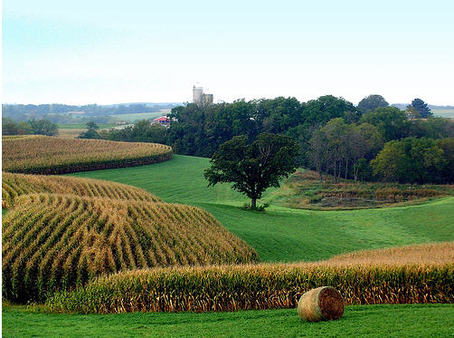
Contour farming enhances the rolling landscape.

Pure American Prairie  As you slip south of the Great Lakes, traveling west, somewhere in Illinois you all of a sudden realize that the woods are receding and the groves are farther apart. The trees look shorter, the sky looks bigger, and the horizon looks farther away. This Illini prairie wedge is preparing your senses for the "splendor in the grassland" that is Iowa (... apologies to Elia Kazan)!


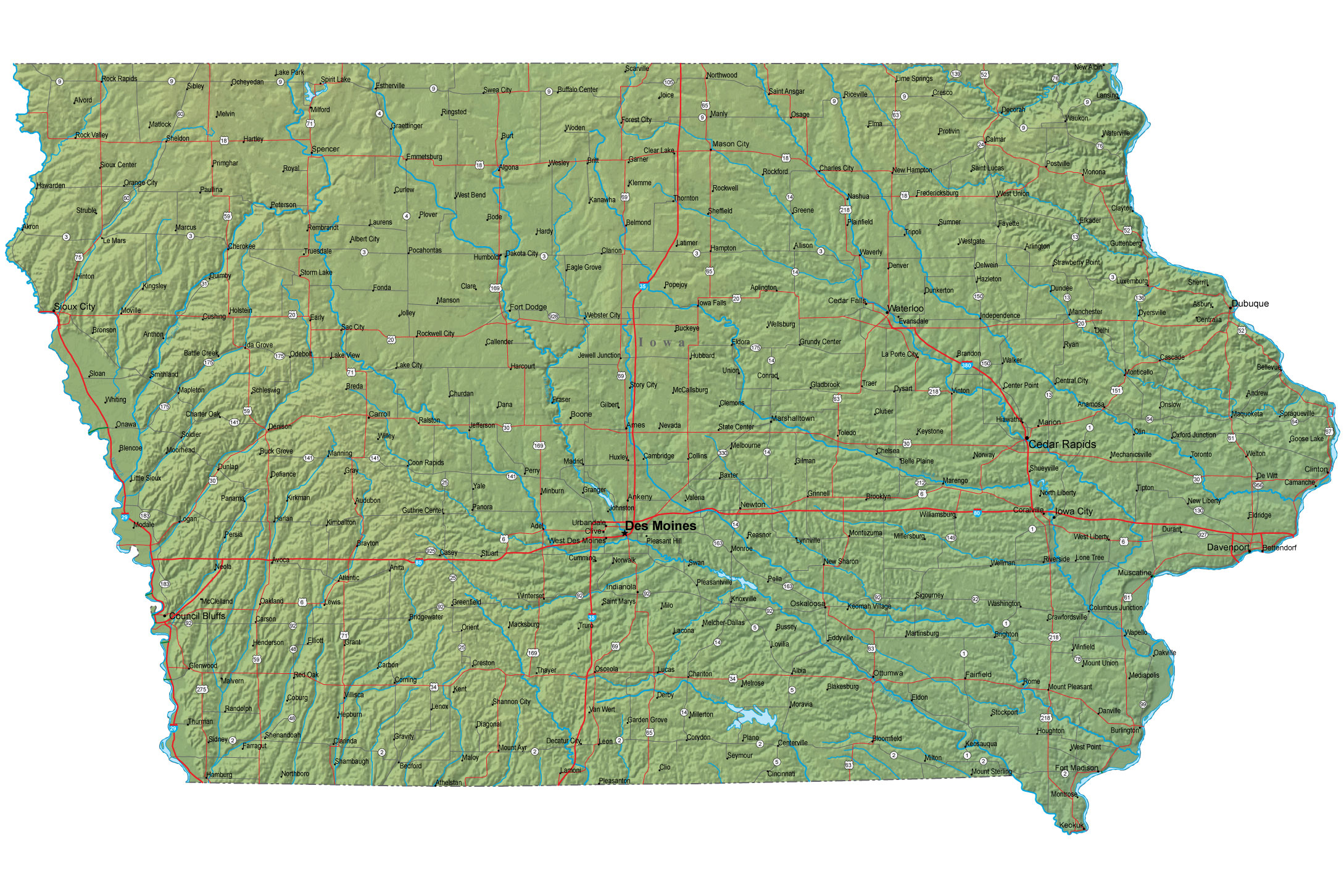
Boundaries defined by the two great Western rivers  Iowa looks more like a piece from a jigsaw puzzle than most states. If the states were pieces of a jigsaw puzzle, Iowa's squiggly left and right sides would squeeze between the Missouri and Mississippi rivers, fitting snugly on top of Missouri, and capped by Minnesota. Did you notice that Iowa is bordered by four "m" words?

This breadbasket has fed billions  "Rolling prairie, the homesteaders called it. Part of the greatest unbroken, unspoiled expanse of land found anywhere in the world -- that area of this wonderfully new, pure continent that was to become the breadbasket of the world. A land distinguished by the wonderfully rich soil that would feed billions. A land nurtured by its native peoples. Absolutely unspoiled.... One can still see the land as the pioneers saw it. Marvelous. Quiet. Stretching endlessly. Verdant. Grasses swaying in the ever-present wind. Having come from the worn-out lands of Europe, how wonderful this rolling prairie must have seemed to those people of no fear." ~Kent Baker, "A Stroll across Hillside Farm," in Glimpses: Iowa's Rural Legacy, p. 72.

90 percent of Iowa's landscape is devoted to agriculture. Contour farming magnifies the visual impact of a rolling landscape, as this aerial photo from the archives of the USDA Natural Resources Conservation Service shows.

The greatest story never told  Apropos of our Iowa breadbasket, Dumas Malone, the Pulitzer Prize winning biographer of Thomas Jefferson, once told journalist Hugh Sidey, "So much of recorded history is about the struggle of individuals and families to feed themselves. That changed dramatically in this country. The greatness of this country was rooted in the fact that a single farmer could produce an abundance of food the likes of which the world had never seen or imagined and so free the energies of countless others to do other things." It's the greatest story never told, in Hugh Sidey's opinion.

Iowa's changing landscape since the early 1800s  The Iowa that Lewis and Clark encountered in their journey up the Missouri River was carpeted by prairie grasses so dense that there was no room for bushes or trees to take advantage of the unbroken soil. Periodic fires swept through the grasslands, keeping bushes and trees at bay. Since the Corps of Discovery went through the region, Iowa's landscape has gone through three overlapping transformations.
  • Settlement: In the early 1830s, the territory was opened by Congress for settlement. The surveyors' straight chain was imposed on the rolling landscape. Land rushes resulted in pioneers churning up the tall-grass prairie, transforming the rolling hills into angular croplands. There were few conservation measures, and much rich, black topsoil ended up washing downstream into the Gulf of Mexico, where it found its graveyard in the Mississippi River Delta. 
  • The New Deal: One hundred years later, the New Deal brought widespread conservation measures to the Hawkeye State. Contour farming became the practice. Rows of trees were planted to act as windbreaks. It's surprising to see how many old trees still grow at the edges of fields. Farmers needed shade from the scorching summers and windbreaks from the freezing winters, as Kent Baker notes [p. 73]. The lack of prairie fires that once swept through the region also allowed the trees to persist.
  • Turning silos into smokestacks: The family farm has been disappearing, replaced in recent decades by agribusiness and factories. In Waterloo, for example, you can see John Deere tractors being assembled. John Deere, the world’s leading manufacturer of agricultural tractors, is the sole tractor manufacturing plant left in the world that retains its founder’s name. 

Native Iowan Henry A. Wallace
Henry A. Wallace  This native son of Adair County took his degree from Iowa State University, where he was trained as a plant scientist. In rapid succession he served as FDR's secretary of agriculture, secretary of commerce, and second vice president -- before running for president in his own right in 1948. Words associated with the Secretary of Agriculture (from an Iowa monument to their native son): prairie restoration, terracing, contours, erosion control, soil restitution, crop rotation, single-cross hybrid seed, farm ponds, woodland restoration, first U.S. Soil Conservation District.

Big tractors, corn, soybeans, hay -- that's Iowa, which bills itself the "Food Capital of the World." It's the kind of place where, if you spend any time there, you should know the difference between a John Deere A and a John Deere B.

At the edge of a rural neighborhood.
Transformation of farms  If you talk to people whose families have farmed in Iowa a long time, you learn that two twentieth-century developments made all the difference in rural America: technologically, tractors replaced horses by the end of World War II, bringing much more power to farming; genetically, hybrids replaced older plants, producing superior crops that could grow through disease, drought, and grasshoppers. ~Neil E. Harl, Introduction, Glimpses, pp. 7-8.

Neighboring skills  Iowa is the kind of place where a lot of people live in identifiable rural neighborhoods. (Think about that word -- an area where people know each other by name and sight and are often "neighborly.") Traditionally at the center of an Iowan rural neighborhood were two institutions: a one-room schoolhouse and a church. A 4-H club might meet nearby. Rural sociologists, studying the cooperative nature of these remote neighborhoods, have observed the "little platoons" people form to help one another. But in recent decades the decline of "neighboring skills" has been noticeable. ~Jack Van Laar, "Maple Grove -- A Rural Neighborhood," in Glimpses, pp. 13-16.

Land of rural towns  People justifiably think of Iowa as an agricultural state. Yet, improbably, Iowa lays claim to 950 towns and small cities -- more than any state but Texas. [LaVon Griffieon, "Let's Keep the 'I' in Iowa," in Glimpses, p. 118.] I don't believe it. As I travel I-80, the nation's greatest, most historic, east-west transportation corridor, I just don't see that many towns.

In the case of I-80, the kitsch is countered by a historic transportation corridor that follows the journey of the American Dream into the West. The Mormon Handcart Trail was blazed across Iowa near I-80, and it approximates the later Lincoln Highway, the nation's first coast-to-coast road. West of the Missouri River, I-80 approximates the Oregon and California trails, and is associated with the first Transcontinental Railroad.

I-80  It is fashionable to blast travel by interstate as kitschy, soul-sucking monotony. But the Interstate-80 corridor, connecting New York and San Francisco via Chicagoland, is one of the great conduits through which our nation's history has pulsed. America's second-longest interstate highway, I-80 most closely approximates the route of the historic Lincoln Highway, the first road across America; and it roughly traces other historically significant travel routes into the West: the Oregon Trail, California Trail, Mormon Trail, Pony Express, and first Transcontinental Railroad.

Cities  According to the U.S. Census Bureau, in 2010 the United States had 275 cities with a population of more than 100,000 people. Iowa has only two cities that make the list: Des Moines is ranked 106th with 203,000 people; and Cedar Rapids is 196th with 126,000 people.

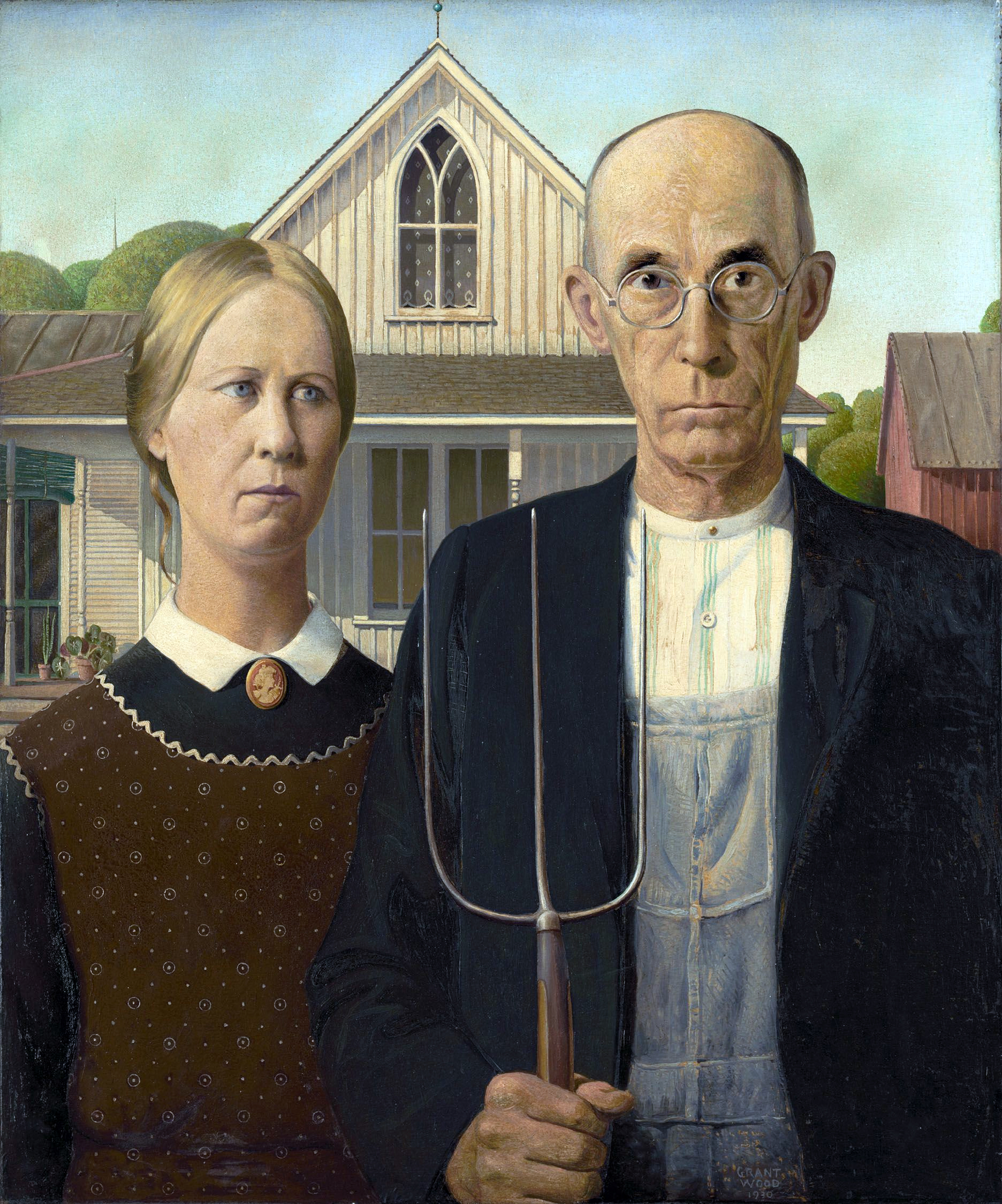
Iconic Iowa: Grant Wood, American Gothic, 1930
American Gothic  Speaking of which, Cedar Rapids is famous for the most iconic work of art ever associated with Iowa. Grant Wood's American Gothic, one of the most parodied paintings of the 20th century, was created in 1930. A product of the Great Depression, American Gothic depicts an Iowa father and his daughter (modeled after Wood's dentist and sister) expressing grim determination to get through hard times. Many modernist critics believed the painting's "deeper" meaning amounted to a satire of the Midwest's provincial lifeways, but apparently Wood was not aiming at social criticism. You can decide for yourself if you go to the Art Institute of Chicago to see the painting.

Hawkeyes  The logo on Iowa football helmets is called the Tigerhawk. The mascot is named "Herky the Hawk." Both are traditions that developed after World War II. But the nickname "Hawkeye" was actually coined in the 1830s to commemorate Chief Black Hawk of Black Hawk War fame.

Pie shakes  An Iowa original. Can't miss 'em!

Iowa's Loess Hills present some of the best loess (windblown silt) topography in the world. You can see picturesque landforms carved out of loess on the western rim of the state above the Missouri River floodplain in places like Council Bluffs and Sioux City. (Again, the Plains are not flat!) Abraham Lincoln ascended Council Bluffs to inspect a potential site for the eastern terminus of the transcontinental railroad. And Sargeant Charles Floyd, the only fatality in Lewis and Clark's Corps of Discovery, was buried in the Loess Hills above Sioux City. The silty deposits came about during the Pleistocene, when continental glaciers ground down rocks to the consistency of flour. When the glaciers retreated and the vast meltwater lakes receded, winds blew the floury silt that had lined the lakebeds into dunes mostly on the east side of the Missouri River floodplain. In many places, the silt deposits are more than 90 feet thick, and erosion has sculpted the loess into fantastic ridges.

Splendor in the Grassland

Iowa in August  County fairs, butter cows, bikers on their way to Sturgis (South Dakota), and the quadrennial straw poll mark the waning days of summer in the Hawkeye state.

*     *     *

Bibliography  Iowans have great pride in their landscape, which is one of the reasons I enjoy visiting the Hawkeye State. Two gems edited by Robert F. Sayre include, Take This Exit: Rediscovering the Iowa Landscape (Ames: Iowa State University Press, 1989); and Take the Next Exit: New Views of the Iowa Landscape (Ames: Iowa State University Press, 2000).

Another little gem I found, on the Mississippi River overlook near the Quad Cities, is Glimpses: Iowa's Rural Legacy (Ames: Iowa Farm Business Association, 2004).

Friday, June 24, 2011

Great Plains geography 2

Jefferson & Trains

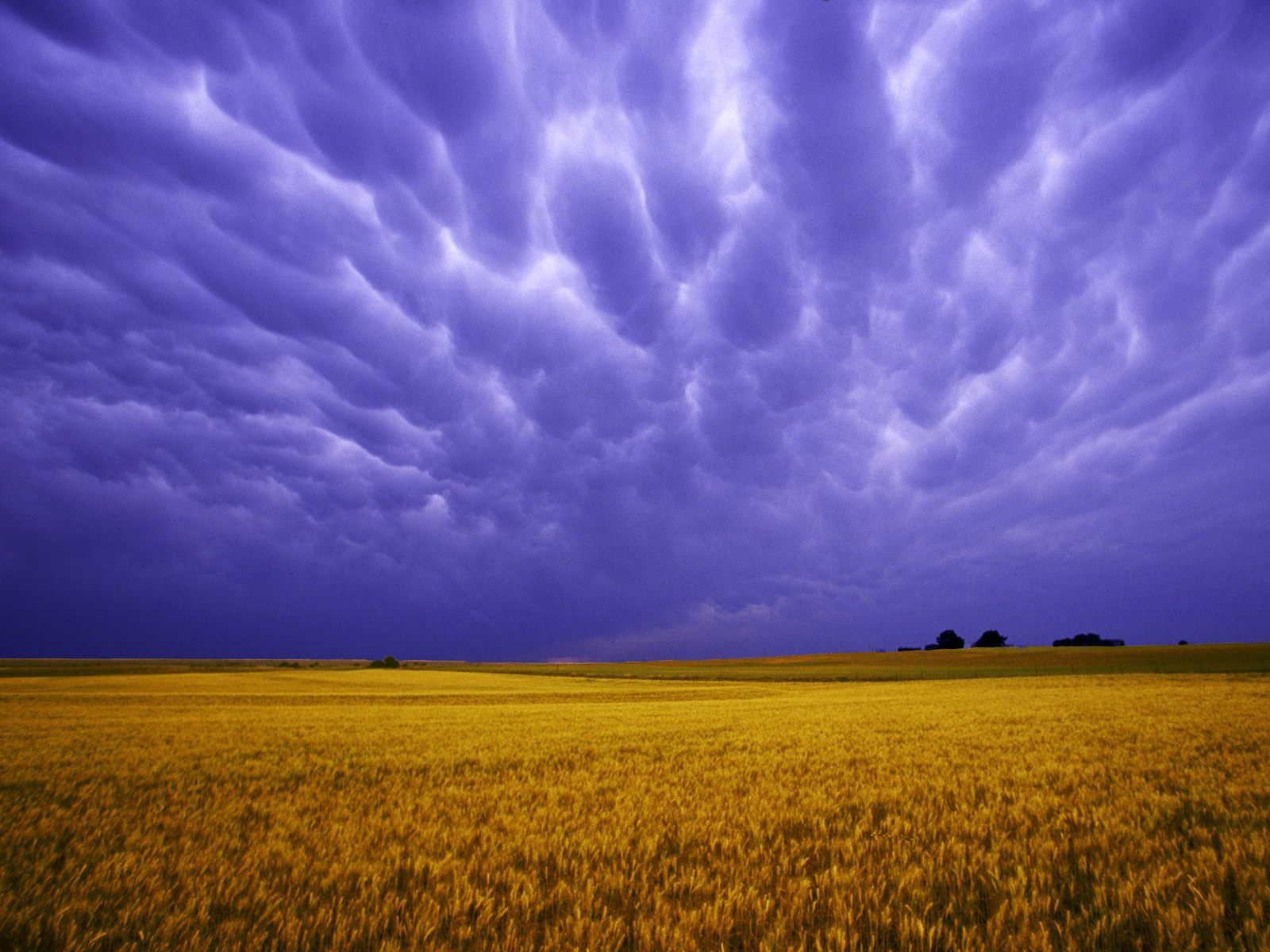
In a land whose reference is the horizon, it is difficult to grasp dimensions. These western grasslands, no respecter of the longest international boundary in the world, extend north into Canada's Prairie Provinces. If you were to drive from southwest Texas to north Alberta, you would cover some 2,400 miles and never have left the Great Plains. If you were to travel from the eastern Dakotas to the Montana Rockies, you'd journey some 700 miles and never have left the Great Plains.

Jefferson anticipated western land rushes.
 The township & range aided surveyors
and expedited property claims.
Because the region was settled by Anglo-Americans after the Civil War, it boggles the mind that one of America's founding fathers would have a lasting impact on the landscape of the Great Plains. But Thomas Jefferson's imposition of the township-and-range survey system -- first on the Old Northwest, then by extension on the Louisiana Purchase -- became the measure of the West. It was the most expeditious way for surveyors to deal with land rushes. From the air, you can see the rectangular layout -- mile after mile of straight rural roads going north-south or east-west -- Etch-a-Sketch lines, as Alicia Rebensdorf puts it. It makes for a seemingly endless checkerboard. As a result, most of the boundaries of the states and provinces in the Great Plains have no correspondence to physical features like rivers, watersheds, or continental divides. Rather, their boundaries are straight-line parallels and meridians. Colorado and Wyoming in the U.S., and Saskatchewan in Canada, are entirely creatures of parallels and meridians. The same holds for many county boundaries in the region. (By the way, Utah is the only other state or province whose boundaries are solely parallels and meridians.)

Railroads, east-west "streams of steel" that replaced river transport, had a great influence on settlement patterns and even the shapes of Great Plains states.


Consistent with the Jeffersonian grid imposed on the Louisiana Purchase, most Great Plains states are rectangles that are elongated on an east-west axis. Why elongated? The answer lies in the development of a dramatic new mode of transportation that took off in the middle of the 19th century, railroads. Linking far-away markets between the Atlantic and Pacific, continental railroads replaced waterways in the arid West as the most expeditious way to move people and goods across the land. The Pacific Railroad Act of 1862 kick-started the laying of rails and dreams of new settlements. Kansas, Nebraska, South Dakota, and North Dakota are each 3 degrees latitude "high" and approximately 7 degrees longitude "wide" because of the east-west movement of people and goods on this sinuous stream of steel.

Most of the states in the Great Plains, moreover, cover a similar extent of land. Why? It goes back to Jefferson's idea of equality regarding national expansion. The new states were to be equal republics not just politically but also geographically. In the world's first great republic, western states would not be colonies dependent on the older states in the East or Midwest.

Given the region's size and diversity, even a bevy of specialists with Ph.D.'s cannot do the landscape justice. Consider all the ways the various disciplines attempt to describe, define, circumscribe, and manage the Great Plains:

The township & range grid --
Jefferson's lasting legacy to the region.


  • Geographers shoehorn the Great Plains into the westernmost physiographic province of North America's interior plains. A rural hinterland, the plains slope east from the foothills of the Rockies toward the Mississippi River. This great expanse of plateau is carpeted with prairie grasses and filled with an array of cultural and natural surprises -- like the fact that a continental divide cuts across the land, separating the watershed of Hudson Bay from that of the Gulf of Mexico. The basic land-use pattern of the land is the square grid -- township and range -- established by Thomas Jefferson to deal judiciously and expeditiously with land rushes.
  • Geologists chisel into its limestones, sandstones, shales -- layer upon layer of sedimentary rocks formed from the outwash of the Ancestral Rockies -- strata laid down over millions of years on the floor of a long-vanished sea. Continental glaciers pushed as far south as the Upper Missouri River Valley, where North Dakota is today.
  • In this big sky country, climatologists describe the region in shorthand -- Dfa, Dfb, Cfa, and Bsk from the Köppen-Geiger climate classification system -- summarizing the extremes of winter and summer, wetness and drought, that are experienced in the interior of a large continent that lies in the lee of a great cordillera. Periodic droughts, blizzards, white outs, and tornadoes are the culprits that descend from the west.
  • Hydrologists have plenty to concern themselves in this arid land. Chill, east-flowing rivers -- the Missouri, North and South Platte, and Arkansas -- cascade out of the Rockies onto the Great Plains. Other rivers have names that evoke a colorful past -- the Yellowstone, Cache la Poudre, Republican. There is also the northern Red River that heads toward Hudson Bay, and the vast Ogallala Aquifer that has been tapped to extend farming west. Surprising to people unfamiliar with the region, there are thousands of natural lakes in the Great Plains -- many thousands. The Nebraska Sand Hills alone have more than 1,400 natural lakes. When levees of the Army Corps of Engineers fail, or when reservoirs and riverbanks overflow in the spring, catastrophe strikes as it did in many Missouri River communities in the spring and summer of 2011. Minot, North Dakota, on the Souris River made the evening news day after day after day.
  • Ecologists have a field day with all the prairie environments. This is the land "where the buffalo roam." In remnants of the tall grass prairie, grasses grow as high as a man. In the short grass prairie, a person has a 360-degree view of the horizon. Antelope and prairie dogs populate the landscape. Slim ribbons of trees along the rivers extend the range of America's eastern forests into the west.
  • Foresters -- yes, foresters -- have for more than a century experimented with ways to bring hardy trees into this hardscrabble land. Gifford Pinchot and Theodore Roosevelt were interested in establishing pine plantations in the Sand Hills of Nebraska. Throughout the region, field windbreaks were established after the Dust Bowl, accentuating the township-and-range grid on the landscape.
  • Soil scientists have made careers studying and managing the deep, rich soils of the region, like the black chernozems that have developed over thousands of years. Continental glaciers only invaded the Great Plains that stretch northeast of the Missouri River, plowing the land in their path and dumping rocks and soil in heaps on the edges of the glaciers. These mixed soils support bountiful crops of wheat. Unfortunately, because of deep plowing and overgrazing, much Great Plains soil has ended up in the Mississippi River delta. For the agricultural economy of the region to remain economically viable, soil conservation is a must.
  • Agricultural economists see the land's value to local communities, as well as to our nation's GDP and world trade. The tallest buildings in a region are telltale signs of the industries that dominate the economy, and on the plains, it is the grain elevator, standing proud and white over hundreds of High Plains hamlets, towns, and small cities. Hard red winter wheat is actually the region's gold; it is the primary bread wheat of the United States, dominating croplands from Texas to South Dakota.
  • Anthropologists and archaeologists have discovered some of the oldest Paleo-Indian sites in North America, at such sites as Clovis and Lindenmeier. The lifeway of Plains Indians changed dramatically when the Spanish brought the horse back to North America. Cheyenne and Apache warriors became the finest cavalry in the world.
  • Historians have a rich harvest of Western and Spanish Borderlands history: conquistadors like Coronado, the Santa Fe Trail, the trappers and traders of European empires, Louisiana Purchase, Lewis and Clark, the landmark year 1862 (Homestead Act, Pacific Railroad Act, Morrill Act, Dakota uprising), territorial settlement, cattle drives, gold rushes, sodbusters, exodusters, republican constitution making, statehood, boom-and-bust cycles, the Great Depression, Dust Bowl, the homefront during World War II, etc. 
  • Americanists have all sorts of wonderful things to study in the culture of the region, from the kitsch along Route 66 to the exodusters, African Americans who left the South after Reconstruction to take up homesteading in Kansas and Nebraska.
  • Demographers examine the pulsing expansion and contraction of the "frontier" in the Great Plains.
  • Recalling the days when Kit Carson and other pathfinders trekked through the region, today guides exploit the possibilities for cultural tourism in the region.
  • People searching for solutions to our nation's energy demands are investing in wind energy (think T. Boone Pickens) and shale gas wells.
  • As a presidential historian, I have studied how our U.S. presidents have put their scent on the land and erected monuments to democracy on this western sea of grass. I have explored the impact this land had on them. Theodore Roosevelt said, "I never would have been president if it had not been for my experiences in North Dakota." (This and other surprising presidential connections to the Great Plains will be explored in a forthcoming essay, but first it is necessary to give a sense of place.)

Albert Bierstadt was the greatest romantic painter of the West, especially where the High Plains delighted sojourners with a panorama of the Rockies. One of Colorado's "fourteeners" is named in the painter's honor.

Every region has its peculiar constellation of challenges and concerns. On the Pacific Coast, for example, people have to worry about "the Big One" -- an earthquake so powerful it changes the tilt of the earth's axis -- as well as about drought exacerbated by Santa Ana winds, fast-spreading brush fires, landslides that can bury neighborhoods, and the prior appropriation of water rights; they also have to deal with immigration issues more than most of the nation. In the Great Lakes states, people have a different set of worries -- about exotic species invading the Great Lakes, the decline of the auto and auto-supply industries, and ethanol subsidies ending for corn. What are the challenges and concerns on the Great Plains? Many are weather-related: floods, tornadoes, droughts, soil erosion, and the depletion of easy water from aquifers would top many lists. In many counties there is also population decline and a brain-drain that worries people tuned into the decline of the region. Many hamlets and small towns are on the verge of extinction.

On the other hand, every region has its ensemble of strengths. The Great Plains have abundant energy resources. Take Billings, Montana, which sits amid the largest coal reserves in the United States as well as large oil and natural gas fields. The communities of the Great Plains hang together, and their students test well in school, making the region an attractive place to raise a family. During the most recent recession, several Great Plains states actually weathered the tough times well. Texas, Montana, and the Dakotas, for example, had some of the lowest unemployment rates in the nation. The High Plains states are doing lots of things right.

*     *     *

This photo-essay is part of a series on Great Plains geography.

Sunday, January 30, 2011

The Language of Leaders: Washington, Jefferson, Webster, Lincoln

This talk was originally delivered at the Heritage Foundation in Washington, DC, on December 10, 1999. The idea that caught most historians' attention was that the Declaration of Independence was every bit as much a rhetorical document as a political document, meant to be read aloud to rally Americans to revolution.

Forging Politics, Rhetoric, and "the Permanent Things" into Messages that Inspire a Nation

... Russell Kirk challenged us to look beyond tomorrow's headlines and see the meaning of our work in the "Permanent Things." This term, suggested to Kirk by his friend T. S. Eliot, is fundamental to my remarks this afternoon. As Kirk explained it:
There is an order which holds all things in their places: ...it is made for us, and we are made for it. The thinking conservative, far from denying the existence of this eternal order, endeavors to ascertain its nature and to conform to that order, which is the source of the Permanent Things. [2]

The Permanent Things are identified, in other words, with truth, goodness, beauty, and all the transcendent norms that give life meaning. In due course I'll be saying more about the relationship between the Permanent Things and political discourse.

But first, permit me to meet head-on a perception that is frequently encountered--even in well-meaning people, not just cynics. It's the sense that the Permanent Things no longer stand tall in the political arena, but have been overmatched by brute Machiavellians. It's the feeling that truth, goodness, and beauty have been muscled out by their postmodern counterfeits--PR, celebrity, and glitz. It's the apprehension that pollsters and focus groups are no longer handmaids but masters of policy. People actually come up to me and ask: How can you stand working in government? Is there any honor left in politics?

The honor is to be found wherever there are men and women who champion the Permanent Things.

Conservatives in the Western tradition like to say, after Richard Weaver, that ideas have consequences. But before there can be ideas, there must be words. It is on the wings of words that ideas are born. It is on the strength of words that ideas either take flight or fall flat. That is why words, language, and rhetoric are so important in a constitutional republic where the people are sovereign and so must sort out how they shall live. As Kirk explained, "we cannot dissociate political principles and the methods of persuasion.... Some genuine connection subsists between the order of rhetoric and the order of society; false phrases open the way for false measures."[3]

What Kirk is saying, in essence, is that behind every abuse of language, there's potentially an abuse of power, and behind every abuse of power, there's probably an abuse of language.

Because our republic has such a rich history, I'd like to take a long view this afternoon and discuss a few key moments in America's past, when a gifted leader forged politics, rhetoric, and the Permanent Things into a powerful unity. The illustrations are, I believe, sufficiently vivid to suggest numerous applications today.

Truth

Let's begin by looking at an American leader whose best speeches are considered literary masterpieces, and that is Abraham Lincoln. He knew one of the greatest sources of persuasion--the radical idea that people are moved by truth. Lincoln wove the truth and other Permanent Things into his speeches as few other leaders have. One of his favorite ways to argue for the truth was by using logic. He was especially masterful at using the law of the excluded middle. He no doubt perfected his use of the excluded middle in the courtroom, where unambiguous guilt or innocence had to be established before a defendant could be judged. But what I want to look at is how he used the excluded middle in his bid for a U.S. Senate seat in 1858. Lincoln's argument was that if the United States was born in freedom, if it defined itself in terms of freedom, if its destiny was freedom's very destiny, then it inevitably followed that--here come the famous words--"A house divided against itself cannot stand.... This government cannot endure permanently half slave and half free.... It will become all one thing, or all the other."[4]

Lincoln explained why this must be so, with a series of powerful rhetorical questions and imagery: "When ... you have succeeded in dehumanizing the Negro [sic]; when you have put him down and made it impossible for him to be but as the beasts of the field; when you have extinguished his soul in this world and placed him where the ray of hope is blown out as in the darkness of the damned," what is the effect on a freedom-loving people?

Furthermore, Lincoln asked:

What constitutes the bulwark of our own liberty and independence? It is not our frowning battlements, our bristling sea coasts, our army and our navy.... Our reliance is in the love of liberty which God has planted in us. Our defense is in the spirit which prizes liberty as the heritage of all men, in all lands everywhere. Destroy this spirit and you have planted the seeds of despotism at your own doors. Familiarize yourselves with the chains of bondage and you prepare your own limbs to wear them. [5]

There's an interesting story behind the "house divided" line, which, as you know, is an allusion from the Bible.[6] Lincoln had actually tried the line out in 1856, two years before the contest with [Stephen A.] Douglas, but had been severely criticized. Advisers said he had put the issue of union too bluntly, and they actually got him to agree never to say it again. But two years later, faced with a formidable opponent in Douglas, he just could not resist. He first rehearsed the House Divided speech before an audience of one, his partner William Herndon, who liked most of it, but questioned whether the "house divided" passage was politic. Lincoln responded: "I would rather be defeated with this expression in my speech, and uphold it and discuss it before the people, than be victorious without it."[7] How many politicians can you imagine talking like that today?

Next, Lincoln tried the speech out on a dozen of his closest supporters and asked what they thought. All but one condemned the "house divided" line, one going so far as to call it a "damned fool utterance."[8]

Lincoln this time stood resolutely in disagreement with his advisers. He said the people needed to hear the stark choice before them--in other words, the law of the excluded middle. "The time has come when these sentiments should be uttered; and if it is decreed that I should go down because of this speech, then let me go down linked to the truth--let me die in the advocacy of what is just and right." As one of Lincoln's biographers noted, this was "Rather a memorable pronouncement of a candidate to his committee"--especially on the eve of the nominating convention. [9]

Now, a minute ago I said that people respond to the truth. And you are thinking, "Yeah, and Lincoln lost to Douglas." Technically, that's true. What is forgotten nowadays is that Lincoln actually won a majority of the popular vote in 1858. This, despite running against a very well-liked, charming candidate. It was a majority of the new Illinois legislature that sent Douglas back to the U.S. Senate.

And yet, in the long run, who lost to whom?

The "house divided" allusion would go on to win the heart of the Republican Party, then only four years old, and after Lincoln's death, it would win the heart of the American people. The fact that these words are studied and memorized to this day shows that human beings do indeed respond to truth.

Goodness

Let's now turn to another American leader whose speeches merit the accolades given to literature, and that's Daniel Webster. Like Lincoln, the Massachusetts Senator knew all the sources of persuasion. But for him the essential thing was that people are moved by goodness--another radical idea. Psychological research confirms scientifically what Webster knew intuitively, that our brain is wired to enjoy listening to a bard recount the great and heroic deeds of others. That's why historical narrative is such a satisfying way to communicate.

A student of Webster's oratory writes that "True eloquence is not an ordinary occurrence; it demands the right person, the right subject, and the right occasion--but when it breaks out it is godlike."[10] That was precisely the effect the 38-year-old Webster had on Americans with a speech that captured the nation's imagination. The occasion was the commemoration of the 200th anniversary of the landing of the Pilgrims. The date was December 22, 1820, and the site was the First Church in Plymouth, Massachusetts. It's difficult to imagine a more historic occasion or more historic site for Americans in the new republic. To a packed audience that included former President John Adams, Webster began:

We have come to this Rock, to record here our homage to our Pilgrim Fathers; our sympathy in their sufferings; our gratitude for their labors; our admiration of their virtues; our veneration for their piety; and our attachments to those principles of civil and religious liberty, which they encountered the dangers of the ocean, the storms of heaven, the violence of savages, disease, exile, and famine....

Webster proceeded to build up the speech with powerful images of the Pilgrims' first years. The audience was visibly moved. A young Harvard professor made a remarkable confession after leaving the church. "I was never so excited by public speaking before in my life," he said. "Three or four times I thought my temples would burst with the pulse of blood.... When I came out, I was almost afraid to stand near him. It seemed to me he was like the mount that might not be touched and that burned with fire. I was beside myself and am so still."[11]

John Adams was not given to being easily impressed by thirty-somethings. Yet even he was so moved by Webster that he urged Americans to read the address "every year forever and ever."[12]

The key to understanding the power of this speech is in part Webster's charisma; he was an extremely impressive individual to be around. But it is also the stories he told, stories of good men and women whose example showed what Americans were made of. We are reading the stories still.

Beauty

Let's now turn to the Founder responsible for the most famous political statement in American history, and that's Thomas Jefferson, the lead author of the Declaration of Independence. If Lincoln was the rhetorical master of truth, and Webster the rhetorical master of goodness, then our nation's third president could claim rhetorical mastery of another source of persuasion--beauty. He knew that people are moved by beauty.

In rhetorical terms, beauty involves using apt words effectively arranged. The task, as Richard Weaver put it, is to use the gift of imagination "to make words even in prose take on wings."[13]

In the English language, there are many ways to achieve beauty in the spoken word--through parallelism, alliteration, simile, metaphor, and so forth. For our present purposes, I want to focus on Jefferson's use of parallelism. In American political discourse, arguably the greatest example of the repeated beginning (what is technically called "anaphora") occurred at the beginning of our nation, in the Declaration.

Now, I'm going to say two things that surprise most people. First, to the Continental Congress that adopted the Declaration, it was not the beginning that was regarded as most important. ("When in the course of human events.... We hold these truths to be self-evident....") I know it's heretical to say nowadays, but political philosophy was not the main thing on the minds of the signers; that's our modern reading of it. To the delegates assembled in Congress, it was rather the middle of the document that was most important. That's the part which justified independence by listing the myriad of ways in which the king had violated their ancient rights as Englishmen.[14] It's the most conservative part of the Declaration, and it consists of 18 well-crafted statements, each attacking George III, and each beginning with the words, "He has...." To cite a few examples:

"He has erected a Multitude of new Offices, and sent hither swarms of new Officers, to harass our People, and eat out their Substance."

"He has plundered our Seas, ravaged our Coasts, burnt our Towns, and destroyed the Lives of our People."

"He has abdicated Government here, by declaring us out of his Protection, and waging War against us."

Without a doubt, the parallelism is one of the most striking rhetorical features of the document. Which leads to the second thing that surprises people, which is that the Declaration was written to be read aloud. It's as much a part of our oral as our written culture. To prove this, I'd draw your attention to the formatting in Jefferson's original draft. It is preserved in the Library of Congress. If you ever have the opportunity to see the original or a facsimile, look at how he wrote out the eighteen "He has" statements. They don't all run together in a single paragraph. Rather, they are broken out in clauses, each having the same left-margin and indent pattern. This makes them visually as well as rhetorically parallel. Not accidentally, the first printing of the document was typographically true to Jefferson's layout.

After examining the original draft, what strikes me as a speechwriter is this: the left-margin and indent pattern is precisely the format I've long used in Governor Engler's texts. I give each sentence its own paragraph, and I line up parallelisms for ease in reading aloud. The Declaration looks to me like the scripted text of a speech.

This thesis is further buttressed when you recall how news spread in the eighteenth century. It was not just by reading newspapers. It was not just by posting documents for passersby. It was also by reading aloud to people gathered in the town squares. It was a form of entertainment. And sure enough, during that hot summer of 1776, the Declaration was proclaimed--read as a speech--in hundreds of town squares up and down the 13 states. The Pennsylvania Gazette reported that when it was read aloud in New York, the crowd became so excited that they pulled down a statue of George III, recovered the lead, and turned it into bullets!* When the Declaration was read aloud in Boston on July 19, Abigail Adams observed in a letter to her husband that the crowd grew quite excited when the reader went through the series of charges against George III. As Jefferson had intended, the parallelism created an irresistible drumbeat, inspiring resolve to fight the War of Independence to the finish.

Love

So where does this bring us, this awareness that such Permanent Things as truth, goodness, and beauty can powerfully shape public discourse, even to the point of changing the course of human events? That may sound as if I am about to launch into my peroration--but not quite yet. I beg your forbearance. For there is one source of persuasion that I've yet to mention but that crowns all the others--and that is love. Every great rhetorician knows that people are moved--moved deeply, inevitably, and finally--by love.

To illustrate I wish to turn to the man, the 200th anniversary of whose passing we shall be celebrating within the week, and that is George Washington. We don't usually think of Washington this way, but the historical record bears out that the father of our country was a master rhetorician when it came to expressing love to, and eliciting love from, an audience.

The most famous example of this is the speech he delivered at Newburgh, New York, on the Ides of March in 1783. This was literally the speech that kept his army from marching against Congress. (Which shows you how little things change; people were even mad at Congress in those days.) The officers were understandably upset that Congress had not given them back pay for their many years of service to their country. They had willingly left their families and farms to aid the cause of freedom, and they simply wanted to be able to pay off their debts. As frustration mounted, someone high up the chain of command circulated a memo through the officer corps, urging insurrection. The malcontents planned a secret meeting.

Washington caught wind of the caucus and intervened swiftly. He denounced the treasonous plot and postponed the gathering by three days. This gave him critically needed time to think about how to give perhaps the most important speech of his life.

Now Washington, as you know, was crafty. He kept his own counsel and didn't alert the officers that he would be confronting them personally. So when they met on the Ides of March, they wondered whether their commander in chief would exert his authority through a surrogate. If this is what they assumed, they miscalculated badly. Remember, Washington had a keen sense of drama. All his adult life he had been a devotee of the theater.

Imagine the officers' surprise when, after the start of their meeting, their commander strode in and made straight for the lectern. There was a tense silence. The General spoke from a prepared text for approximately five minutes. The remarks were built around a series of parallel constructions that emphasized the men's common sacrifice. They had become like family, and he only wanted what was just and right for them. But they must not be imprudent or disloyal, not after having gone through so much together, and not when so much was at stake. The men were moved by his appeals--in fact, it was the best speech they had ever heard him deliver.

But all this, powerful as it was, was a prelude contrived to set the stage for the final act. After Washington finished his prepared remarks, he removed a letter from his coat pocket that he said he wished to read aloud. He began to read, then all of a sudden fell silent. Not a word came from his mouth as he fumbled awkwardly with the letter. Then he pulled a new pair of eyeglasses out of his pocket and remarked, "Gentlemen, you must pardon me. I have grown gray in your service and now find myself growing blind."

The high drama had its intended impact. The men stood in stunned silence. The gesture and words did more than any armed force could have to dissolve the insurrection, for it dissolved the rebellion in their hearts. As one officer later recorded, Washington's action was so disarming that it brought tears to the eyes of every man present. They suddenly felt inexpressible shame mixed with a renewed love for their leader. He had sacrificed more than anyone, yet never complained. They pledged their abiding support to Washington and to the new republic.

A narrow escape for the new nation, this, and it was pulled off by love--the love that Washington expressed for his men, and the love that they returned to him.[15]

Mirror or Lamp?

Truth, goodness, beauty, love--these are the Permanent Things, the wellsprings of persuasion that are never out of season. The good rhetorician instinctively knows that they move people more deeply than anything else.

But these days there are two competing schools of thought about speechwriting, especially as it applies to political discourse. One school of thought says that a speech should hold a mirror up to the public. It should reflect the fashions of the day. You study focus groups and polling data to get a sense for who's up and who's down, who's in and who's out. The speechwriter, merely one "consultant" among many, is typically brought in at the end of the process. He is a clever fellow, a merchant of sophistry who knows how to package flattery for mass consumption.

Another school of thought says that a speech should be more than a mirror; it should be a lamp lighting the way for the better angels of our nature. It understands that the act of speaking is one of the most ethical things we do, and thus that "language is sermonic," as Richard Weaver so memorably put it. It apprehends that rhetoric, at its best, seeks union with the Permanent Things. "The rhetorician," observes Weaver, "is a preacher to us, noble if he tries to direct our passion toward noble ends and base if he uses our passion to confuse and degrade us."[16] At the very least, such a rhetoric should issue some challenge to be stronger, truer, and worthier of our blessings. It should remind us to keep the roots of our American order embedded in the Permanent Things.

There's no doubt in my mind which school of thought orators like Washington, Jefferson, Webster, and Lincoln subscribed to. As in much else, we would do well to follow in their footsteps.

References:

[2]Russell Kirk, Prospects for Conservatives, revised ed. (Washington, D.C.: Regnery Gateway, 1989), pp. 36-37. Examination of earlier editions reveals that Kirk originally wrote the statement in a slightly differently form. See, for example, Russell Kirk, A Program for Conservatives, 2nd ed. (Chicago: Henry Regnery, 1962), p. 50.

[3]Russell Kirk, "Rhetoricians and Politicians," Kenyon Review, Fall 1964, p. 768.

[4]Abraham Lincoln, speech to Republican State Convention, Springfield, Illinois, June 16, 1858.

[5]Abraham Lincoln, speech, Edwardsville, Illinois, September 11, 1858.

[6]Mark 3:25.

[7]Quoted in Lord Charnworth, Abraham Lincoln: A Biography, Introduction by Peter W. Schramm (Lanham, Md: Madison Books, 1996; originally published 1916), p. 110.

[8]Charnworth, Lincoln, p. 110.

[9]Charnworth, Lincoln, pp. 110-111.

[10]Irving H. Bartlett, "Daniel Webster: The Orator and Writer," in Daniel Webster: The Completest Man, edited by Kenneth E. Shewmaker, foreword by William H. Rehnquist (Hanover, N.H.: Dartmouth College/University Press of New England, 1990), p. 80.

[11]George Ticknor quoted in George Ticknor Curtis, Life of Daniel Webster, vol. 1 (New York, 1870), p. 194. See also Bartlett, "Daniel Webster," p. 83.

[12]Adams quoted in Bartlett, "Daniel Webster," p. 83.

[13]Richard M. Weaver, "Language Is Sermonic," Language Is Sermonic: Richard M. Weaver on the Nature of Rhetoric, ed. Richard J. Johannesen, Rennard Strickland, and Ralph T. Eubanks (Baton Rouge: Louisiana State University Press, 1970), p. 202.

[14]To say that the conservative heart of the Declaration was the most important part to the Founders is hardly an unorthodox historical interpretation. It has even made its way into common reference works. See, for example, Jack P. Greene, "Declaration of Independence, United States," in Encyclopedia Americana, 1986 ed., vol. 8, p. 592.

[15]Virtually every competent biography of Washington recounts this pivotal event. One of the most detailed accounts, based on a primary source, is found in Josiah Quincy, Memoir of Major Samuel Shaw, p. 104. See also Washington Irving, George Washington: A Biography, ed. Charles Neider (New York: Da Capo Press, 1994), pp. 603-607, which draws from Shaw's observations; and Richard Norton Smith, Patriarch: George Washington and the New American Nation (Boston: Houghton Mifflin, 1997), which takes a less idolizing view of Washington's thespian talents.

[16]Weaver, "Language Is Sermonic," p. 201.

Additional source:

*For the July 17, 1776, story in the Pennsylvania Gazette about the statue of George III being turned into bullets after the Declaration was read, see Peter C. Mancall, Origins and Ideologies of the American Revolution, vol. 3 (Chantilly, VA: Teaching Company, 2006), p. 28.