Showing posts with label David McCullough. Show all posts

Saturday, July 2, 2011

American Founding -- John Adams 4

His Rotundity -- His Own Worst Enemy

Like any public figure who lives into his nineties, Adams experienced his share of setbacks -- more than a few of his own making. Isn't one of the most difficult things any of us learns is how to deal with our own personality and its liabilities? Adams fessed up that he had a difficult personality. He could be his own worst enemy -- ironic given that he once wrote Abigail a letter cataloging all her faults!

Examining the numerous liabilities of his personality, biographer John Ferling observes, "Adams struck many people as vain, irritable, irascible, supercilious, and tactless. He maintained a stiffly formal and aloof demeanor, what one acquaintance called a habitually 'ceremonious' manner.... Abigail once scolded him for his tendency to indulge in 'intolerable forbidding expecting Silence' while in the midst of a conversation; 'tis impossible for a Stranger to be tranquil in your presence'" [Ferling 170].

Moreover, he nursed a tendency toward brooding pessimism. As he revealed to his diary on the eve of the Second Continental Congress -- the Congress that would declare independence -- "I wander alone, and ponder. I muse, I mope, I ruminate. We have not men fit for the times. We are deficient in genius, education, in travel, fortune -- in everything. I feel unutterable anxiety" [McCullough 23].

Adams also had a hot temper. He managed to keep his outbursts confined to private conversations, but there was widespread conjecture that he might be emotionally unstable. One of the most egregious outbursts occurred the only known time Adams demeaned a subordinate to his face. In the presidential mansion one day he dressed down an aide, James McHenry, unjustly accusing him of scheming with Hamilton to bring Adams down. Then came the volley of insults. He frothed that that "foreigner," Hamilton, was "the most restless, impatient, artful, indefatigable, and unprincipled intriguer in the United States, if not the world." "The bastard brat of a Scotch peddler” had a “superabundance of secretions which he could not find whores enough to draw off.” Finally Adams decried “the profligacy of his life; his fornications, adulteries and his incests.” Such a surprising outburst, this, that McHenry later wrote down what happened in letters to friends and family. He ventured that the second president of the United States was "actually insane" [McCullough 538-39].

Besides a penchant for being his own worst enemy, there were situations that arose which Adams thought might do harm to his reputation.

1. At great risk to his young law career, Adams defended the Redcoats who were involved in the Boston Massacre because he believed that the law rather than popular passions should rule Massachusetts.

2. Adams's two terms as Vice President were frustrating for a man of his restlessness, vigor, brilliance, and vanity. Complaining to Abigail, he opined, "My country has in its wisdom contrived for me the most insignificant office that ever the invention of man contrived or his imagination conceived." After eight years of biding his time, a lesser man might have given up and gone home.

3. The four Alien and Sedition Acts as well as the so-called Midnight appointments to the judiciary -- on the eve of Jefferson taking office -- made Adams look thin-skinned, unprincipled, and unpresidential.
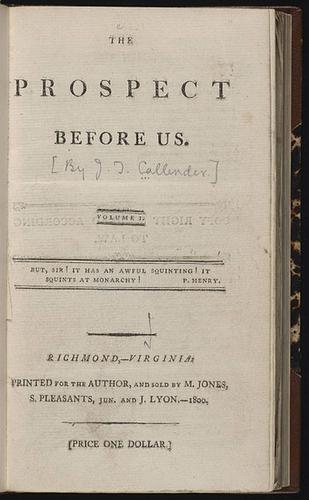
Scumbag: James Calender
4. Perhaps his most bitter setback was losing the White House to Jefferson in the Election of 1800. Adams despaired that his reputation could ever recover from such an ugly campaign. We think politicking is a dirty business today, but we forget that it was even dirtier in the early republic. In 1800, Jefferson and his allies roused an unprincipled journalist, James Callender, to attack Adams's character in the Richmond Examiner. The sitting president was accused of being a monarchist, a warmonger, and even a hermaphrodite who had "neither the force and firmness of a man, nor the gentleness and sensibility of a woman." Callender especially wanted to drive home the impression that Adams was insane with rage. He spread the unfounded rumor that Adams once became so enraged he ripped off his wig, threw it on the floor, and stomped on it [McCullough 536-37].

It gets worse. Callender, with Jefferson's blessings, accused Adams of importing two mistresses shortly after being elected president in 1796. Ridiculous rumor, of course, but in the battleground state of Pennsylvania, this was a serious allegation. One of the mistresses supposedly was from France, the other from Germany. As Alf Mapp humorously puts it, "While retaining the French charmer ... Adams supposedly had returned her rival to her native Germany. The Pennsylvania Germans were incensed, not so much by reports of sexual immorality as by the thought that the president would reject a fräulein while holding fast to a mademoiselle [Mapp 55]. Because Adams couldn't carry Pennsylvania, he wasn't reelected, and to Adams, this further robbed him of respect.

*     *     *

This essay is the fourth in a series on John Adams. The Adams series served as the basis for my talk accompanying the exhibition, John Adams Unbound, organized by the Boston Public Library and the American Library Association. The talk was given at the Loutit District Library, Grand Haven, Michigan, on June 30, 2011.

This Adams series is posted on July 2 because he thought that was the day our country's independence should be pondered and celebrated.

For more on presidents and leadership, see http://www.allpresidents.org/.

American Founding -- John Adams 3

The Thorn of Fame

John Adams has finally gotten the fame he craved, but it was a long time coming over a rough road. Already as a young man he tortured himself thinking about a future without fame. Historians don't need to speculate on this point because he and his wife Abigail seemed to write down everything. Because of the thousands of letters they left us, we know John Adams's inner life better than the inner life of any other founding father. We know, apropos of this talk, that he thought he should be famous, once declaring that the "Times alone have destined me to Fame" [Ferling 170].

Yet the quest for fame was a thorn in his side. As David McCullough put it, as a young man "John Adams was not a man of the world. He enjoyed no social standing. He was an awkward dancer and poor at cards. He never learned to flatter.... There was no money in his background" [19]. Everything he earned -- from respect in the courtroom, to readership in the newspapers, to leadership in Philadelphia -- he had to work hard at. He knew that fame can be fickle and fleeting. For that reason, he feared posterity would not pay him sufficient homage.

Moreover, he was eaten up with envy when he thought of the more illustrious founders of his own day. Given his Puritan New England heritage, Adams knew envy was one of the seven deadlies, but he seemed helpless before the green-eyed monster. Even when Adams was the runner-up to George Washington in our first national election, he still felt green with envy. One year after that election, in a letter to Benjamin Rush, Adams railed: "The history of our revolution will be one continued lie from one end to the other. The essence of the whole will be that Dr. Franklin's electrical rod smote the earth and out sprang General Washington. That Franklin electrified him with his rod -- and henceforward these two conducted all the policy, negotiations, legislatures, and war."

Adams gold coin
Adams's hunger for fame stands in stark contrast to the easy-going attitude of a later president, Ronald Reagan, who quipped: "There is no limit to what you can accomplish if you don't care who gets the credit." Lacking Reagan's insouciance, Adams yearned for the credit. But here's the good news. If Adams didn't get enough of it in his own time, he perhaps is finally satisfied with the credit he receives today. Looking down on us (for he believed in eternal life), this stubborn man would likely be happy to concede how wrong he was about posterity. Americans have been lionizing him since the Second World War.


*     *     *

This essay is the third in a series on John Adams. The Adams series served as the basis for my talk accompanying the exhibition, John Adams Unbound, organized by the Boston Public Library and the American Library Association. The talk was given at the Loutit District Library, Grand Haven, Michigan, on June 30, 2011.

This Adams series is posted on July 2 because he thought that was the day our country's independence should be pondered and celebrated.

For more on presidents and leadership, see http://www.allpresidents.org/.

American Founding -- John Adams 2

Rising Tide

Tides do rise, and John Adams's reputation started to rise a half century before McCullough's biography. In 1953 Russell Kirk canonized John Adams in his magnum opus, The Conservative Mind, arguing that of all the patriot founders, it was our second president who best understood history, constitutions, and the consequences of ideas. Kirk realized Adams's intellectual achievement was one key to any fame posterity would confer.

Two decades later the musical 1776 came out, and it was not Washington, Jefferson, or Franklin in the limelight, but the brainy delegate from Braintree, Massachusetts, who took center stage. In the movie that followed, Adams's irritability was turned into a clever device to make him more human and approachable than he otherwise would be.

Also during the Bicentennial celebration, PBS aired a 13-part series called the Adams Chronicles that presented 150 years of the family's history and fetched many Emmys.

And then McCullough's masterpiece came out in 2001 and brought about a historiographic revolution, a paradigm shift in the way we regard America's founding fathers. Adams waxes, Jefferson wanes. As of this writing (June 2011), according to amazon.com, McCullough's Pulitzer Prize-winning biography of Adams is the 9th-most-purchased book on the American Revolution, and the 14th-most-purchased book on US presidents. And the HBO production based on McCullough's book is the 4th-most-purchased miniseries on the site.

The book's splash caused more than a ripple. The historian Gordon Wood, who is currently editing a collection of Adams's papers for the Library of America series, observes that Washington and Jefferson got only one volume each of their writings, whereas Adams is getting four volumes.

And the U.S. Treasury has issued a John Adams gold coin honoring the 2nd president, an unwitting double-entendre for his "currency."

*     *     *

This essay is the second in a series on John Adams. The Adams series served as the basis for my talk accompanying the exhibition, John Adams Unbound, organized by the Boston Public Library and the American Library Association. The talk was given at the Loutit District Library, Grand Haven, Michigan, on June 30, 2011.

This Adams series is posted on July 2 because he thought that was the day our country's independence should be pondered and celebrated.

For more on presidents and leadership, see http://www.allpresidents.org/.

American Founding -- John Adams 1

America's greatest philosopher president
Once Forgotten Founding Father and Philosopher President Makes a Comeback.... Why?

Ten years ago, David McCullough told audiences something that still has the capacity to surprise us. The Pulitzer Prize-winning author said that he initially intended to write a joint biography of John Adams and Thomas Jefferson. At first his concern was that Adams could not hold his own next to Jefferson. But the more research he did, the more his concern shifted. At some point he realized that Jefferson could not hold his own next to Adams, so he decided to devote the biography to our second rather than to our third president. As the distingished historian Pauline Maier notes, "McCullough's biography of Adams inevitably has a lot to say about Jefferson, but on virtually all points of comparison between the two men, Jefferson comes in second."

High recommendation, that, and arguably so. John Adams's public life makes for a compelling story. Consider the number of firsts that he is associated with during the early days of the republic. He was:
  • the lead author of the oldest constitution in the world still in use (that of the Commonwealth of Massachusetts, dating from 1780);
  • the first vice president of the United States;
  • the first president who lived in the White House;
  • the first president who was challenged for re-election, indeed, the only president in U.S. history who was challenged by the sitting vice president (Thomas Jefferson);
  • the first one-term president (because he lost to Jefferson);
  • the first commander in chief who had to direct major military operations off U.S. territory (the Quasi War that was fought against the superpower of the day, France, in the Caribbean Sea);
  • adapting Plato's term, "philosopher king," let us also call Adams our first "philosopher president" -- the best we have ever had.
All of these points make Adams worthy of admiration, but the last point makes him worthy of the fame he coveted and that we posthumously confer on him. And yet, from my experience in the classroom, I am not certain that most Americans are aware of his intellectual achievements.

One of the greatest first ladies, Abigail Adams
I will come back to the intellectual achievements of our philosopher president later in these remarks, but first let's remind ourselves that, in the pre-David-McCullough world, John Adams was our "forgotten founding father." If you go to Washington, DC -- the city of great monuments to presidents -- there is not a single statue of John Adams. His absence in Statuary Hall is especially conspicuous in light of the statue of his cousin, Samuel Adams, and the marker where his son, John Quincy Adams, died at his desk. There is not a single statue of him in Philadelphia, even though he was the most ardent defender of independence at the Second Continental Congress. There is not a single statue of him at the U.S. Naval Academy, even though the first vessels of our permanent U.S. Navy were launched during his administration. The most prominent statue of him you'll find is in his hometown of Quincy (Braintree), Massachusetts; yet even this memorial was erected just a few years ago, after McCullough's biography.


"Dearest Friend" -- John to Abigail, September 14, 1774
Adams himself predicted that he would be the forgotten founding father. To Benjamin Rush, he wrote with mock humility, “Mausoleums, statues, monuments will never be erected to me. I wish them not. Panegyrical romances will never be written, nor flattering orations spoken, to transmit me to posterity in brilliant colors. No, nor in true colors. All but the last I loathe” [John Adams to Benjamin Rush, March 23, 1809].

Why the neglect relegating Adams to the founding fathers' back bench? One explanation is that his presidency was shoe-horned between two very dominant figures -- George Washington, the indispensable man who became a legend in his lifetime, and Thomas Jefferson, who was not keen on rehabilitating Adams publicly. Moreover, Jefferson and his party enjoyed longevity in contrast to the Federalists, who would soon die out as a political force. Jeffersonians set the nation's political agenda for more than two decades following the Adams administration. For many decades, the New Englander got lost in a Virginia crowd.

And even though John Adams's son, John Quincy Adams, won the White House in 1825, he also was a one-termer. The Adams name again went into decline because Andrew Jackson booted JQA out of the White House in 1829. The succeeding "Age of Jackson" was not friendly to the Adams brand. As a consequence, the reputations of our 2nd and 6th presidents suffered in the popular imagination.

*     *     *

This essay is the first in a series on John Adams. The Adams series served as the basis for my talk accompanying the exhibition, John Adams Unbound, organized by the Boston Public Library and the American Library Association. The talk was given at the Loutit District Library, Grand Haven, Michigan, on June 30, 2011.

This Adams series is posted on July 2 because he thought that was the day our country's independence should be pondered and celebrated.

For more on presidents and leadership, see http://www.allpresidents.org/.