Showing posts with label American founding. Show all posts

Monday, September 11, 2017

Tonsor: America: Liberal or Conservative at the Founding?

I.

A heavy overcast settled over the Huron Valley. Expecting a cold rain at any moment, I sought shelter in Haven Hall. My hope was to intercept Tonsor coming down from his office, then to accompany him on the walk across the Diag to class. I had the proverbial "deep question" for him. Seeing him emerge from the elevator in his Paddington Bear hat, I greeted him and after pleasantries put my subject before him:

"Professor Tonsor, I am interested in how you think about the American founding. A political philosopher I'm reading says that America was the product of the Enlightenment, meaning that it was founded as a classical liberal nation. According to this view, conservatism in America is just classical liberalism's 'right wing,' pushing for freer markets in a free-market system and smaller government in a federal system. American conservatives are thus not like European conservatives who, in reaction to the French Revolution, sought to restore the ancien regime with its monarchy, mercantilism, and three orders. Since that old-world conservative tradition never existed in the U.S. after the founding, what we call 'conservative' on this side of the Atlantic looks much different from conservatism in Europe. Do you think that conservatism in America is just classical liberalism's right wing and nothing more?"


Tonsor responded: "The question, as you ask it, is not well framed. It tries to make the founding an 'either-or' event: liberal or conservative? But the interpretive methods that characterize the humanities encourage us to think not in terms of 'either-or' but in terms of 'both-and.' Complex events elicit divergences of interpretation. Note that I use the plural, "divergences" of interpretation. Given human incomprehension, it is rare to have just one interpretation that is intellectually sufficient.[1]

"Were we all liberals then? Were we all liberals in 1776 and 1787? That's what you're asking. From the viewpoint of the political philosophers who see the founding as the outcome of debate during the Enlightenment, we were liberal. But is there another way of reading the Founding? Taking in the longer perspective of Western civilization, we might ask: Were we conservative in any sense that is prior to and separate from liberalism? And the answer to that question is, yes, most definitely, if you consider the founders' inheritance from the ancient world and Christendom." 

I said, "That longer perspective is what Russell Kirk achieved in The Roots of American Order."[2] 

"There are many who have looked at the American founding in a longer perspective -- Wilson Carey McWilliams, for instance.[3] But since you are taken with Russell Kirk's argument, Mr. Whitney, I'd like you to elaborate."

Oh, my. I was taken aback when Tonsor suddenly lobbed the question back to me -- it was unusual for him to do so. But since I was the one who had just teed up Kirk's Roots, I had to run with it. The ideas in The Roots were once considered mainstream in the academy,[4] and I had read the book with enthusiasm before moving to Ann Arbor. But in the 1980s the book was hardly ever referenced much less taught in American and Western civ surveys. This presented problems for a graduate student. In the company of the methodological gatekeepers in Michigan's history department, it was best not to cite Kirk's Roots since his thesis was considered out-of-date at best; and racist, sexist, classist, and elitest at worst.

Taking a deep breath I said: "There is truth in the claim of the political philosophers. Since we were the first nation established in the modern age, our political economy was liberal from the start. In the first place, we didn't have a feudal or mercantile economy. We had a modern free-market system that owed much to Adam Smith and the Enlightenment. 

"Second, we didn't have a feudal or absolutist monarchy. Instead we had a mixed constitution that was the result of enlightened reflection [5] on liberal philosophers like Locke and republican thinkers like Montesquieu; the resulting federated polity balanced the primacy of the individual (seen in the liberalism of the Bill of Rights) with the primacy of civic virtue (seen in the republicanism of the Northwest Ordinance, Article III), and did so within a framework of innovative checks and balances to thwart the tyranny of the majority (seen in the Constitution of 1787). 

"Third, we didn't have a social order that looked like the ancien regime with its aristocratic privileges, noble titles, and laws upholding primogeniture. Traditionalist European conservatives -- Joseph de Maistre, Louis de Bonald, and Pio Nono -- hated what we were. They condemned 'Americanism.' Our natural aristocracy renewed itself each generation in a relatively mobile society where most could rise due to merit and a little luck. So, yes, in all these fundamental ways, we were not a conservative European nation but a modern liberal one that owed its founding institutions mostly to the Enlightenment."

"Fine, but is there another way of reading the founding?" asked Tonsor in his laconic way.

"Yes," I said, "there's also truth in the claim that our founding was conservative -- deeply conservative in ways that were prior to and separate from liberalism. Our modern liberal roots, strong as they are, do not tell of deeper roots still. America's deeper cultural roots are revealed in our unwritten constitution, our habits of the heart, and our syncretic worldview -- a fusion that holds in dynamic tension the living traditions of ancient Jerusalem, Athens, and Rome, as well as medieval London."

"I'm surprised," said Tonsor, "that you stop at medieval London. Remember that Protestant and Catholic thinkers were engaging the Enlightenment in the seventeenth and eighteenth centuries. Archbishop Fenelon, Bishop Berkeley, John Locke, John Witherspoon -- they sifted the Age of Reason in light of what Jerusalem, Athens, Rome, and London had to teach.[6] Out of that dynamic tension, out of that struggle between those who argued for continuity and those who argued for change, emerged the Founders' syncretic worldview. The intellectual leaders of the American founding -- Adams, Jefferson, Franklin, Hamilton, Madison, Dickinson, Wilson -- stood atop the pinnacle of that worldview." 

One thing about my conversations with Tonsor: He always kept my mind on the stretch. There was no resting with him. I had never read any Dickinson or Wilson and in fact did not know that they were intellectual leaders of the founding.

"Dr. Kirk," I said, "does speak to our moral and spiritual formation. When Americans go to church or temple on Sunday, we are walking into the space inspired by premodern, illiberal religions that originated in the Near East between two thousand and three thousand years ago.[7] In theory liberalism is neutral when it comes to religion. It claims to have no necessary or sufficient need for citizens to believe in the God of the Christians or the God of the Jews. Yet Judeo-Christian moral norms and spiritual comfort have been a cornerstone of our culture from the start."

"Yes," said Tonsor. "To paraphrase Tocqueville: 'I doubt whether man can ever support at the same time complete religious indifference and complete political freedom. I am inclined to think that if he lacks faith, he will be a subject. But if he believes, he has the chance to be free.' Liberalism, he thought, cannot exist in some theoretical cultural vacuum. It needs religion to prop it up."[8]

Sucking in a larger breath, I said: "Another example Dr. Kirk explores comes from our intellectual formation. When young Americans read Plato, Aristotle, Cicero, and others who inform our defense of reason and discourse, they are entering a space inspired by premodern, pre-liberal philosophies that originated in the eastern Mediterranean more than two thousand years ago.[9] Liberalism does not mandate what must be taught. It tries to be value free when it comes to knowledge. It claims to have no necessary or sufficient need for citizens to pursue the ancient classics that originated prior to and separate from liberalism. Yet we know that deep engagement with the 'great books' expands the competence of citizens to assess the human condition and to judge current events."

Tonsor weighed in: "So it seems that, in addition to religion, liberalism needs the interior reflection encouraged by the humanities to prop it up." 

"I think so, yes," I said in agreement. "Still another example in Kirk comes not from the Anglo-Saxons so much as from medieval England after the Conquest. Liberals would like to take credit for many of the developments that have contributed to ordered freedom in the modern age -- the common law, stare decisis, Parliament, habeas corpus, trial by jury, and other individual rights that were later adopted by liberalism.[10] In truth, they cannot. There was no -ism called liberalism when these rights and innovations appeared in the Middle Ages. Yet their absence today would be unthinkable in liberalism's public square."

Tonsor objected: "Stop right there. Using the term, 'public square,' is such a banal descent into cliche."[11]

"Okay," I said, trying to disguise my pique. Unfortunately, I was becoming used to Tonsor's gratuitous criticism of the way I said things. At the same time, I figuratively slapped my forehead since the word "okay" also made him peevish. If ever I wanted to drive him nuts I could say: "The public square is okay." 

It was probably a good thing that I did not have time to dwell on Tonsor's peevishness since we had mounted the stairs and were entering the classroom. I was proud of myself for making the case that classical liberalism could not fully account for the American mind. Using Kirk, I had pulled back the curtain on our founders' deeper conservative roots -- evidenced by the living traditions they embraced from Semitic Jerusalem, Mediterranean Athens, cosmopolitan Rome, and Germanic London. Conservatism was not just the right wing of classical liberalism but something much richer.


II.

After Tonsor slapped his satchel down on the table at the front of the class, he came back to the desk into which I was settling. "You know, Mr. Whitney, we must talk more about The Roots. It's a beautiful work in conception but a flawed work in execution."

My professor's words reminded me of something I'd read between Fort Collins and Ann Arbor the previous summer. At the beginning of the road trip to Michigan I had grappled with Tonsor's "The United States as a 'Revolutionary Society,'"[12] and it occurred to me then that his 1975 essay might be a critique of Kirk's 1974 book. Both were written in anticipation of America's bicentennial celebration, and both sought to plumb the meaning of the American experience. 

Tonsor's thesis was that the American founding revitalized Britain's governing principles and thus could be seen as a conservative event. However, in the process of revitalizing Britain's governing principles, the American founding also unleashed the ideas of liberty and equality to an unexpected degree. After 1776, the empire of liberty would spread as never before. Also after 1776 and especially after the four Civil War years culminating in 1865 -- what Lord Acton called "the Second American Revolution"[13] -- the empire of equality would spread as never before. The American founding, paradoxically, was just as much an act of revolution as it was an act of conservation. Looking back, Kirk had focused on the American founding as a fusion of the living traditions of four old cities -- Jerusalem, Athens, Rome, and London. Looking forward, Tonsor saw the American Revolution as a launchpad that took man's aspiration for more liberty and more equality to new heights. It was both-and: both a conservative and an innovative event; both a stroke for liberty and a stroke for equality.

Given my admiration for both men, I needed to come to terms with the tension between Kirk's and Tonsor's interpretation of the founding era. Each in his own way seemed to sound the right note. Could their notes be harmonized? The Roots was one of my favorite works of history, plumbing the subjects I liked to think about most. It played no small part in my decision to pursue graduate studies in history. The Roots was also an important work since it preserved an interpretation of American history that was important to keep alive, somewhere, anywhere, in the postmodern academy that dismissed it amid a swarm of deconstructing "narratives." But Tonsor's insight was also critically important to understanding how America became the country she was. Could I keep the thought of both men in dynamic tension? 

Kirk published the Roots in 1974 in anticipation
of America's bicentennial celebration.
_________________

Notes

[1] Tonsor thought that the most difficult problems of modern history did not usually involve what happened but why it happened. Rarely was there just one correct interpretation of why a historical event or movement occurred. Sifting a variety of interpretations was thus a fixity in Stephen Tonsor's thought. He demonstrated appreciation for different interpretations in one of his first publications after graduate school, when he assembled and compared then-current interpretations of Nazism: Stephen J. Tonsor, National Socialism: Conservative Reaction or Nihilist Revolt? (New York: Holt, Rinehart & Winston, 1959). The pamphlet is in a series called "Source Problems in World Civilization." In a statement that serves as the foreword, the publisher explains that the task of the historian "is essentially one of selection ... for it is only through selection that knowledge can be arranged in meaningful and usable patterns." Tonsor's pamphlet is a selection of the most compelling interpretations of the philosophical and ideological roots of Nazism. Tonsor concludes: "Perhaps the variety and contradiction in the four major interpretations of National Socialism [in this pamphlet] suggest the difficulty involved in reaching conclusions concerning any historical event or movement. Moreover, these are only four among many interpretations.... If the judgments of [conflicting students and historians] are sometimes ambiguous or slow in coming, perhaps the fault lies in mankind's incomprehension rather than in history's opaqueness." (pp. i, 26, 27).

[2] Russell Kirk, The Roots of American Order (Malibu: Pepperdine University Press, 1974). 

[3] Wilson Carey McWilliams, The Idea of Fraternity in America (Berkeley: University of California Press, 1973). This award-winning book treats some of the same themes as Kirk's Roots and Tonsor's "The United States as a 'Revolutionary Society,'" but precedes them both.

[4] For an earlier statement of Kirk's basic thesis, see the address by the former president of the American Historical Association, Carlton J. H. Hayes, "The American Frontier -- Frontier of What?" December 27, 1945, American Historical Review, vol. 50, no. 2 (January 1946): 199-216, at URL https://www.historians.org/about-aha-and-membership/aha-history-and-archives/presidential-addresses/carlton-j-h-hayes. 

[5] Alexander Hamilton, Federalist Papers, 1 and 9, 1787. 

[6] For a recent study of the traditionalists' confrontation with the Enlightenment, see Ulrich L. Lehner, The Catholic Enlightenment: The Forgotten History of a Global Movement (Oxford: Oxford University Press, 2016).

[7] Kirk, Roots, chaps. 2, 5.

[8] Stephen J. Tonsor, "Et tu, brutish?" Christian Science Monitor, April 9, 1979, p. B36.

[9] Kirk, Roots, chaps. 3-4.

[10] Kirk, Roots, chap. 6.

[11] Both Tonsor and I were alluding to a recently published book by Richard John Neuhaus, The Naked Public Square: Religion and Democracy in America (Grand Rapids: Eerdmans, 1984).

[12] Stephen J. Tonsor, "The United States as a 'Revolutionary Society,'" Modern Age, vol. 19, no. 2 (spring 1975): 136-45.

[13] Stephen J. Tonsor, "Quest for Liberty: America in Acton's Thought," Introduction by James C. Holland (Grand Rapids, MI: Acton Institute for the Study of Religion and Liberty, Occasional Paper No. 1, 1993).


Monday, December 12, 2016

Tonsor #19 -- Bryn Mawr

At the conclusion of the fall semester in 1987, I accepted my brother's invitation to spend the holidays with his family in New Jersey. After the feasting and festivity of Christmas Day, I wanted to do some networking on the East Coast. Since I was within an hour of the headquarters of the Intercollegiate Studies Institute in Bryn Mawr, I headed out for the City of Brotherly Love to visit the organization that had conferred the Richard M. Weaver Fellowship on me. I'd arranged a meeting with the man who had led ISI in some capacity for 35 years, E. Victor Milione. He had served as executive vice president and then as president of ISI from 1953-1988. We arranged to meet on Monday, December 28. As I drove into town, waves of sleet and snow were rolling eastward across the Delaware River Valley, and I thought of George Washington's treacherous crossing of the Delaware on Christmas night, 1776.

Emanuel Leutze, "Washington Crossing the Delaware" (1851)

I found Milione alone in a darkish office on the Main Line; the space felt more like an old-fashioned law firm than a salient for the defense of Western civilization. He was an elfish man with bright eyes and a quick intelligence, and we were able to talk for more than one hour about his philosophy at ISI and about my graduate advisor and his place in the conservative movement in America.

From my opening question about the evolution of ISI, he became quite animated: "At ISI we throw ourselves into the battle of ideas. Whether it is the mission of the university, or the American experiment in ordered liberty, or the contest between faith and unbelief, or the crises of the twentieth century with its totalitarian threats and nihilistic philosophies -- we confront these challenges at the level of ideas. We must win the battle of ideas.[1]

"What exacerbates the crises nowadays is the tendency to forget. What with all the glittery distractions that bombard us, we tend to forget the historic foundations that made our civilization possible. But imagine what would happen if we forgot -- I mean really forgot -- if teachers quit teaching and preachers quit preaching; if no one played Bach; if no museum exhibited Michelangelo. Why, in just one generation we'd devolve into barbarians tearing down the intricate edifice of our civilization with all its beauty and strength. So the central task of our time is what the great Catholic historian Christopher Dawson called "enculturation." Our aim must be to encourage each new generation of young people to learn, better than their fathers, that our heritage must be studied, understood, nurtured, and transmitted."[2]

"Now, your graduate advisor Steve Tonsor understands how important enculturation is. He's been a great ally of ISI. I've worked with Steve for some three decades now. He is unpredictable, which makes him interesting. You never know what is going to emerge from that fierce intellect of his!"

"You're not talking about his Philadelphia Society address last year?" I asked with bemusement.

E. Victor Milione (1924-2008)
"That was a corker," Milione chuckled, "but the surprise doesn't end there. Take his view of America. Here we sit, just a few miles from Independence Hall. Steve's take on the American Revolution has the most interesting way of combining opposing ideas. On the one hand, he argues that the rebellion changed everything. Like Gordon Wood, he see our Revolution as the first major break with the pattern of rule by monarchs and hereditary nobles. They had governed according to principles derived from divine right, reason of state, and traditional and customary usage. Rejecting those principles, America's revolutionaries substituted in their stead republicanism and a rational politics based upon the self-interest of the citizenry.[3]

"On the other hand, Steve argues for the Founding's continuity with what came before. Along the lines of Russell Kirk, he maintains that by 1776 the American Revolution was already centuries old. I commend to you the essay he wrote on the American Bicentennial -- I just had occasion to reread it myself. In the piece he argues that the War of the Revolution was waged in the name of a conservative appeal to rights won and cherished -- rights that many of the American colonists believed had been usurped and violated by London. They were fighting to restore their traditional rights as Englishmen. It is difficult to believe that those articulate spokesmen of the American cause were insincere when they appealed not just to the revolutionary break from Britain, but also to the ancient, hard-won rights of free men.[4]

"In fact, I remember Steve telling me that it was precisely this conservative devotion to liberty which made, and still makes, the American Revolution the most radical political movement of the modern era.[5] How many scholars can pull off combining 'conservative' and 'radical' in the same thought?" Milione wondered, laughing.

"How is life in Ann Arbor? Last I heard, there were not many conservatives in that particular grove of academe."

"It's been intense, like intellectual boot camp. Maybe I'm lucky, but the professors I have at Michigan are really good. A few graduate students from the East Coast confess they haven't had much contact with conservatives in higher ed. I guess for them, talking to Tonsor is like a visit to the circus, where they can gather around the biological rarity at the freak show. I get the feeling that he is avoided by the more liberal students. They don't enroll in his classes."

"What a shame -- the loss is theirs. We conservatives who sit around the fireplace, sipping Scotch and smoking pipes and talking about Russell Kirk, are characters, yes, but extremists, no. Steve once told me about the time the founder of the American Nazi Party, George Lincoln Rockwell, went to the University of Michigan to give a campaign speech. It was when he ran as a write-in candidate for president in 1964. Rockwell began by saying that everywhere he spoke, fights broke out. I don't think the cultural conservatives could be accused of inciting any riots! Our weapons of choice are ideas." 

"Yes -- Professor Tonsor certainly holds his own. When challenged, he gives as good as he gets. Since arriving in Ann Arbor, I've been slowly navigating his view of conservatism, doing frequent soundings as I go. He defies stereotypes, but his political philosophy seems to fit best in the 'liberal conservative' tradition that Russell Kirk writes about in The Conservative Mind -- especially the section of the book that is devoted to Cooper and Tocqueville and that tips its hat to Burke and Acton.[6] What confused me at first is that this term, 'liberal conservative,' is not one that I've encountered outside of Kirk or outside of my conversations with Professor Tonsor.[7] He outright told me that the 'liberal conservatives' are his kind of people.[8] It seems that his vision of conservatism differs from that of the traditionalist wing in that he more readily accepts, rather than rejects, the tension between the two sources of authority in Western civilization -- classical Christendom and the modern Enlightenment. You can see it in the way he grafts what is conservative in the American Founding to what is liberal in the American Revolution. It's really quite brilliant the way he pulls the opposing ideas together."

SJT's mentor in political philosophy, Frank Meyer
"And you can bet Steve is brilliant enough to pull it off," Milione said. "I see Steve as a fusionist influenced by the work of his late mentor, Frank Meyer.[9] About the time Steve was becoming a self-conscious conservative, around 1955 or 1960, the house that conservatism built was in disarray. There were cracks that went right through the middle of the foundation. Off in one wing were the libertarians -- Nock, Hayek, Chodorov -- who championed freedom as the highest good, and along with it minimal government and the sanctity of the individual. Off in another wing were the traditionalists led by Kirk, Weaver, and Nisbet, men who championed the need for transcendent order, especially in the revolutionary modern age when so much was in flux anthropologically, philosophically, ethically, and spiritually.[10]

"Frank had a vision. He wanted to pull these two factious wings of the conservative house into a well-integrated family. He made the case that freedom needs order if it is not to devolve into anarchism or libertinism, and that order needs freedom if it's not to devolve into authoritarianism or antiquarianism. Frank saw America's founders as the original fusionists because they believed in the need to leaven a manly freedom with an organic moral order. While our nation's founding documents are relatively silent on the subject of virtue -- the notable exception being the Northwest Ordinance with its Article Three -- they do present freedom as the ultimate political goal. But freedom needs a complement -- the helpmates of religion, morality, and knowledge -- as that same article declares. Our founders taught that citizens must use their freedom to choose virtue in the public square. And because the exercise of virtue requires man's free will, it should not be compelled by government or by force. Indeed, by definition virtue cannot be compelled because, obviously...."[11] Milione looked at me intently.

"Yes," I jumped in. "There is a passage in Mere Christianity in which C. S. Lewis writes: "If a thing is free to be good it is also free to be bad. And free will is what has made evil possible. Why, then, did God give us humans free will? Because free will, though it makes evil possible, is also the only thing that makes possible any love or goodness or joy worth having."[12]

"Lewis nailed it!" Milione said with enthusiasm: "Unfortunately, Frank didn't succeed in renovating the house that conservatism built. He had a pugilistic personality and got in fights with Russell Kirk and other leaders in the movement. We conservatives, like any big sprawling family, were as fractious at the end of his life as we were when he started his fusionist project. Nevertheless, Steve's political philosophy is heavily indebted to Frank. I think Frank's fusionism is a good way to understand Steve as a 'liberal conservative,' since the former is preoccupied with political freedom and the latter is concerned with the organic moral order. They are a necessary unity in any free society."

"It's courageous of him to use the word 'liberal' in his self-description since the word has become a term of opprobrium," I said. "But I think the reactionary in him wants to reclaim the old idea of liberal, Lord Acton's idea of liberal. And it explains why Professor Tonsor quotes Walt Whitman's lines in "Song of Myself" where he speaks of containing multitudes and even celebrates the fact that he contradicts himself.[13] He is radically open to every good experience or tradition that shapes the character of a man and a civilization. Professor Tonsor is quite insistent that the conservative must discern the inevitable tensions that arise among powerful ideas. It's a messy process; it doesn't allow for the tidiness of the ideologue's design. The civilizational mission of the "liberal conservative" is in the very label, with its tension. It is to work for the organic accommodation of opposites -- freedom and virtue, liberty and order, natural aristocracy and equality, the individual and community, the profit motive in the free marketplace and those values that cannot be commodified. I see Professor Tonsor as the champion of a method of political philosophy and historical interpretation that one might call the hermeneutic of accommodating opposites. He comes the closest to saying as much in his essay on "The Conservative Search for Identity."[14]

"Yes, that's one of Steve's seminal essays. As I recall, Frank commissioned that essay in a 1964 collection, What Is Conservatism?[15] That's where Steve grapples with paradox, tension, and opposites, just as Meyer did. And to bring it back to this place, Philadelphia: For as much as he is a champion of order, Steve never loses sight of the freedom at the center of the American experiment. By putting liberty at the center of the American political order, the American revolutionaries served notice that they would not be distracted or deflected from its pursuit by other political, social, and economic objectives. Whatever the merits of equality or social justice, ethnicity or nationality, established religion or high culture -- if any of those pursuits interfered with liberty, or deflected the citizenry from the pursuit of liberty, they were eventually rejected. As a result, over the past two centuries, the world has witnessed the way in which liberty has permeated and revolutionized every aspect of American society. From the way in which we greet strangers to the way in which we pray, the most common and ordinary activities of our daily lives have been transformed by an ever greater participation by free men and an appeal to the sanction of their opinion.[16]

Frank S. Meyer's most read essays
"Especially modern notions of the state have changed as a result of the American experiment. Under the impetus of the idea of liberty, the state stood on the sidelines of the public arena and left the game to be played by individual men, voluntary associations, and corporate groups. Most Americans have believed that what the state necessarily does poorly, individuals and voluntary associations can do better. Ideally, the supreme achievement of revolutionary liberty is 'the withering away of the state.'[17] That was the idea that launched Ronald Reagan on the road to the White House," Milione added, laughing with irony. "I think we will need a succession of Reagans if we are ever to see that happen."

As my visit with Milione wrapped up, he did something as gracious as it was unexpected. He led me to a room with stacks of books that ISI had either published or carried under its banner. "It's Christmas. Why don't you take some books back to Ann Arbor?"

He gave me a largish box and told me to fill it with the books I needed for my library. Due to Vic Milione's kindness, I got to celebrate a second Christmas in a place called Bryn Mawr.

*     *     *

Late in the afternoon, as I was leaving Philadelphia and approaching the Delaware River, the snow and sleet stopped. I pulled into a filling station to warm myself up with hot chocolate. As I stood waiting for the drink to cool, I kept feeling the pull of a nearby phone booth. There was a question I had to ask....

"Professor Tonsor, I am just leaving Philadelphia after having a great visit with Vic Milione, who sends his regards. I have just one question. I think I know the answer but I still have to ask it. You and I have talked about the West's 'inner dialogue' that informs your liberal conservative worldview. It's the dialogue between its two sources of authority -- classical Christendom in which our faith and morals are rooted, and the modern Enlightenment in which our science and our secular peace in a pluralistic world are rooted, preeminently in America. When these two sources of authority clash and cannot be reconciled, you stand with...."

That's the call I wanted to make and the question I wanted to ask. But I hesitated. And then the moment passed, and I was back in the car crossing the Delaware. On the drive back through the bare ruined choirs of the Jersey countryside, I hardly noticed the scenery.

_______________________

[1] T. Kenneth Cribb, "William F. Buckley Jr. and E. Victor Milione," Intercollegiate Review (fall 2008); at URL https://home.isi.org/william-f-buckley-jr-and-e-victor-milione.
[2] Cribb, "Buckley and Milione," Intercollegiate Review; at URL https://home.isi.org/william-f-buckley-jr-and-e-victor-milione.
[3] Stephen J. Tonsor, Introduction, America's Continuing Revolution: An Act of Conservation, ed. Stephen J. Tonsor (Washington, DC: American Enterprise Institute for Public Policy Research, 1975), p. ix. Tonsor was credited by the president of AEI, William Baroody, with "conceiving and guiding the project ... a crucial factor in its success."
[4] Tonsor, Introduction, America's Continuing Revolution, p. ix.
[5] Tonsor, Introduction, America's Continuing Revolution, p. ix.
[6] Russell Kirk, The Conservative Mind: From Burke to Eliot, 7th ed. (Washington: Regnery Publishing, 1985), pp. 185-224.
[7] Confirming my hunch that the term, "liberal conservative," is rarely used are two volumes that thoroughly assess the postwar conservative movement in America. One is the great compendium of the movement, American Conservatism: An Encyclopedia, eds. Bruce Frohnen, Jeremy Beer, and Jeffrey O. Nelson (Wilmington, DE: ISI Books, 2006); and George H. Nash, The Conservative Intellectual Movement in American since 1945 (Wilmington, DE: ISI Books, 2008). Neither has an entry or section devoted to the term, "liberal conservatism." I believe Tonsor's use of the term was influenced by his first encounter of it in 1953, when he was exposed to Kirk's The Conservative Mind.
[8] Stephen J. Tonsor to Henry Regnery, August 17, 1987, p. 2; letter in GW's possession, courtesy of Alfred Regnery.
[9] SOURCE?
[10] Various articles in American Conservatism flesh out the line of argument. See, e.g., "Milione, E. Victor" (by Lee Edwards); "Meyer, Frank S." (by Kevin Smant); "Fusionism" (by E. C. Pasour Jr.); "Libertarianism" (by David Boaz); and "Traditionalism" (by Mark C. Henrie).
[11] Smant, "Meyer, Frank S.," American Conservatism, p. 571.
[12] C. S. Lewis, "The Shocking Alternative," Mere Christianity. Thanks to Darrin Moore for this reminder.
[13] Walt Whitman, "Song of Myself," quoted by Stephen J. Tonsor, "The Conservatives Search for Identity," Equality, Decadence, and Modernity, ed. Gregory L. Schneider (Wilmington, DE: ISI Books, 2005), p. 247.
[14] Tonsor, "Conservative Search for Identity," Equality, pp. 247-49.
[15] There are two editions. Stephen J. Tonsor, "The Conservative Search for Identity," What is Conservatism, ed. Frank Meyer (New York: Holt, Rinehart & Winston, 1964); republished (Wilmington, DE: ISI Books, 2015), pp. 161-84.
[16] Tonsor, Introduction, America's Continuing Revolution, pp. ix-x.
[17] Tonsor, Introduction, America's Continuing Revolution, p. x.


Saturday, July 2, 2011

American Founding -- John Adams 5

Why the Fame?

Given John Adams's liabilities -- his prickly personality, several career setbacks, and the inconvenient fact that his presidency was shoehorned between that of eminent Virginians -- it is hardly surprising that his revival came so late -- 200 years after his retirement from public life. I'd argue that it is not justifiable to give all the credit to David McCullough and HBO. It is true that Adams needed people to plead his case before the bar of public opinion, but there was a good case to champion because of the man himself. Adams himself deserves the fame that Americans now accord him because of his decisive response to the challenging times in which he lived, as well as because of his good character, hard work, intelligent writing, ability to judge character, and vision for our nation. Let's examine these half-dozen elements in more detail. 

birthplace of Abigail Smith Adams
1. The grand stage  It's a truism that's lost none of its truth: "the times make the man." A person is more likely to be famous if by accident of birth he lives in heroic times and if by accident of geography he is close to the action. The American founding was a threshold in the human experience, changing the human estate forever. Adams was born in 1735, near Boston. He was nearing forty years of age when hostilities commenced at Lexington Green and Concord Bridge, near Boston. Harnessing his considerable moral and intellectual virtues, Adams seized opportunities to lead during the crisis with Great Britain. The accidents of history and geography put a man leaving his youth and entering his best years in the cockpit of revolutionary tumult then gripping Massachusetts.

I cannot help but add the "accident" of a great marriage to those of time and place. The Adamses were exceedingly fortunate to have found and married one another.

Adams, like Jefferson, read Plutarch's Lives in the original Greek
2. Classical education  Adams's lifelong reading of the classics also prepared him for fame. His teachers were Thucydides, Polybius, Sallust, Livy, Tacitus, Cicero, Suetonius, Plutarch, Jesus, and St. Paul. Each ancient teacher grounded him in the understanding that fame is a social state that is not inherited but earned. If earned, it should be based, above all, on the fineness of one's moral character. Honorable living, courage amid danger, prudence in decision-making, temperance in the face of temptation -- all these virtues are the result of a lifetime of moral discipline.  They become more evident when living in challenging times, and when life-and-death decisions have to be made.

Adams knew that fame could be fickle, and he knew not to confuse fame with celebrity. He would be appalled by today's celebrity culture that has confused celebrities with heroes. Adams would have scoffed at the way people seek to break into 24/7 media coverage with 15 seconds of insipid notoriety.

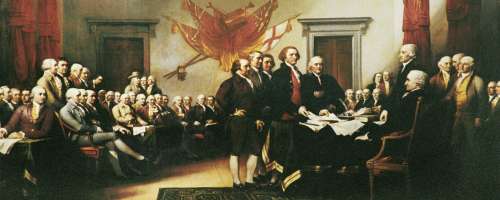
John Trumbull's "Declaration of Independence," in the U.S. Capitol Rotunda, captures not the Fourth of July, but the presentation of the document to the Second Continental Congress on July 2nd, after legal separation from Britain had been achieved. Adams, appropriately, is the delegate in the middle of the picture -- on the left among the five founders who are submitting the Declaration of Independence to the chairman. Jefferson is the tallest of the group, and Franklin is on the right.
3. Ambition  Adams was ambitious to make something of his life. As a young person he thought he might be happy as a farmer. But the more he learned about himself, the more he set his shoulder to the wheel of ambition. His rise from humble beginnings was impressive -- from the Braintree house to scholar at Harvard, to teacher, to law apprentice, to small-town lawyer, to delegate to the Continental Congresses, to diplomat, to constitution maker, to Vice President, to President of the United States, to elder statesman. At each stage in his career he performed his duties with integrity and intensity. In the Continental Congress, for instance, he served on 90 different committees -- more than any other congressman -- and chaired 20 of them. His work on behalf of our country meant long periods of time when he could not be with Abigail and his children, or tending his farm in Braintree. His diligent study and hard work insured that what he said and what he did made genuine contributions to his country. In Paris, his hard work probably saved him from many a temptation [McCullough 236-37]! More, his sense of duty made him stoical in the face of difficulties. He wryly observed that, "No man who ever held the office of president would congratulate a friend on obtaining it."

4. Master stylist  Adams was a serious student of the English language, and his attention to the ancient liberal art of rhetoric helped him become a forceful writer. Writing, he admitted, was a self-imposed discipline. "I have a great Deal of Leisure, which I chiefly employ in Scribbling, that my Mind may not stand still or run back like my Fortune," he once wrote. He became one of the most prolific and quotable of the founding fathers, spitting out quips ready-made for Bartlett's. Some of the best quotations from America's original "greatest generation" came from Adams's quill. A good example: "Facts are stubborn things," uttered by the young attorney when he courageously defended the British soldiers on trial for the Boston Massacre in 1770. Years later, contemplating his frustrations with the do-nothing Continental Congress, he supposedly complained (revealing a wit worthy of comparison with Mark Twain's): "In my many years I have come to a conclusion that one useless man is called a disgrace, two are called a law firm, and three or more are called a congress."

One Great Founding Mother: Abigail Adams
Lasting fame is built on evidence of greatness. Americans are fortunate to have access to two great letter exchanges, both involving John Adams. His writing gives us insight into the most interesting aspect of the human person, the inner life. The letters reveal how his mind worked and how his character responded to challenges. The 1,160 letters he and Abigail exchanged offer a treasure-trove to posterity, yielding rich insights into the politics, mores, and domestic life of the era. These exchanges with his "Dearest Friend" are all the more rewarding to read because of Abigail's insightful observations and powerful intellect, the match of her husband's.

In addition, the famous Adams-Jefferson correspondence, resumed after more than a decade of chilliness between the second and third presidents, offers insights into the religious, philosophical, and historical dimensions of the American founding.

Also notable are the letter exchanges between John Adams and his good friend, Dr. Benjamin Rush. The correspondence of these two minds of the Enlightenment tended to probe the power of the irrational in human affairs [Joseph Ellis, Founding Brothers, 215].

5. Judge of character  Adams also deserves fame because he was an estimable judge of character. He pushed for George Washington to serve as the commander of the Continental army, persuaded Thomas Jefferson to write the Declaration of Independence, and nominated John Marshall to be chief justice of the United States. Not bad calls, these.

6. The American idea  Finally, Adams richly deserves fame as a patriot because he got the American idea right. There is a good reason to call him our greatest philosopher president. For one thing, he was no woolly thinker seduced by the gauzy utopian schemes of French salons. Rather he held to a clear vision of what citizens of the new republic must be to thrive in a hostile world of fallen human beings.

Here it is worth saying a word about Adams's religious beliefs, which were complex and deserve more space than I can here devote to the topic. Privately, Adams was not an orthodox Christian, as we understand the term today. Theologically he was not a Trinitarian. He was a Unitarian who yet called himself a Christian and "followed" Christ. Students are confused by the fluidity of meaning, but I point out that Adams followed Christ in much the same way that Buddhists follow the Buddha (understood to be a man and not a god). In his public life Adams was like a flying buttress: supportive of more orthodoxly Christian churches but content to be outside of them. He believed in Providence, which mostly consisted of the laws under which God had created the world (so the human duty, if the goal was to prosper, was to learn these laws and act in accordance with them). Nor did Adams have any doubt that religion was necessary to the survival of the new republic. As he famously put it, "We have no government armed with power capable of contending with human passions unbridled by morality and religion. Avarice, ambition, revenge, or gallantry, would break the strongest cords of our Constitution as a whale goes through a net. Our Constitution was made only for a moral and religious people. It is wholly inadequate to the government of any other" [Adams to the Military, October 11, 1798].

Adams got the American idea right in other key ways. When we look at the spectrum of ideas among the founders, he took the via media, convinced that the center must hold. On the one hand, he distanced himself from radical revolutionaries like Thomas Paine and his cousin Sam Adams, rejecting anything like pure democracy. "Remember democracy never lasts long," Adams advised John Taylor in 1814. "It soon wastes, exhausts, and murders itself. There never was a democracy yet that did not commit suicide." On the other hand, his energetic temperament as well as his grounding in history and first principles led him away from the more pacific instincts of founders like John Dickinson. When the time came to move decisively for independence, Adams had already thought it through and was able to shape the course of events.

A keen student of history and political theory, Adams also understood the nature of republican government. It was not just anti-monarchical, nor just a democracy expressed through elected representatives. Properly understood, a republic was a form of government that balanced the three historically dominant classes of power: rule by the one (monarchy), rule by the few (aristocracy), and rule by the many (democracy). The tensions among these three groups is what Adams and others exploited to articulate the separation of powers. Thus the monarchic impulse would find expression in the Presidency; the aristocratic impulse, in the Senate and Supreme Court; the democratic impulse, in the House. Power was further attenuated in a federated polity that did not over-concentrate power in the national capital but respected civil society's "little platoons" found at the local level as well as the traditional prerogatives of villages, townships, counties, and states. Above all, power must never accrete to one ruler. Human nature was too corruptible to trust any man or woman with too much power. "They define a republic to be a government of laws, and not of men," wrote Adams in Novanglus No. 7 (March 6, 1775).

Finally, Adams got the American idea right by articulating a wise conception of happiness. He brooded quite a lot on human flourishing. Perhaps his broadest utterance on the topic is found in Thoughts on Government: "We ought to consider what is the end of government before we determine which is the best form," wrote Adams. "Upon this point all speculative politicians will agree that the happiness of society is the end of government, as all divines and moral philosophers will agree that the happiness of the individual is the end of man.... All sober inquirers after truth, ancient and modern, pagan and Christian, have declared that the happiness of man, as well as his dignity, consists in virtue" [Thoughts on Government, 1776].

This statement strikes modern sensibilities as too Puritanical. Nowadays we only think about happiness as a private good. And over time, that private good has tended to degenerate into narcissism, into the calculus of I-me-mine. Today we pursue happiness in power, profit, pleasure, prestige, preeminence, progress, and pride in getting our way.

But Adams held to a deeper understanding of happiness that sought to integrate its public and private dimensions. Although Americans today have lost sight of "public happiness," it was much on the minds of the founders when they deliberated over what qualities of citizenship Americans should possess, and what kind of republic America should be. Allow me to elaborate.

Adams's notion of private happiness was informed by Aristotle and Cicero, who believed that well-being was inseparable from virtue. Most fundamentally, we must obey our informed conscience. If you have a bad conscience, you cannot be happy. If you are a slave to your passions and drives, you cannot be happy. Adams expressed this stern idea when he defined happiness as the ability to do what one ought. Where there is no virtue, there is no happiness. And as we have already seen, virtue for Adams was inseparable from religion. Performing the rituals that are pleasing to God -- being in right relation to God -- is essential to human flourishing.

Adams' notion of public happiness was also informed by ancient traditions of our Western heritage: the civic republican tradition that emphasized duties, and the natural rights tradition that emphasized (what else?) rights. The former stretched back to ancient Greece and Rome, while the latter was traceable to the European Middle Ages. Adams managed to balance both of these living traditions -- the civic republican tradition that stressed each person's duties to community, and the natural rights tradition that underscored the inalienable rights that each person enjoys before the state. If there is too much emphasis on duties, the citizen lives unhappily in an authoritarian state. If there is too much emphasis on rights, the citizen lives unhappily in anarchy or licentiousness, or both. If the proper balance could be struck -- if the behavior and habits of citizens reflected the proper balance of rights and duties, then individuals had the chance to live integrated, and thus relatively happy, lives in community.

In sum, happiness for Adams was inseparable from religion, virtue, education, civic participation, and -- and marrying a good wife. He was fortunate to have a peerless spouse in Abigail. In the end, perhaps it was her excellent influence that helped make John Adams worthy of the fame that he craved, and that posterity has finally bestowed upon him.

*     *     *

This essay is the fifth and last in a series on John Adams. The Adams series served as the basis for my talk accompanying the exhibition, John Adams Unbound, organized by the Boston Public Library and the American Library Association. The talk was given at the Loutit District Library, Grand Haven, Michigan, on June 30, 2011.

This Adams series is posted on July 2 because he thought that was the day our country's independence should be pondered and celebrated.

For more on presidents and leadership, see http://www.allpresidents.org/.


American Founding -- John Adams 1

America's greatest philosopher president
Once Forgotten Founding Father and Philosopher President Makes a Comeback.... Why?

Ten years ago, David McCullough told audiences something that still has the capacity to surprise us. The Pulitzer Prize-winning author said that he initially intended to write a joint biography of John Adams and Thomas Jefferson. At first his concern was that Adams could not hold his own next to Jefferson. But the more research he did, the more his concern shifted. At some point he realized that Jefferson could not hold his own next to Adams, so he decided to devote the biography to our second rather than to our third president. As the distingished historian Pauline Maier notes, "McCullough's biography of Adams inevitably has a lot to say about Jefferson, but on virtually all points of comparison between the two men, Jefferson comes in second."

High recommendation, that, and arguably so. John Adams's public life makes for a compelling story. Consider the number of firsts that he is associated with during the early days of the republic. He was:
  • the lead author of the oldest constitution in the world still in use (that of the Commonwealth of Massachusetts, dating from 1780);
  • the first vice president of the United States;
  • the first president who lived in the White House;
  • the first president who was challenged for re-election, indeed, the only president in U.S. history who was challenged by the sitting vice president (Thomas Jefferson);
  • the first one-term president (because he lost to Jefferson);
  • the first commander in chief who had to direct major military operations off U.S. territory (the Quasi War that was fought against the superpower of the day, France, in the Caribbean Sea);
  • adapting Plato's term, "philosopher king," let us also call Adams our first "philosopher president" -- the best we have ever had.
All of these points make Adams worthy of admiration, but the last point makes him worthy of the fame he coveted and that we posthumously confer on him. And yet, from my experience in the classroom, I am not certain that most Americans are aware of his intellectual achievements.

One of the greatest first ladies, Abigail Adams
I will come back to the intellectual achievements of our philosopher president later in these remarks, but first let's remind ourselves that, in the pre-David-McCullough world, John Adams was our "forgotten founding father." If you go to Washington, DC -- the city of great monuments to presidents -- there is not a single statue of John Adams. His absence in Statuary Hall is especially conspicuous in light of the statue of his cousin, Samuel Adams, and the marker where his son, John Quincy Adams, died at his desk. There is not a single statue of him in Philadelphia, even though he was the most ardent defender of independence at the Second Continental Congress. There is not a single statue of him at the U.S. Naval Academy, even though the first vessels of our permanent U.S. Navy were launched during his administration. The most prominent statue of him you'll find is in his hometown of Quincy (Braintree), Massachusetts; yet even this memorial was erected just a few years ago, after McCullough's biography.


"Dearest Friend" -- John to Abigail, September 14, 1774
Adams himself predicted that he would be the forgotten founding father. To Benjamin Rush, he wrote with mock humility, “Mausoleums, statues, monuments will never be erected to me. I wish them not. Panegyrical romances will never be written, nor flattering orations spoken, to transmit me to posterity in brilliant colors. No, nor in true colors. All but the last I loathe” [John Adams to Benjamin Rush, March 23, 1809].

Why the neglect relegating Adams to the founding fathers' back bench? One explanation is that his presidency was shoe-horned between two very dominant figures -- George Washington, the indispensable man who became a legend in his lifetime, and Thomas Jefferson, who was not keen on rehabilitating Adams publicly. Moreover, Jefferson and his party enjoyed longevity in contrast to the Federalists, who would soon die out as a political force. Jeffersonians set the nation's political agenda for more than two decades following the Adams administration. For many decades, the New Englander got lost in a Virginia crowd.

And even though John Adams's son, John Quincy Adams, won the White House in 1825, he also was a one-termer. The Adams name again went into decline because Andrew Jackson booted JQA out of the White House in 1829. The succeeding "Age of Jackson" was not friendly to the Adams brand. As a consequence, the reputations of our 2nd and 6th presidents suffered in the popular imagination.

*     *     *

This essay is the first in a series on John Adams. The Adams series served as the basis for my talk accompanying the exhibition, John Adams Unbound, organized by the Boston Public Library and the American Library Association. The talk was given at the Loutit District Library, Grand Haven, Michigan, on June 30, 2011.

This Adams series is posted on July 2 because he thought that was the day our country's independence should be pondered and celebrated.

For more on presidents and leadership, see http://www.allpresidents.org/.

Thursday, May 19, 2011

American Founding -- no more whipping boys

Whipping boy and prince
Divine Right to Be a Whipping Boy?

A new life in America gave settlers from Europe the chance to push the social reset button. Consider one Old World custom that was cheerfully left behind when emigrants set out on the Atlantic -- that of having a whipping boy around the palace.

Having a whipping boy was customary in the courts of early modern England, when Britain's North American colonies were being settled. In the 17th century, a monarch's family would find a boy to raise with the prince. The whipping boy might be of high birth, or he might be a foundling or orphan. Since no tutor or teacher could strike the prince for failing to learn his lessons or for misbehaving, the whipping boy was punished instead.

At first blush, it is incongruous for a culture steeped in Christian and classical ideals -- including the ideal of justice, which requires that each be given his due -- to have whipping boys. Justice demands that the innocent not be punished for the acts of the guilty. England's high-born justified whipping boys by the doubtful appeal to the divine right of kings. Because God Himself ordained a king to rule, it followed that his prince would ascend to the throne with divine favor. By this logic, no mortal but the father was allowed to strike the son. However, since the king was often away, the prince might go for weeks without being disciplined. Somebody had to be punished for wrong doing. Thus the whipping boy was disciplined in his stead. (This is one weird notion of karma.)

Mark Twain used the custom of the whipping boy to construct the plot of The Prince and the Pauper, summarized here. There is also a Newbery Medal winner that deals with the social custom, Sid Fleischman's The Whipping Boy. In both novels, the prince learns humility in light of the natural dignity of the whipping boy -- which raises the question:

Did the practice of whipping a surrogate improve the behavior of the prince? I don't know that we will ever have the documentary evidence to settle the argument. In their novels, both Twain and Fleischman show how psychologically close the prince and his whipping boy become. At court, perhaps it was hoped that the boys' friendship would enable the prince to feel sympathy (if not empathy) for the whipped boy. Sympathy would teach the prince valuable lessons in life, thus making him a more humane sovereign. We know of at least one whipping boy who was well rewarded for his services: King Charles I made his whipping boy, William Murray, an earl in 1643.

America: For Those Who Didn't Have It Made ... Or Who Blew It the First Time

In the 17th and 18th centuries, the people who wanted to escape to America were -- metaphorically speaking -- whipping boys. The monarchy and aristocracy rode their backs and lived off the sweat of their brows. Commoners did not "have it made" back home in western Europe. Why would princes, aristocrats, wealthy men, and the scions of wealthy families abandon their social advantages? The people who came to Britain's North American colonies figured they had something to gain by risking it all and leaving their Old World home, precisely because they were neither princes, nor aristocrats, nor wealthy men, nor the scions of wealthy families. Gettysburg College historian Allen Guelzo says about the immigrants: "We need to remember how very unusual these particular Europeans were. No middling or prosperous Englishman sitting comfortably by a normal English fire would choose to throw it all up and take ship for Jamestown." America was settled by the unlucky, the unskilled, the unemployed, and the underemployed [lecture 5].

Harvard historian Oscar Handlin gave us a rich perspective in his Pulitzer Prize winning book, The Uprooted: By July 4, 1776 (I paraphrase), the colonies were settled by 2.5 million people who had already made their personal Declarations of Independence from the social, political, and/or economic oppression of Europe.

Of course, the smuggest of the British high-born would soon get their comeuppance. Those American commoners and rabble would work harder than anybody expected, and build an economy that would rival that of England by the 1770s. Until the Revolution many of them would remain loyal subjects of Their Majesty. But they were no doubt happy to abandon the custom of the whipping boy.

Wednesday, May 4, 2011

Wanted: Statesman

The ideal candidate for the job of American statesman will have the following qualifications. He or she will have begun studying French, Latin, and Greek by the age of 9; be well on the way to fluency in classical languages and be conversant with classical literature by 14; attend a prestigious college by 16; begin the study of law by 19; establish his own law practice by 23; run a successful campaign and be elected to the state house of representatives by 25; write a best-seller in current affairs by 31; draft major state papers by 33; be elected governor of his state by 36; begin serving in Congress by 40; serve the nation as a diplomat to a superpower by 41; become secretary of state in a presidential administration – and thus be fourth in the line of succession to the U.S. presidency – by 46; be capable of founding a new political party by 50; serve as vice president of the U.S. by 54; become POTUS by 58; and found a major university by 74. Oh (almost forgot), and arrange your death on a major holiday that will forever enshrine your memory. A Google search of your name should result in at least 41.2 million results as of 5/5/11.

#     #     #

Do you know any American politicians who are qualified to apply?


The above qualifications are drawn from the resume of America's third president, Thomas Jefferson.

Sunday, February 20, 2011

American Founding: Getting It Right

Do you think you know the birth of our nation? John Adams doesn't think so. "The history of our Revolution will be one continued lie from one end to the other," he railed in a letter to his friend Benjamin Rush in 1790. "The essence of the whole will be that Dr. Franklin's electrical rod smote the Earth and out sprung General Washington. That Franklin electrified him with his rod, and thence forward these two conducted all the policy, negotiations, legislatures and war."

I ask audiences how they would characterize what happened between 1761-1815 in Anglo-British North America. Something obviously changed.

Words matter. Ideas have consequences. Different words are used to characterize the change. Does the grand term "American Revolution" best capture what happened? Or does emphasizing the more defensive nature of the conflict with the term "resistance movement" seem more accurate? Some people highlight the military conflict, the "War for Independence." Others underscore the more positive action encapsulated by the term "American Founding." Still others perceptively insist that the conflict on both sides of the Atlantic was in essence a civil war over the meaning of the British constitution and ancient rights of Englishmen.

Perhaps it takes all five terms to characterize the change in Anglo-British North America between 1761-1815: What began as a constitutional debate turned into a resistance movement; the resistance movement morphed into a kind of civil war for independence; victory on the battlefield enabled Americans to found a new nation; Americans had to reassert that victory on the battlefield and at sea in the War of 1812; in retrospect, some of the changes during the war and founding were intentional and revolutionary. This is, indeed, a precis of what happened in Anglo-British North America between 1761-1815.
 
The purpose of the following essays is to get behind the convenient label "American Revolution" that we put on the box crammed with founding era stuff. The purpose is to explore the meaning of the changes in Anglo-British North America between 1761-1801. February 24, 1761, is a convenient beginning because that is when one of the chief protagonists of the story, John Adams, listened to a James Otis speech in a courtroom and was later moved to claim, "Then and there, the child independence was born." March 4, 1801, is an important marker because another chief protagonist, Thomas Jefferson, would look back and see the day of his inauguration as a second American Revolution.

You note that I follow some historians who stretch the ending of the period to include the War of 1812, often referred to as the Second War for Independence since the Americans and Brits still had not settled fundamental differences. U.S. territory was invaded and our nation's capital burned.

Other historians measure the end of the era with the presidency of John Quincy Adams or Andrew Jackson, the nation's last commanders in chief to have participated in some capacity in the era of the Revolutionary War. 

Historians vs. Hotheads

In any case, to understand two-and-a-half centuries of debate over the American Revolution, one must grapple with the legacy of the French Revolution (1789-'99). Although the French Revolution occurred in the 18th century, much of the history of the 19th century was a reaction to it. La Révolution française spawned or reinforced a passel of "isms" -- romanticism, liberalism, socialism, Marxism, progressivism, anarchism, social Darwinism, conservatism -- all competing in the marketplace of ideas. These ideologies generated a variety of polemical works not just about the French but also about the American Revolution. They can be fascinating reads, but they are not necessarily good history.

Out of the French Revolution and subsequent "isms" came the modern notion of the ideologue. The first known use of the word "ideologue" was, not surprisingly, in French in 1815. Merriam-Webster defines the ideologue as "an often blindly partisan advocate or adherent of a particular ideology." Synonyms include crusader, fanatic, zealot, militant, partisan, red hot, true believer.

Philip Tetlock has humorously opined that partisan-ideologues "across the opinion spectrum are vulnerable to occasional bouts of ideologically induced insanity."

If ideologues are by definition incapable of dispassionate work, can their writing be historically sound? Sure, parts of their writing can provide insights and the stimulus to further research. But the very definition of the word "ideologue" casts doubt on the historical integrity of their writing.

In part to take on the hotheaded "history" of the ideologues, academic history congealed as a profession in the 19th century. The new profession was an extension of the Enlightenment project and highly influenced by the German historian Leopold von Ranke. This father of modern history left a huge footprint on the historical profession. For he stressed the empirical method, gleaned facts from primary sources, constructed narratives that limited speculation, and resisted abstract theories. History should be written wie es eigentlich gewesen -- "as it actually happened." Moreover, professionally trained historians were to keep cool heads. They were to resist being co-opted by hotheads -- ideologues -- who subsumed all else to some religious, political, or social agenda. The antidote to ideology, this.

The trouble with historians is that they can appear to be dispassionate when in fact they are partisan. The trouble with ideologues is that their religious, political, or social agenda trumps the search for historical truth. Conflate the two, and such ideologically motivated historians should be handled with tongs. Their agendas are likely camouflaged by such trappings of objectivity as the use of archives, primary sources, direct quotations, footnotes, bibliographies, refereed literature, and other scientific apparatus. Don't be fooled. These trappings no more guarantee objectivity than makeup guarantees beauty. When a religious, political, or social agenda is considered more important than scrupulous inquiry into the past as it actually happened, then inconvenient evidence is ignored or manipulated. Tensions and paradoxes go unacknowledged. Historical narrative is warped by polemical assertion.

Ideology -- modernity's intellectual alchemy

Another antidote to ideologues and ideology goes farther back than Ranke. It is the scientific journal, an innovation that appeared in the 17th century at the dawn of the Enlightenment. Many honest seekers of knowledge about the natural world -- dubbed "natural philosophers" in early modern Europe -- were frustrated by alchemists who claimed secret knowledge of nature and refused to share that knowledge or submit their secrets to a candid world. To flush the alchemists out, these natural philosophers began publishing scientific journals. The idea behind scientific journals was to propose a more intellectually open and honest model to advance knowledge of the natural world. Pioneeering natural philosophers submitted their hypotheses, methods, data, knowledge, and assessments to a candid world so that anyone could test claims for themselves and evaluate the findings, consistent with the canons of evidence and the laws of thinking. Knowledge became established -- "laws" became paradigmatic -- when corroborated by subsequent experiments that were corroborated by universal reason over time.

We all know the limits of the Enlightenment ideal: (1) Reason is not the only way knowledge is acquired -- think of how important instinct, intuition, and emotional intelligence are to knowing. (2) Even when reason is scrupulously applied to the evidence, radically different interpretations -- each valid -- can result. (3) Believers in the three Abraham faiths -- Judaism, Christianity, and Islam -- believe that there are some things that human beings need to know but cannot know on their own, thus the necessity of God's revelation as a source of knowledge.

Whatever its limits, the Enlightenment model became normative for the historical profession. It proved useful for the acquisition of public knowledge of the past. It is the working assumption of historians trained after Ranke that knowledge of the past is advanced when researchers have open, equal access to the same archives and historical materials. Ideologues are not indifferent or friendly to this ideal. Worse, they do not have the courage, as Stephen Tonsor used to tell his students, to follow the evidence wherever it might lead, no matter how upsetting it may be to the status quo or to conventional wisdom. Ideologues are threatened by the open search for knowledge. They seek to coopt the evidence for their own purposes, often hiding behind jargon-laden theories that are comprehensible only to the gnostic few. They are yesterday's alchemists.

We have all heard about sensational instances of fraudulent science (fluoride, vaccines, aspartame, and both sides of the global warming debate). History is no less prone to fraud. Numerous flawed or fraudulent monographs have been foisted on the scholarly community and book-reading public. Perhaps most famous of all is David Irving's work that denied the reality of the Final Solution. Another notorious example of problematic "scholarship" is Michael Bellesiles's Arming America (2001). Because the author could not produce the evidence he claims to have consulted, the work appears to be more of an attack on the National Rifle Association than an accurate study of early American gun ownership. The History News Network has posted a longish list of authors who have been accused by of sloppy, misleading, or outright dishonest scholarship.

As William Kelleher Storey points out in Writing History, "Real historical writers probe factual uncertainties, but they do not invent convenient facts and they do not ignore inconvenient facts. People are entitled to their own opinions, but not to their own facts."

McDonald vs. Beard


The American founding is one of the salients over which historians of various schools and ideologues of various stripes have fought. One of the most famous contests occurred when Forrest McDonald answered -- and corrected -- Charles Beard's highly partisan interpretation of the Constitution's framers. Beard's Economic Interpretation of the Constitution of the United States (1913) reevaluated the founders as economic agents. In deliberations over the Constitution, their votes yea or nay supposedly reflected class- and self-interest above all else. It was a questionable assumption but, among progressive historians, the work was well received. Beard's career took a turn for the worse when he asserted that Franklin Roosevelt was more to blame for American involvement in World War II than Japan or Germany.

As a graduate student, Forrest McDonald challenged Beard by revisiting the source material and discovering that the Constitution's framers were motivated not so much by economic interest as by the political ideals and experiences of a people living in the legacy of the Glorious Revolution and a century of self-rule. McDonald's work has stood the test of time. It is honest historical scholarship untainted by ideology. After McDonald published three books demolishing Beard, it was hard ever to read Beard's Economic Interpretation other than as a period piece of the Progressive Era.

One U.S. President's Interpretation of the American Revolution

Not surprisingly, U.S. presidents come to terms with the American Revolution in instructive ways. One president recently wrote of the Founders:
"It's not just absolute power that the Founders sought to prevent. Implicit in its structure, in the very idea of ordered liberty, was a rejection of absolute truth, the infallibility of an idea or ideology or theology or "ism," any tyrannical consistency that might lock future generations into a single unalterable course, to drive both majorities and minorities into the cruelties of the Inquisition, the pogrom, the gulag, or the jihad. The Founders may have trusted in God, but true to the Enlightenment spirit, they also trusted in the minds and senses that God had given them.... They were suspicious of abstraction and liked asking questions, which is why at every turn in our early history theory yielded to fact and necessity."
This passage is from The Audacity of Hope: Thoughts on Reclaiming the American Dream (p. 93), by then-Senator Barack Obama. On the face of it, the author properly rejects ideologies and "isms." His interpretation sounds reasonable, but is it entirely plausible?

No doubt, some of the more intellectually radical founders -- Thomas Paine and the very young Thomas Jefferson -- did subscribe to the Enlightenment ideal of the open-ended pursuit of truth in all its manifestations -- theological, philosophical, political, and historical. But to claim that the Founders rejected absolute truth is inaccurate. More precisely, it is to commit the historical fallacy of presentism, which interprets the past not in its context but in ours.

There is evidence aplenty to refute the notion that the Founders were relativists. Even Jefferson by the time he was 33 years old was writing in the Declaration of Independence of self-evident truths established by the laws of nature and nature's God. Doesn't the notion of transcendent laws suggest that he and the 55 other signers of the Declaration subscribed to at least a few absolute truths, especially regarding the rights of human beings? Indeed, quite a number of founders were confident in a good many absolutes. Take John Jay, a devout, orthodox, church-going Christian through the entire founding period. He and other orthodox Christians rejected the more extreme claims of the radical Enlightenment then current in France. It was only because they were confident in "the protection of divine Providence" that the Founders could stake their lives, fortunes, and sacred honor on the revolution. It would be difficult to imagine such an assertion in the defense of a thoroughgoing relativism.

A later writer, John Courtney Murray, observed in We Hold These Truths -- and I thank Tracy Mehan for reminding me of the passage -- "The sense of the famous phrase ["We hold these truths"] is simply this: There are truths, and we hold them, and we here lay them down as the basis and inspiration of the American project, this constitutional commonwealth." Against the relativists, Murray argued that "the life of man in society under government is founded on truths, on a certain body of objective truth, universal in its import, accessible to the reason of man, definable, defensible.... If this assertion is denied, the American Proposition is, I think, eviscerated at one stroke."

Getting It Right

The American founding deserves to be understood as it actually happened. After all, this is our founding. It realized our inherent rights as human beings. It makes our way of life possible. Not only that, but it is also one of the top 25 threshold events in human history, guided by the most remarkable generation of political thinkers and actors the world has ever seen. We owe it to the rising generation (and of course to ourselves) to get the history right.

In the spirit of getting the history right, the following essays explore big issues of the American founding that have been historiographic and ideological minefields.


To learn more, visit http://www.allpresidents.org/

Sunday, February 13, 2011

American Founding (1): Who Cares?

Why haven't there been more blockbuster movies about the American founding and Revolution? There were heroes, there were villains, and there was war. Yet moviegoers are likely to know more about Troy, the Spartan 300, and Roman gladiators than they do about George Washington, Alexander Hamilton, and the American Revolution.

One reason the American founding lacks entertainment value is that it was more about what did not happen, than what did. As historian John Willson astutely observes, "most of what is really important about the American Founding lies in how a potentially harmful revolution was contained. It was not entirely averted, but it was contained and directed to the ends of limited government and the practice of liberties that had long existed in most American provinces." (There will be more on the proper interpretation of the American founding in the next essay.)

Perhaps because the American Revolution does not attract much attention in Hollywood or among the makers of video games, most young people are uninformed or misinformed about it. Surveys by the Intercollegiate Studies Institute (http://www.isi.org/) show that few college freshmen grasp the significance of the American founding. Informal surveys that I administer to my own classes confirm this finding. Many college students are not particularly curious about the source of their freedom. They don't fully embrace what the American founding means for themselves or for humankind. It's sort of like gravity: just there.

Most of our youth, I've discovered, cannot say why George Washington was a rare leader worthy of our esteem. They cannot identify the most significant passages of the Declaration of Independence or U.S. Constitution. (For comic relief, see the clip of Barney Fife trying to recite the Preamble of the Constitution here.) There is no way they could explain why Thomas Jefferson called the Federalist Papers "the best commentary on the principles of government which ever was written."

Few students have encountered the idea that King George III was arguably more of a rebel than George Washington. Beyond a few vague slogans about freedom and equality, most students are neither conversant with the ideas that animated the Founders, nor the principles by which they sought to govern, nor the succession of events that made independence possible, nor the incredible difficulties involved in founding the new republic, nor the tensions that were left unresolved in 1787 and bequeathed to later generations (e.g., constitutional interpretation, state vs. national sovereignty, and, tragically, the scandal of slavery).

Not only are most American students uninformed about the founding; they are misinformed as well. Most think the Constitution's framers were democrats; they are not aware that the delegates of 1787 loathed or feared direct rule by the many. Most students also fail to understand the founders' view of freedom, especially the notion that it must be ordered so that it does not devolve into licentious behavior or anarchy. Most students don't always appreciate that every right has a corresponding duty. And most are under the mistaken notion that there was everywhere a "wall of separation" between church and state from the get-go.

Do Americans not sufficiently value the founding as it actually happened? Has it been hijacked by ideologues? Does this help explain how uninformed and misinformed students are?

My aim in asking such a question is not to heap scorn on students. I do not blame our youth for what they have not been taught. I cannot hold them accountable for what they do not know when they reach my classroom, only for what they know when they leave it.

Truth is, the students starting my history classes probably know about as much as the leaders who represent them. It is our elected leaders who have no excuse when they are uninspired, uninformed, or misinformed about the founding. How ironic that Minnesota Congresswoman Michele Bachmann, the Tea Party leader in Congress -- a political movement that consciously identifies with the American Founding -- claimed in a stump speech that New Hampshire was the state famous for Lexington, Concord, and the "shot heard round the world"! It was not her first gaffe regarding basic American history.

As a college professor, my charge is to turn students on to history. It is to help them discover the amazing story of the American founding -- their founding -- and to inspire them to learn about it for the rest of their lives.

Maybe along the way some of our nation's leaders will also be inspired to get our story right.