Showing posts with label happiness. Show all posts

Sunday, July 17, 2011

Happiness


The following essay served as the basis of my guest sermon at Fountain Street Church, Grand Rapids, Michigan, on July 17, 2011. Because the congregation is latitudinarian, I chose to address a topic of near universal interest, happiness, and to ground it in several traditions. I would like to thank the Rev. Fred Wooden for inviting me to address the church.


A Vain Pursuit?

Imagine two different people. One of them discovers that she’s won the lottery and is suddenly worth millions of dollars. The other is run over walking to church; he survives but will suffer from paraplegia for the rest of his life. Now fast-forward one year. Who will be happier, the person who wins the lottery or the person who suffers from paraplegia? 

If you are like me and like most people, you’re confident predicting that the lottery winner will be happier a year from now. And we’re wrong. Dan Gilbert points out that real case studies show that the person who wins the lottery and the person who suffers from paraplegia will be about equally happy one year after their sudden change of fortune. (That's assuming they have roughly similar baselines of cheerfulness to begin with.) This morning, I hope to unpack the mystery of why this is so.

But first, I’d like to thank Rev. Fred Wooden and the Fountain Street community for inviting me to share some thoughts with you. Aware of the eminent men and women who have preceded me in this pulpit, I come here in humility and won’t take the approach of a guest speaker in a church across town who began by saying, “There are many ways to worship God – you in your way, and I in His.”

As a historian, I have developed some expertise in the American presidency. A couple of my friends kid me, saying that I’ve specialized in answering questions that people don’t ask. This morning I will depart from the usual expectation and address a question that is either in the foreground or background of your mind: How to be happier?

We ask the question in every stage of life. It is just one of those existentials. As mortals we are aware that every day brings us closer to the end of our time. So we want to get life right; we want our portion of happiness; so we chase after it in all kinds of things -- in people or nature, in adventure or habit, in myth or philosophy, in ritual or addiction, in therapy or worship, in new cars or new houses, in new spas or sprees at the mall.

We see a Niagara of ways this obsession with happiness inundates us: In shelf after shelf of self-help books generated by our therapeutic culture; in a cottage industry of so-called happiness coaches; in the Gallup Organization’s world poll in which more than a half-million people have participated when asked about their state of happiness and satisfaction; in the University of Chicago’s General Social Survey that’s been coming out since 1972; in the World Database of Happiness out of Rotterdam. (See http://worlddatabaseofhappiness.eur.nl/) In preparing for this morning, I was surprised to see the number of TED talks devoted to the topic.

So we are all thinking about it. You want it. I want it. They (out there) want it. The evidence is that Homo sapiens – which is Latin for “people are weird” – have been thinking about happiness seriously and systematically for at least 3,000 years. And yet – and yet – is it not striking that there is so little agreement? There is no consensus on defining happiness. There is no consensus on the qualitative difference between relatively enduring states of happiness vis-à-vis relatively temporary experiences of pleasure. There is no consensus on how to achieve this state of flourishing and wellbeing. There is not even a consensus whether happiness should be one of the ultimate goal of our efforts. Moreover, when you read the sages, prophets, and philosophers of the last 3,000 years -- then consider your own life – happiness has a surprising quality that often violates our everyday experience and common sense. 


Chinese ideogram of happiness
A Personal Survey

I began inquiry into happiness when, as director of the Hauenstein Center for Presidential Studies, I searched out the link between happiness and leadership. My hypothesis was that happy people make better leaders and better followers than unhappy people, so I did two things: I thought about what I had picked up about happiness from others, and then I looked at what psychologists and social scientists had to say in scholarly studies. What did I learn from reflection on others' experience with happiness? 

1. Let’s start with individuals who practice the dominant religion of our culture, Christianity. During the Cold War, I taught German students in a Gymnasium. Some of my students were from Eastern Europe or traveled to see family there. From them I learned about the reality of Christian martyrdom. These students told me of relatives behind the Iron Curtain who had been physically and psychologically tortured yet, at the height of their agony, experienced a beatific vision of union with Christ that filled them with peace and joy. Try to get your mind around torture as a source of happiness.  

2. When I lived in Colorado, I used to visit my sister at a Taoist commune, Still Point, and listen to talks by Gia-Fu Feng. A disciple of Lao Tzu, Gia-Fu had journeyed from China to Big Sur to Colorado and taught about the Taoist tradition of wu wei that emphasized natural harmony in all our thoughts and actions. We could only be happy if we did not try to be happy, but surrendered our ego and lived effortlessly in harmony with the nature of things. Try to get your mind around surrendering your individuality as the way to happiness. 

3. When I talk to my cousin Christopher Clowery, now called Heng Sure, an ordained Buddhist monk and director of the Berkeley Buddhist Monastery, he helps deepen my understanding of “nirvana,” a concept built from two Sanskrit words indicating the “blowing out” of a candle or the fire of desire, greed, anger, and ignorance, so as to make one free of suffering. From my sister Pam, an ordained Buddhist nun now named Jin Hai, I learn that Buddhism is a religion without God and that its disciples surrender their ego (their distinction as individuals) to release themselves from Vesuvian desires. Try to get your mind around being happy by not wanting to be happy. 

4. When I was a senior in high school, I practiced Transcendental Meditation and learned from Maharishi Mahesh Yogi and the Vedic tradition that happiness is only attained in a transcendent state called “cosmic consciousness” when one’s being is absorbed into a larger reality like a raindrop falling into the ocean. Again, in such a tradition there is no being like our Western God, and no privileging of the individual. Try to get your mind around the idea that being a raindrop in the ocean is your happiness.  

5. When as a teenager I hitchhiked to Taliesin and Taliesin West to learn more about Frank Lloyd Wright and a life of creativity and good work, I discovered that the Fellowship at Taliesin sought not happiness so much as satisfaction. Satisfaction was found in the integrity and intensity of one's work. Try to get your mind around the thought that laboring is the source of your happiness.  

6. As an undergraduate, I read Elizabeth Kübler-Ross on death and dying, and discovered that a surprising number of people had their peak experience of happiness during the process of dying. I have since looked at David Casarett's work, Last Acts, and spoken to many families with a loved one in hospice care, and they speak of the peace and reconciliation their loved one experiences when the body begins to shut down. Try to get your mind around the awareness of dying as your happiness.

The examples in this little survey violate our common sense as Americans, do they not? We normally don’t associate happiness with persecution, loss of personality, extinguished desire, unceasing work, and the process of dying. On the contrary, we learn to pursue happiness in power, profit, pleasure, privilege, performance, prestige, and pride in getting our way.

General Social Survey (University of Chicago)

Flummoxed by all the unconventional ways people claimed to experience happiness, I next turned to the social scientific literature, starting with the General Social Survey conducted by the University of Chicago since 1972. It is one of the most thorough studies of happiness ever undertaken in the U.S., and it consistently shows that:

  • Climate has hardly anything to do with one's happiness. Hard as it is to believe, people in Michigan are basically as happy as people in California.
  • Americans grow happier as they grow older.
  • My generation, baby boomers, are not as content as other generations.
  • African Americans are less happy than whites.
  • Men are less happy than women.
  • The happiness of a people waxes and wanes from era to era.

Arthur Brooks

I also looked at the work of the behavioral economist Arthur Brooks, author of Gross National Happiness: Why Happiness Matters for America – and How We Can Get More of It. He sought the sources of happiness in our values, behavior, lifestyle, culture, and even public policy. Brooks used U of C’s General Social Survey and research into identical twins separated at birth. He found that seven elements are particularly important in the calculus of happiness.

  • Having good DNA is essential. Genetics accounts for 50-80 percent of our baseline cheerfulness. That should not make us despair. We can work with the other 20-50 percent that is not genetic, so it’s important to get our values, behavior, and lifestyle right.
  • Practicing a religion is important. It turns out that 30-40 percent of our proclivity to worship is genetic, and the rest is environmental, so you should choose a church whose doctrines you believe are true and that provides a rich, regenerating experience.
  • Having good friends and meaningful relationships is also important to enjoying life (en-joy-ment – literally, being in a state of joy).
  • Giving voluntarily to others increases our well-being.
  • Having pathways of opportunity to fulfill our potential is important to our flourishing.
  • Having the feeling of earned success beats the alternative.
  • And -- here is the darker side -- perceiving that we are relatively better off than our neighbors makes us feel better. Whether it's a bigger car, nicer house, prettier yard, more prestigious job, or more successful children, we like to compare how we are doing with others.

Notice that winning the lottery did not make the list?

Brooks has also looked into very specific demographic slices. He discovered, for example, that the average age a man feels most miserable is 44 years old. That’s when:

  • his wife figures out he a bore;
  • a strong divergence emerges between his sense of success and his earning power;
  • and his kids turn into teenagers!

Daniel Kahneman

After reading Arthur Brooks, I turned to Daniel Kahneman, the Israeli-American psychologist and Nobel laureate. He asks, why is it that people can go through an experience and not think they are happy, but then remember the experience as a happy one? The converse, too. People can go through an experience convinced that they are happy, but remember it as an unhappy time. Kahneman concludes that there are two psychological selves at odds within us, and they confuse experience and memory. There is a difference between being happy in your everyday life – in your current experiencing self – and being happy about your life in the narrative you keep. When we reconstruct our past, we are choosing not so much between experiences, as between memories of experiences. And when we look toward the future, we look at what we are about to go through as anticipated memories. We are beings that consume memories. Thus we are constantly negotiating between these two selves.

The Founders and Happiness

Remember my saying a few minutes ago that happiness has a surprising quality that often violates our everyday experience and common sense? In my research, one of the surprises came from something familiar -- the American founding. It was Thomas Jefferson and America's original "greatest generation" that set culture on a new course when they declared that all human beings had the inalienable right to the "pursuit of happiness." It has been said -- by David McCullough and Jacob Needleman, among others -- that that phrase in the Declaration of Independence has done more to shape the sensibilities of the modern age than any other.

About one year ago, I was asked to teach a class on the American founding. During the months I prepared, I reexamined the founders – George Washington, John and Abigail Adams, Thomas Jefferson, Benjamin Franklin, Alexander Hamilton, James Madison, Mercy Otis Warren -- and I was struck by how differently they defined happiness compared to definitions that are current today. Their definition sought to integrate private and public happiness. Nowadays we tend to think of happiness as a  private good. We have lost the sense of "public happiness," but it was much on the minds of the founders in their debates over what qualities of citizenship Americans should possess, and what kind of republic America should be. Allow me to elaborate.

The founders' notion of private happiness is foreign to postmodern sensibilities. Their sense of well-being was informed by Aristotle and Cicero, who believed that happiness was inseparable from virtue. The starting point for any understanding of human flourishing is that we must obey our informed conscience. If you have a bad conscience, you cannot be happy. If you are a slave to your passions, you cannot be happy. John Adams expressed this stern idea when he defined happiness as the ability to do what one ought. Where there is no virtue, there is no happiness. No abstract virtue, this. For many of the founders -- people of the Enlightenment though they were -- virtue was inseparable from religion. Performing the rituals that were pleasing to God -- being in right relation to God -- was essential to human flourishing.

The founders' notion of public happiness also seems foreign to postmodern sensibilities, but it was based on balancing two great traditions in our Western heritage: the civic republican tradition that emphasized duties, and the natural rights tradition that emphasized (what else?) rights. The former stretched back to ancient Greece and Rome, while the latter was traceable to the European Middle Ages. The founders managed to balance both of these living traditions -- the civic republican tradition that stressed each person's duties to community, and the natural rights tradition that underscored the inalienable rights each person enjoys before the state. If there is too much emphasis on duties, the citizen lives unhappily in an authoritarian state. If there is too much emphasis on rights, the atomized citizen lives unhappily in anarchy, licentiousness, or narcissism. One current of conversation at the Constitutional Convention of 1787 was about achieving this balance of rights and duties in the "common wealth." (Think about that word.) If the behavior and habits of citizens reflected the balancing of rights and duties, then individuals had a chance to live integrated -- and thus relatively happy -- lives in community. But balancing the two is the key to the integration, and thus to the happiness.

The founders comprise one of the greatest generations of political leadership in any time and any place. No utopians, they were realistic about the pursuit of happiness. Essential to well-being were virtue in one’s private life and a judicious balance of rights and duties in one’s public life. The founders, I believe, got it right. In the end, they afforded me the best case studies for my hypothesis that happy people tend to make better leaders and followers than unhappy people.

Conclusion

I teach the founders. I believe that young Americans should learn from them. But it is difficult to do so because the founders lived in a different time, place, and mentality. They did not know a world transformed by industrial, urban, or high-tech revolutions, nor the radical ideas of Darwin, Marx, Nietzsche, Freud, and Einstein. We face challenges of integration that they did not. Perhaps that is why, for many of us, happiness remains elusive. It is not just a mood, not just a fleeting spike of dopamine, serotonin, and norepinephrine. Because it cannot be grasped by the prefrontal cortex alone, it remains a mysterious and irreducible state of being.

And yet, somehow, we know happiness when we experience it in ourselves, and we sense it when we see it in others. It’s people living their passion – building a boat, writing a symphony, educating their child, growing flowers in their garden -- but it's more. I believe the pursuit of happiness is linked to a primordial urge deep within us. It's a mythic return to Eden as the vestibule to the Heaven that awaits. This urge leads humans in all cultures and in all eras to redeem their time and to sanctify their place. 

In reality, of course, we never find Eden on Earth. But we should not despair. As Denis Waitley observed, even though happiness cannot be traveled to, owned, earned, worn, or consumed, happiness is the spiritual experience of living every possible moment with love, grace, and gratitude.

To love, grace, and gratitude let us say “amen”!

LLLLLLLLLLLLLLLLLLLLLLLLLLLLLLLLLLLLLLLLLLLLLLLLLLLL

Below are some resources out the various traditions of happiness that I consulted while preparing these remarks:


Confucius on Happiness

here, here and, with a lot of modern psychology added, here.


Ancient Greeks and Romans on Happiness


St. Thomas Aquinas: "Happiness is the conscious possession of a good."

Scottish Enlightenment Thinkers on Happiness

Francis Hutcheson portrait and prose on happiness here.

Darrin M. McMahon book here.

Daniel N. Robinson article here.


America's Founding Generation on Happiness

John Adams on the link between happiness and virtue: The happiness of the individual is the end of man. The happiness of society is the end of government. Upon these points, all speculative politicians, divines, and moral philosophers will agree. All sober inquirers after truth, ancient and modern, pagan and Christian, have declared that the happiness of man, as well as his dignity, consists in virtue. Confucius, Zoroaster, Socrates, Mahomet, not to mention Jewish and Christian authorities, have agreed in this. ~close paraphrase of John Adams, letter to George Wythe, 1776

Where did Thomas Jefferson's notion of the "pursuit of happiness" come from? One of the few books annotated by Jefferson was Essays on the Principles of Morality and Natural Religion, written by the Scottish moral philosopher, Lord Kames (1696-1782), a leader of the "moral sense" school that argued that human beings had an inner sense of right and wrong. Lord Kames, also known as Henry Home, provided the philosophical foundation of the phrase, "pursuit of happiness," which was included by Jefferson as an inalienable right of mankind in the Declaration of Independence. ~paraphrase from the Library of Congress's Jefferson collection

Happiness -- the product of civic virtue and public duty: As a scholar well-versed in the ideas and ideals of the French and English enlightenments, Jefferson found his greatest inspiration in the language and arguments of English philosopher John Locke, who had justified England's "Glorious Revolution" of 1688 on the basis of man's "natural rights." Locke's theory held that government was a contract between the governed and those governing, who derived their power solely from the consent of the governed and whose purpose it was to protect every man's inherent right to property, life and liberty. Jefferson's theory of "natural law" differed in that it substituted the inalienable right of "the pursuit of happiness" for "property," emphasizing that happiness is the product of civic virtue and public duty. The concept of the "pursuit of happiness" originated in the Common Sense School of Scottish philosophy, of which Lord Kames was the best-known proponent. ~from the Marine family website

Religion, morality, and knowledge are three essential components of the happiness of a people. From Article 3 of the Northwest Ordinance: Religion, morality, and knowledge, being necessary to good government and the happiness of mankind, schools and the means of education shall forever be encouraged.

Happiness linked to holiness.  The Continental and Confederation Congresses were the first national governments of the United States. The majority of men who served in Congress believed that the "public prosperity" of a society depended on the vitality of its religion. Nothing less than a "spirit of universal reformation among all ranks and degrees of our citizens," Congress declared to the American people, would "make us a holy, that so we may be a happy people." 

David McCullough links happiness and education in the thought of Adams and Jefferson: I think we need history as much as we need bread or water or love. To make the point, I want to discuss a single human being and why we should know him. First off, he is an example of the transforming miracle of education. When he and others wrote in the Declaration of Independence about "life, liberty, and the pursuit of happiness," what they meant by "happiness" was not longer vacations or more material goods. They were talking about the enlargement of the human experience through the life of the mind and spirit. They knew that the system of government they were setting up would not work if the people were not educated. "If a nation expects to be ignorant and free, in a state of civilization," Thomas Jefferson wrote, "it expects what never was and never will be."

George Will
"America was born in recoil against an overbearing executive's 'repeated injuries and usurpations' (the Declaration of Independence); modern conservatism was born in reaction against executive aggrandizement, first by Franklin Roosevelt, then by his acolyte Lyndon Johnson....
"The idea of American exceptionalism is obnoxious to progressives, who, evidently unaware of the idea's long pedigree (it traces to Alexis de Tocqueville) and the rich scholarship concerning the idea, assume it is a crude strain of patriotism. America, Tocqueville said, is unique because it was born free -- free of a feudal past, free from an entrenched aristocracy, and [free from a] established religion.
"The American Revolution was a political, not a social, revolution; it was about emancipating individuals for the pursuit of happiness, not about the state allocating wealth and opportunity. Hence our exceptional Constitution, which says not what government must do for Americans but what it cannot do to them.
"Americans are exceptionally committed to limited government because they are exceptionally confident of social mobility through personal striving. And they are exceptionally immune to a distinctively modern pessimism: It holds that individuals are powerless to assert their autonomy against society's vast impersonal forces, so people must become wards of government, which supposedly is the locus and engine of society's creativity." ~George F. Will, "A Congress that Reasserts Its Power," Washington Post, January 16, 2011 [at http://www.washingtonpost.com/wp-dyn/content/article/2011/01/14/AR2011011404663.html]

Jack P. Greene, Pursuits of Happiness: The Social Development of Early Modern British Colonies and the Formation of Modern Culture (Chapel Hill: University of North Carolina Press, 1988).

Robert Hamowy article here.

History of Political Ideas article here.

Arthur M. Schlesinger, "The Lost Meaning of 'The Pursuit of Happiness,'" William and Mary Quarterly 21:3 (1964). 

Naomi Wulf, "Liberty, (the Pursuit of) Happiness, and the Anxious Democrat: Conflicting Views of Liberalism in the Early Republic," Cercles 17 (2007). 


Freud on Happiness
  
Carmelo Scudari PDF here, here, here,  


Finally: http://www.happiness-project.com/


Saturday, July 2, 2011

American Founding -- John Adams 5

Why the Fame?

Given John Adams's liabilities -- his prickly personality, several career setbacks, and the inconvenient fact that his presidency was shoehorned between that of eminent Virginians -- it is hardly surprising that his revival came so late -- 200 years after his retirement from public life. I'd argue that it is not justifiable to give all the credit to David McCullough and HBO. It is true that Adams needed people to plead his case before the bar of public opinion, but there was a good case to champion because of the man himself. Adams himself deserves the fame that Americans now accord him because of his decisive response to the challenging times in which he lived, as well as because of his good character, hard work, intelligent writing, ability to judge character, and vision for our nation. Let's examine these half-dozen elements in more detail. 

birthplace of Abigail Smith Adams
1. The grand stage  It's a truism that's lost none of its truth: "the times make the man." A person is more likely to be famous if by accident of birth he lives in heroic times and if by accident of geography he is close to the action. The American founding was a threshold in the human experience, changing the human estate forever. Adams was born in 1735, near Boston. He was nearing forty years of age when hostilities commenced at Lexington Green and Concord Bridge, near Boston. Harnessing his considerable moral and intellectual virtues, Adams seized opportunities to lead during the crisis with Great Britain. The accidents of history and geography put a man leaving his youth and entering his best years in the cockpit of revolutionary tumult then gripping Massachusetts.

I cannot help but add the "accident" of a great marriage to those of time and place. The Adamses were exceedingly fortunate to have found and married one another.

Adams, like Jefferson, read Plutarch's Lives in the original Greek
2. Classical education  Adams's lifelong reading of the classics also prepared him for fame. His teachers were Thucydides, Polybius, Sallust, Livy, Tacitus, Cicero, Suetonius, Plutarch, Jesus, and St. Paul. Each ancient teacher grounded him in the understanding that fame is a social state that is not inherited but earned. If earned, it should be based, above all, on the fineness of one's moral character. Honorable living, courage amid danger, prudence in decision-making, temperance in the face of temptation -- all these virtues are the result of a lifetime of moral discipline.  They become more evident when living in challenging times, and when life-and-death decisions have to be made.

Adams knew that fame could be fickle, and he knew not to confuse fame with celebrity. He would be appalled by today's celebrity culture that has confused celebrities with heroes. Adams would have scoffed at the way people seek to break into 24/7 media coverage with 15 seconds of insipid notoriety.

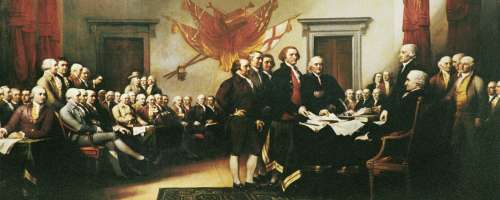
John Trumbull's "Declaration of Independence," in the U.S. Capitol Rotunda, captures not the Fourth of July, but the presentation of the document to the Second Continental Congress on July 2nd, after legal separation from Britain had been achieved. Adams, appropriately, is the delegate in the middle of the picture -- on the left among the five founders who are submitting the Declaration of Independence to the chairman. Jefferson is the tallest of the group, and Franklin is on the right.
3. Ambition  Adams was ambitious to make something of his life. As a young person he thought he might be happy as a farmer. But the more he learned about himself, the more he set his shoulder to the wheel of ambition. His rise from humble beginnings was impressive -- from the Braintree house to scholar at Harvard, to teacher, to law apprentice, to small-town lawyer, to delegate to the Continental Congresses, to diplomat, to constitution maker, to Vice President, to President of the United States, to elder statesman. At each stage in his career he performed his duties with integrity and intensity. In the Continental Congress, for instance, he served on 90 different committees -- more than any other congressman -- and chaired 20 of them. His work on behalf of our country meant long periods of time when he could not be with Abigail and his children, or tending his farm in Braintree. His diligent study and hard work insured that what he said and what he did made genuine contributions to his country. In Paris, his hard work probably saved him from many a temptation [McCullough 236-37]! More, his sense of duty made him stoical in the face of difficulties. He wryly observed that, "No man who ever held the office of president would congratulate a friend on obtaining it."

4. Master stylist  Adams was a serious student of the English language, and his attention to the ancient liberal art of rhetoric helped him become a forceful writer. Writing, he admitted, was a self-imposed discipline. "I have a great Deal of Leisure, which I chiefly employ in Scribbling, that my Mind may not stand still or run back like my Fortune," he once wrote. He became one of the most prolific and quotable of the founding fathers, spitting out quips ready-made for Bartlett's. Some of the best quotations from America's original "greatest generation" came from Adams's quill. A good example: "Facts are stubborn things," uttered by the young attorney when he courageously defended the British soldiers on trial for the Boston Massacre in 1770. Years later, contemplating his frustrations with the do-nothing Continental Congress, he supposedly complained (revealing a wit worthy of comparison with Mark Twain's): "In my many years I have come to a conclusion that one useless man is called a disgrace, two are called a law firm, and three or more are called a congress."

One Great Founding Mother: Abigail Adams
Lasting fame is built on evidence of greatness. Americans are fortunate to have access to two great letter exchanges, both involving John Adams. His writing gives us insight into the most interesting aspect of the human person, the inner life. The letters reveal how his mind worked and how his character responded to challenges. The 1,160 letters he and Abigail exchanged offer a treasure-trove to posterity, yielding rich insights into the politics, mores, and domestic life of the era. These exchanges with his "Dearest Friend" are all the more rewarding to read because of Abigail's insightful observations and powerful intellect, the match of her husband's.

In addition, the famous Adams-Jefferson correspondence, resumed after more than a decade of chilliness between the second and third presidents, offers insights into the religious, philosophical, and historical dimensions of the American founding.

Also notable are the letter exchanges between John Adams and his good friend, Dr. Benjamin Rush. The correspondence of these two minds of the Enlightenment tended to probe the power of the irrational in human affairs [Joseph Ellis, Founding Brothers, 215].

5. Judge of character  Adams also deserves fame because he was an estimable judge of character. He pushed for George Washington to serve as the commander of the Continental army, persuaded Thomas Jefferson to write the Declaration of Independence, and nominated John Marshall to be chief justice of the United States. Not bad calls, these.

6. The American idea  Finally, Adams richly deserves fame as a patriot because he got the American idea right. There is a good reason to call him our greatest philosopher president. For one thing, he was no woolly thinker seduced by the gauzy utopian schemes of French salons. Rather he held to a clear vision of what citizens of the new republic must be to thrive in a hostile world of fallen human beings.

Here it is worth saying a word about Adams's religious beliefs, which were complex and deserve more space than I can here devote to the topic. Privately, Adams was not an orthodox Christian, as we understand the term today. Theologically he was not a Trinitarian. He was a Unitarian who yet called himself a Christian and "followed" Christ. Students are confused by the fluidity of meaning, but I point out that Adams followed Christ in much the same way that Buddhists follow the Buddha (understood to be a man and not a god). In his public life Adams was like a flying buttress: supportive of more orthodoxly Christian churches but content to be outside of them. He believed in Providence, which mostly consisted of the laws under which God had created the world (so the human duty, if the goal was to prosper, was to learn these laws and act in accordance with them). Nor did Adams have any doubt that religion was necessary to the survival of the new republic. As he famously put it, "We have no government armed with power capable of contending with human passions unbridled by morality and religion. Avarice, ambition, revenge, or gallantry, would break the strongest cords of our Constitution as a whale goes through a net. Our Constitution was made only for a moral and religious people. It is wholly inadequate to the government of any other" [Adams to the Military, October 11, 1798].

Adams got the American idea right in other key ways. When we look at the spectrum of ideas among the founders, he took the via media, convinced that the center must hold. On the one hand, he distanced himself from radical revolutionaries like Thomas Paine and his cousin Sam Adams, rejecting anything like pure democracy. "Remember democracy never lasts long," Adams advised John Taylor in 1814. "It soon wastes, exhausts, and murders itself. There never was a democracy yet that did not commit suicide." On the other hand, his energetic temperament as well as his grounding in history and first principles led him away from the more pacific instincts of founders like John Dickinson. When the time came to move decisively for independence, Adams had already thought it through and was able to shape the course of events.

A keen student of history and political theory, Adams also understood the nature of republican government. It was not just anti-monarchical, nor just a democracy expressed through elected representatives. Properly understood, a republic was a form of government that balanced the three historically dominant classes of power: rule by the one (monarchy), rule by the few (aristocracy), and rule by the many (democracy). The tensions among these three groups is what Adams and others exploited to articulate the separation of powers. Thus the monarchic impulse would find expression in the Presidency; the aristocratic impulse, in the Senate and Supreme Court; the democratic impulse, in the House. Power was further attenuated in a federated polity that did not over-concentrate power in the national capital but respected civil society's "little platoons" found at the local level as well as the traditional prerogatives of villages, townships, counties, and states. Above all, power must never accrete to one ruler. Human nature was too corruptible to trust any man or woman with too much power. "They define a republic to be a government of laws, and not of men," wrote Adams in Novanglus No. 7 (March 6, 1775).

Finally, Adams got the American idea right by articulating a wise conception of happiness. He brooded quite a lot on human flourishing. Perhaps his broadest utterance on the topic is found in Thoughts on Government: "We ought to consider what is the end of government before we determine which is the best form," wrote Adams. "Upon this point all speculative politicians will agree that the happiness of society is the end of government, as all divines and moral philosophers will agree that the happiness of the individual is the end of man.... All sober inquirers after truth, ancient and modern, pagan and Christian, have declared that the happiness of man, as well as his dignity, consists in virtue" [Thoughts on Government, 1776].

This statement strikes modern sensibilities as too Puritanical. Nowadays we only think about happiness as a private good. And over time, that private good has tended to degenerate into narcissism, into the calculus of I-me-mine. Today we pursue happiness in power, profit, pleasure, prestige, preeminence, progress, and pride in getting our way.

But Adams held to a deeper understanding of happiness that sought to integrate its public and private dimensions. Although Americans today have lost sight of "public happiness," it was much on the minds of the founders when they deliberated over what qualities of citizenship Americans should possess, and what kind of republic America should be. Allow me to elaborate.

Adams's notion of private happiness was informed by Aristotle and Cicero, who believed that well-being was inseparable from virtue. Most fundamentally, we must obey our informed conscience. If you have a bad conscience, you cannot be happy. If you are a slave to your passions and drives, you cannot be happy. Adams expressed this stern idea when he defined happiness as the ability to do what one ought. Where there is no virtue, there is no happiness. And as we have already seen, virtue for Adams was inseparable from religion. Performing the rituals that are pleasing to God -- being in right relation to God -- is essential to human flourishing.

Adams' notion of public happiness was also informed by ancient traditions of our Western heritage: the civic republican tradition that emphasized duties, and the natural rights tradition that emphasized (what else?) rights. The former stretched back to ancient Greece and Rome, while the latter was traceable to the European Middle Ages. Adams managed to balance both of these living traditions -- the civic republican tradition that stressed each person's duties to community, and the natural rights tradition that underscored the inalienable rights that each person enjoys before the state. If there is too much emphasis on duties, the citizen lives unhappily in an authoritarian state. If there is too much emphasis on rights, the citizen lives unhappily in anarchy or licentiousness, or both. If the proper balance could be struck -- if the behavior and habits of citizens reflected the proper balance of rights and duties, then individuals had the chance to live integrated, and thus relatively happy, lives in community.

In sum, happiness for Adams was inseparable from religion, virtue, education, civic participation, and -- and marrying a good wife. He was fortunate to have a peerless spouse in Abigail. In the end, perhaps it was her excellent influence that helped make John Adams worthy of the fame that he craved, and that posterity has finally bestowed upon him.

*     *     *

This essay is the fifth and last in a series on John Adams. The Adams series served as the basis for my talk accompanying the exhibition, John Adams Unbound, organized by the Boston Public Library and the American Library Association. The talk was given at the Loutit District Library, Grand Haven, Michigan, on June 30, 2011.

This Adams series is posted on July 2 because he thought that was the day our country's independence should be pondered and celebrated.

For more on presidents and leadership, see http://www.allpresidents.org/.


Friday, May 20, 2011

American Founding -- Top Ten

The professor in me is always curious to discover what a class finds most memorable -- what nuggets will they carry with them long after our course together ends? By way of review, I surveyed my OLLI class at Aquinas College during the last meeting (May 19, 2011), asking them what they most enjoyed learning in "The Amazing American Revolution." More than 50 students participated in polishing these nuggets.

10. Don't believe everything you hear on cable TV. Most commentators don't know the founding well at all. To get a better grasp of what Gordon Wood calls "the most important event in American history, bar none," it's useful to correct some misconceptions.
        
    Misinformation began early in the republic's history. This painting is typical in that it depicts the founders as unified statesmen possessing calm resolve. Yet at the conclusion of the Constitutional Convention, 16 delegates would not even sign the document they had debated. This 1856 painting by Junius Brutus Stearns -- titled "Washington as a Statesman" -- shows the General addressing the Constitutional Convention. It is at the Virginia Museum of Fine Arts, Richmond. By the way, Washington spoke only once at the Convention, toward the end of the deliberations.
    
  • Despite assertions to the contrary by some cable TV commentators and pols, the founders were a diverse lot when it came to religion, philosophy, and politics. That's why the question -- What would the founders do? -- is tricky. True, they shared the conviction that King George III and Lord North had violated the English constitution to an unconscionable degree. Applying the principles of the 1688 Glorious Revolution, they agreed to throw off the British Crown (though some were willing to crown George Washington in his stead). They also subscribed to the idea of "ordered liberty" more than we do. Beyond that, the founders could not even agree on what the American republic should look like. 16 of the delegates to the Constitutional convention refused to sign the document. Splitting up into Federalists and Antifederalists, most of the former championed a commercial republic (Hamilton); many of the latter, an agrarian republic (Jefferson).... You could hardly find two more diverse leaders than John Dickinson and Sam Adams. The intellectual antipathy between John Adams and Tom Paine was palpable.... Perhaps it was precisely the tensions among them that led the founders to become the greatest generation of statesmen ever.

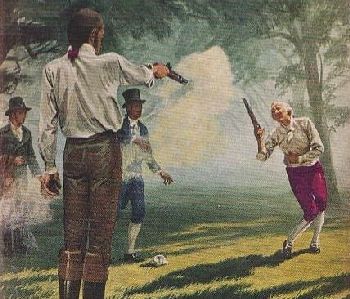
    The most famous duel in American history: Aaron Burr, our sitting vice president, killed Alexander Hamilton, our first treasury secretary, in Weehawken, NJ, on July 11, 1804.
  • It is mistaken to think that the founders basically got along well with one another. Some wore white hats; some wore black hats. Like the rest of us, they nursed resentments, held grudges, and had knock-down-drag-outs. Recall: a sitting vice president shot and killed the first secretary of the treasury in a duel. George and Martha Washington felt personally betrayed by Jefferson.... Then there's John Adams, who had a plethora of apparent foibles. He could not stand Thomas Paine. He poked fun of John Dickinson for hiding behind the skirts of his Quaker wife and mother-in-law. He envied the credit George Washington, Benjamin Franklin, and Thomas Jefferson received for the founding. By the Election of 1800, Adams and Jefferson were not even on speaking terms. Each of these "statesmen" had mobilized partisan newspapers to write such scurrilous things about the other that it is a miracle they ever restored their friendship. The campaign rhetoric in 1800 was much more vicious than anything you see today, even on cable TV.
  • 
    Ever wonder how Gouverneur Morris lost his left leg?
    
  • It is also mistaken to think that all the founders were buckled-shoe Puritans in their private lives. Several of our statesmen were not "family values" people at all. Luther Martin was such a lush that historians like Gordon Lloyd joke that it would be more accurate to call him "Luther Martini." Gouverneur Morris's many affairs on both sides of the Atlantic -- including sharing Talleyrand's mistress -- gives new meaning to the idea of (to use his words in the Preamble) "domestic tranquility." While Treasury secretary, Alexander Hamilton had a notorious affair with the financially desperate Maria Reynolds, making him vulnerable to bribery. (As Hamilton himself later confessed, "I took the bill out of my pocket and gave it to her. Some conversation ensued from which it was quickly apparent that other than pecuniary consolation would be acceptable").... In his Autobiography Benjamin Franklin admitted he frequently visited prostitutes; moreover, he was not very considerate of his wife Deborah, abandoning her for long periods of time; and he refused to reconcile with his son when he declared with the Tories. George Washington was still flirting with Sally Fairfax after his engagement to Martha. Washington's famous will, in which he released his slaves (the only founder to do so), certainly betrays mixed motives upon closer inspection. Thomas Jefferson was not only accused of sleeping with his teenage slave, Sally Hemings, but also with trying to seduce his neighbor's wife, Betsy Walker. The sins and peccadillos of our founders would fill an Everest of People magazines.... But that's okay. It is important to see the founders as they were. They were not marble statues, cold and unapproachable and inaccessible. When we bring them down from Mt. Olympus, when we see them as they were, warts and all, we can respect them all the more as flawed humans who nevertheless accomplished much good.... Plus, we can identify with them. If these flawed human beings were capable of such heroic personal sacrifice in the service of a greater good, then perhaps we really can follow in their footsteps and expect better from ourselves.

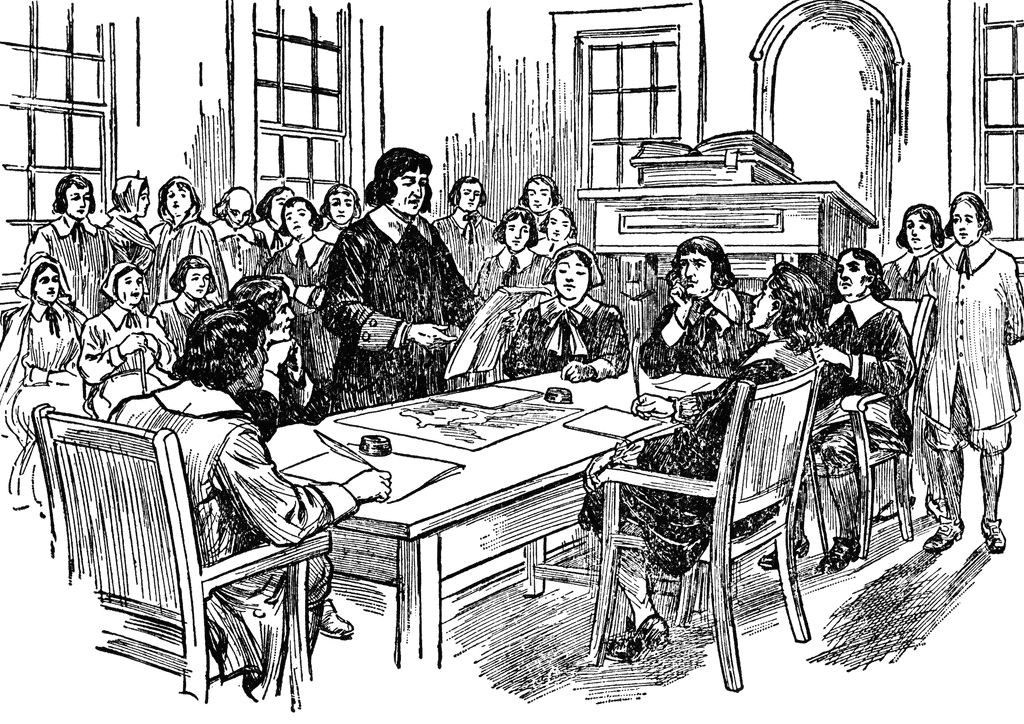
    Politically, America was founded as a constitutional republic. But direct democracy was practiced in early New England town meetings. This illustration is from a civil government text used in the early 20th century.
  • It is misleading to assert that America was founded as a democracy. That statement is only partially true. Constitutionally, America was founded as a republic. The populist element in our early history was situational. Ad hoc direct democracy arose on the Mayflower, in New England town meetings, and along the frontier. Moreover, our civil society, marketplace, and militias were democratically organized. The democratic principle in our culture would spill inexorably over into politics during the Progressive Era a hundred years after the founding. But the national government would not change significantly until many decades after the founding generation had passed. Strictly speaking, the national frame of government that came out of Philadelphia in 1787 was republican. A republican constitution by definition balances rule by the one (presidency), with rule by the few (Senate and Supreme Court), with rule by the many (House). America was founded as a constitutional republic. 

  • I sometimes hear it said, erroneously, that America was the world's first republic. Actually there were numerous republics that preceded America. Ancient Carthage was a prominent republic that contended with Rome for control of the Mediterranean. Ancient Rome was a republic for almost 500 years. Medieval Venice was a republic for more than 1,000 years. Prior to the American Revolution, in the 17th century, the Dutch formed a powerful commercial republic, and Britain experimented with republicanism under Cromwell. It is more accurate to say that we were the modern world's first constitutional republic.

    Charles Carroll of Carrollton (Maryland) was the only Catholic signer of the Declaration of Independence and the last surviving signer of the document. He was educated in Europe by the Jesuits. This serene oil painting, by Thomas Sully in 1834, fails to convey all the suffering Carroll and his family endured both as Catholics and as nation founders. Bradley Birzer's authoritative biography, American Cicero, brings to life one of the most fascinating statesman of the founding era.
  • "America is a Protestant nation" -- a largely true statement at the time of the founding, but one that needs qualifying. Most citizens were indeed Protestant, but two percent of the population was Catholic and heterodox faiths abounded, as did people who professed no faith at all. In British North America there were numerous Quaker settlements, for example, and many of our foremost founders were either Unitarian (John Adams) or Deists (Jefferson, Franklin, Paine). Only once in his public life did George Washington speak the name of Jesus. (He was nominally Anglican.) Only one of the nine most prominent founders, John Jay, was a devout, orthodox, church-going Protestant during the revolutionary period. During one particularly tense session at the Constitutional Convention, Benjamin Franklin suggested that the delegates pray, to which Alexander Hamilton quipped that Americans had no need of foreign intervention. There is no question that most American settlers were Protestant, and that most of the founders were Protestant. But it is also accurate to say that a small number of prominent founders were like flying buttresses -- supportive of the church but happy outside of it.

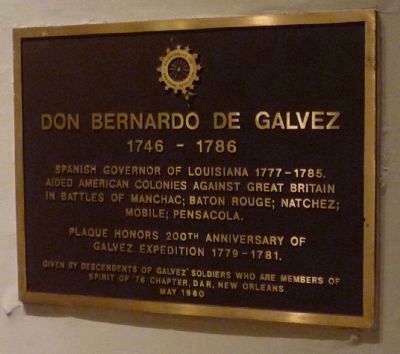
    Texas vaqueros helped win the American Revolution. This historical plaque in New Orleans commemorates the role of Spanish Governor Bernardo de Galvez in defeating the British. Galvez fed Spanish and American armies with cattle from Franciscan ranches around San Antonio, in the Spanish province of Texas.
  • When speaking of the War for Independence, it is misleading to concentrate solely on the upper East Coast between, say, Fort Ticonderoga and Yorktown. To do so is to neglect other critically important theaters in the Western Hemisphere. Historically, Boston and New York publishing houses tended to focus on their own region to the neglect of (1) the Carolinas, which saw some of the heaviest fighting in the war; (2) the Caribbean, where the French navy kept most of the Royal navy pinned down; (3) the West, where George Rogers Clark subdued Britain's Indian allies, even in far-off places around Fort Detroit; (4) the Southwest, where Spanish Governor Bernardo de Galvez kept the Gulf Coast and Mississippi River cleared of the British, with even Spanish vaqueros in Texas playing a logistical role. Each theater contributed to the successful quest of the Americans who sought independence. It's not just an East Coast thing.

      Also:

  • July 4th, 1776, is not technically Independence Day. As John Adams pointed out, July 2nd was the day when the Second Continental Congress voted on Richard Henry Lee's resolution (introduced on June 7, 1776) to separate from Great Britain. July 4th was the day the Congress voted to adopt the Declaration of Independence, setting forth the rationale for the break with Britain. It was intended for both for domestic and international consumption.

  • George Washington was a great man, but he was not a great battlefield general -- certainly no Alexander the Great, Julius Caesar, or Napoleon Bonaparte. In fact, GW lost more battles than he won. His strength lay in his ability to hold a ragtag army together, his example of sacrifice, his intelligence gathering, his holding an international alliance together, and his ability to walk away from power. That is why he was great and it is why we honor him. (Even his enemy, King George III, remarked that Washington's ability to walk away from power made him "the greatest man in the world.")

    A set of George Washington's dentures, obviously not made of wood. 
  • George Washington did not have wooden teeth. His dentures were made of slave teeth set in ivory that were stained by tea, so they eventually looked like wood. They caused him much difficulty (stories about which prompts laughter at the expense of the Father of our Country).

  • It is not true that democracies (and, by extension, representative democracies) do not go to war against one another. The German philosopher Immanuel Kant foreshadowed the "democratic peace theory" in his essay, "Perpetual Peace" (1795). Kant reasoned that a majority of the people would never vote to go to war, unless in self-defense. Therefore, if all nations were constitutional republics, international warfare would end, because there would be no aggressors. It's a bad theory refuted by history. Numerous times a body of people or their representatives have elected to go to war against each other: Athens vs. Sparta; Rome vs. Carthage; Great Britain vs. the U.S. in the War of 1812; the North vs. the South in the Civil War, and both, by the way, were the largest two democracies in the world at the time. 


9. The American War for Independence was both a civil war and a world war. It began as a civil war. A formerly united empire consisting of Englishmen loyal to the Crown split up when about 1/3rd of the colonists in British North America decided they had put up with too many abuses for too long. They justified their violent breakout in the Declaration of Independence, citing some two-dozen specific abuses.... Within three years the conflict morphed into a world war, and here the larger global context is important. England and France had fought four wars in the hundred years leading up to the American Revolution. They had scrapped in Europe, the Indian Ocean, the Caribbean, and North America.... In 1754 a young George Washington precipitated the fourth of these wars in a glen in southwestern Pennsylvania. Britain eventually won the Seven Years War, but at a high price -- literally. The American Revolution grew out of the tensions that arose when Britain, financially strapped, taxed colonials without their consent to ease the crushing debt of empire. Patriot resistance led to the War for Independence, but Britain would end up fighting not just 13 of their former colonies, but also France, Spain, and Netherlands, all of which had scores to settle with the British.... After Saratoga, France came in on the American side hoping to humiliate the British after their own humiliation in the Seven Years War. Although France got the satisfaction of seeing Britain humiliated, her war debts, in turn, would lead to the calling of the Estates General and the outbreak of the French Revolution.... Out of the chaos of the 1790s rose Napoleon, whose wars in turn led to financial troubles that would open up the opportunity for Americans to purchase Louisiana, recently purchased by the French from Spain.... The American revolt is further linked to her former allies through the Haitian slaves who unsuccessfully attempted to break away from France and found the New World's second republic, and to all the South American republics that successfully broke away from Spain. It's all linked -- like that old toy, the barrel of monkeys. The American founding is better understood when seen in all its complex linkage to the broader world.

The neoclassical painter, John Trumbull, actually took part in the scene above, titled "The Death of General Warren at the Battle of Bunker Hill, June 17, 1775." The painting hangs at the Boston Museum of Fine Arts.


8. The casualty rate of the Revolutionary War was much higher than anyone today realizes -- second highest of all our wars. In the Civil War, America lost almost 2 percent of her population. In the Revolutionary War (which was also a civil war), America lost almost 1 percent of her population. Out of a population of 2.5 million, the Americans lost close to 25,000 people by mortal wounds, subsequent infections, and disease.... By contrast, in World War II and the War of 1812, the U.S. lost about 1/3rd of 1 percent of her population. In World War I we lost about 1/10th of 1 percent of our population. In Vietnam we lost an even lower percentage of our population.

It was once common to depict George Washington sporting a Roman toga, symbolic of the old high Roman virtues -- labor, pietas, dignitas, gravitas, and fatum. This period piece from the 1840s, by Horatio Greenough, is part of the Smithsonian collection.
7. The American founders were latter-day Roman republicans. Many could read Latin, were classically educated, and consciously identified with some of the leading republicans of ancient Rome. They especially valued the civic virtue of the ancient Romans that made men capable of great sacrifice for others and for the community.
    
    Cincinnatus put down his plow and took up his sword when he was called to lead Rome against tyrants. In this sculpture (in Cincinnati, OH), the republican leader is handing the fasces, symbol of constitutional authority in Rome, back to the republic's legitimate authorities. Fasces are a common symbol of republican power -- and also the origin of the word "fascist." Fasces are depicted in the U.S. House of Representatives on each side of the rostrum. 
    
  • George Washington was alternately regarded as a Cincinnatus (for laying down his sword and returning to his plow) or Fabius the Delayer (for patiently avoiding a military catastrophe with the British). He also was a great fan of Joseph Addison's play, Cato, which he had performed again and again for his men. In both sculpture and painting, contemporaries frequently portrayed GW in a toga.
  • John Adams, an attorney, looked back to the greatest lawyer of ancient times, the Roman republican Cicero, for inspiration. 
  • Alexander Hamilton signed his Federalist papers with the name of the early Roman republican, Publius. There is evidence that he signed early papers "Julius Caesar."
  • James Madison signed his Federalist papers with the name of the early Roman republican, Publius.
  • John Jay signed his Federalist papers with the name of the early Roman republican, Publius.
  • In fact, when debating the merits of the Constitution, most of the Federalists and Antifederalists used Roman noms de plume.  
  • Nathan Hale's last words -- "I regret that I have but one life to lose for my country" -- were likely based on words from Joseph Addison's play, Cato.
  • In this famous sculpture of George Washington by Houdon (in the Virginia Capitol in Richmond), the General and first President of the United States rests his left hand on the fasces, symbol of Roman republican power. Fasces were composed of a bundle of rods around an axe. Compare Washington's pose with that of Cincinnatus, above, who is handing the fasces (power) back to legitimate public authorities.
  • It was fashionable for earlier generations of Americans to have Roman names. Did you notice the painting of the Constitutional Convention of 1787 at the top of the page? The artist's name is Junius Brutus Stearns (1810-1885).

6. The American Revolution and founding should be chronologically and spatially s-t-r-e-t-c-h-e-d, seen as (1) beginning much earlier, (2) including more Indian battles in the West, and (3) ending much later than the conventional wisdom suggests. Following Longfellow's famous poem, we tend to put the start of the Revolution at April 19, 1775, when Lexington and Concord flared up. We conventionally mark the end of the Revolution at either the Battle of Yorktown in 1781 or the Peace of Paris in 1783. But John Adams claimed the American Revolution began much earlier, in a Boston courtroom in February 1761, when James Otis delivered a speech asserting that Americans had the right to interpret English constitutional principles and rights differently from British politicians back home. In fact, according to Adams, many Patriot Americans had already declared their independence from the mother country in their minds and hearts before a shot was fired.... But to mean anything, ideas on parchment had to be backed by victories on battlefields. Americans simply had to wear down the British will to keep them in the empire.... We tend to overlook the importance of the Indian battles. Successfully confronting Indian unrest among the Iroquois, Shawnee, Cherokee, and Miami was critical to the struggle for independence. Many Indian battles, even as late as Fallen Timbers (1794) and Tippecanoe (1811), were due to British agitation of her Indian allies who continued to harass American settlers in the West.... As for an ending date, Jefferson called the Election of 1800 the Second American Revolution. And the War of 1812 was widely perceived to be the Second War for Independence because it was not until the conclusion of that conflict that the British seemed truly resigned to having lost her 13 North American colonies.
In 1794 the Battle of Fallen Timbers took place outside of present-day Toledo, OH. It should be seen in the context of the War for Independence and American Revolution.

5. The American founders, a minority of the population, were gutsy. Given similar circumstances today, we would probably be either Loyalists or fence-sitters. I'd wager that most of us today would not be treasonous but play it safe. Americans in 1776 were, after all, part of the greatest empire on earth. We enjoyed more rights and liberties than any other people. Why risk it all?... John Adams observed that 1/3 of the population was Patriot, 1/3 was Loyalist, and 1/3 was opportunistic or neutral. We are not as animated by constitutional ideals and historic precedents as much as they were. Maybe some of us would tip our hat to the most conservative founder, John Dickinson. But probably not. The War for Independence was a vicious civil war here at home. Even non-combatants paid dearly. We'd seek convenience and try to avoid the pain.... American Patriots were fighting the superpower of the day, against the greatest army on earth and the greatest navy on the seas. The odds of winning were slim. There was much to lose if you committed high treason against the Crown, not least of which was life and limb. Most people are not willing to risk their all.... The American Revolution almost didn't happen. On several occasions, it was almost aborted. That's why I title my course, "The Amazing American Revolution." It is amazing that the founders pulled it off.

4. In its street plan, Washington, DC, is one of the great Baroque (and broke) cities of the world. Architecturally, it looks like a latter-day outpost of Rome. In plan, L'Enfant, Ellicott, and the McMillan Commission all reinforced the classical and baroque motifs. Even as late as the 1930s, FDR's Washington seemed to be competing to become the Third Rome (as were Hitler's Berlin, Mussolini's Rome, and to some extent even Stalin's Moscow).
L'Enfant's street plan for the new capital city appealed to the Baroque imagination.

3. George III was every bit the revolutionary that George Washington was. The king was a revolutionizing tyrant, destroying the English constitution and denying the ancient rights of Englishmen to colonial subjects. His tyranny was as revolutionary as George Washington's principled resistance was. Perhaps the American founding could best be described with the Burkean phrase, "a revolution not made, but prevented." For the revolutionary impulse was largely kept within bounds when compared to the later French Revolution or Russian Revolution. As the historian John Willson suggests, maybe this is the true achievement of the American founders, to form a more perfect union without turning the world upside down.

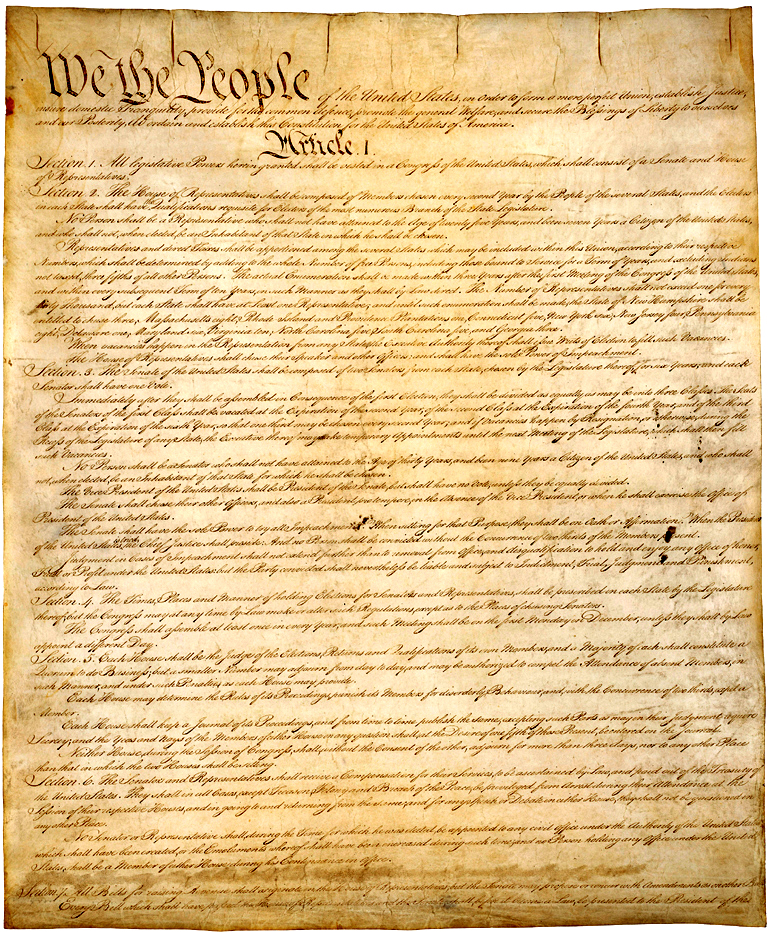
2. The founders' understanding of freedom was different from ours. They did not think it was the right to do whatever you wanted. They were not libertarians. The founders' understanding of freedom merged two intellectual streams of thought. One was the civic republican tradition, an inheritance of classical, Renaissance, and English Whig thought; it emphasized the citizens' duties to the commonwealth and engendered the habit of putting service before self. The other was the natural rights tradition, influenced by William of Occam, John Locke, and the Enlightenment; it emphasized the government's duty to the individual, especially to protect one's God-given right to life, liberty, property, and pursuit of happiness. Taken together, both the republican and liberal streams of thought recognize that freedom comprises rights and duties.... Further, freedom must be ordered to be secured; otherwise it can devolve into licentiousness and/or anarchy, as Polybius, Sallust, Livy, and Tacitus taught when meditating on the Roman experience.... Gouverneur Morris's 52-word Preamble to the U.S. Constitution offers a sublime lesson in the five conditions that must obtain before a people can be truly free. Every American should know this wonderful little lesson in political philosophy.

The first page of the U.S. Constitution containing Gouverneur Morris's 52-word Preamble, one of the most sublime lessons in political philosophy ever crafted.
1. The founders spoke of our nation's happiness. They were concerned about posterity -- about our happiness. Of all the state papers ever produced, one of the most famous is the Declaration of Independence. And of all the phrases Jefferson ever penned, surely one of the most appealing to modern sensibilities is "the pursuit of happiness." That line has played a part in shaping the modern world. Yet most Americans today are not familiar with older conceptions of happiness. The founders would not have confused happiness with power, profit, prestige, pleasure, or pride in getting our way. What does the pursuit of happiness entail? To the founders, above all it meant reconciling the public duties of our civic republican tradition with the private rights of our natural law tradition. But the private sense of happiness does not end there. At the end of Sophocles' play, Antigone, the chorus instructs us in the happiness we seek. The main ingredient of happiness is wisdom. How do we become wise? For most of us, punishment and suffering pound out our foolishness. They school us until we learn the lessons needed to live the good life. Experience teaches that wisdom mostly comes from keeping a clear conscience, worshiping God rightly, and learning from mistakes, our own and others'. If we are mindful of these things, we have a shot at being happy. We are smart about "the pursuit of happiness." For we know that, absent wisdom, there is no happiness.

*     *     *

Final thoughts in the final class

There were several honorable mentions cited by the class, nuggets that almost made it into the Top Ten. For example, they enjoyed learning about the critical moment in American history that occurred in Newburgh, New York, on the Ides of March 1783, when George Washington saved the new republic from impatient, angry officers who wanted him to lead a junta against the Confederated Congress.

One woman in class was fascinated by how rifling a gun barrel was a technological leap over smooth-bore muskets, increasing the lethal velocity of a lead ball. In a related vein, a man seized on Nathaniel Greene's brilliant strategy at Cowpens and Guildford Courthouse.

Of course, they enjoyed all the people stories -- of Nathan Hale's bravery in the face of death, of Molly Pitcher manning the cannon after her husband collapsed, of Abigail Adams watching the early battles with her children, of Ethan Allen and his Green Mountain Boys in the Grants, of John Paul Jones's daring-do off the coast of Scotland, etc. There is never enough time for all the interesting people stories, but they are what make history come alive in any class.

Bottom line: Time will tell, future historians will ratify, whether America is the greatest republic ever founded. A little perspective is in order. Our republic has existed less than 240 years. Chinese dynasties passed the baton for some 4,000 years. Egyptian civilization lasted some 3,000 years. The Venetian Republic lasted more than 1,000 years. The Roman republic lasted some 500 years. A fraction of that age, our American nation is a relative new-comer to the world stage. Are we up to the awesome task of continuing it? As Benjamin Franklin told the woman outside the Pennsylvania State House in 1787, the founders bequeathed to the American people a republic. Now it is up to us to keep it.

The United States Capitol is freighted with architectural significance, marrying the eternal heavens with earthly ambition and achievement. Reminiscent of St. Peter's and (further back) the Roman Pantheon, the circular dome symbolizes the eternal first principles of a constitutional republic in which the people are sovereign under the rule of law. The rectangular floor plan that rises from the foundation symbolizes our nation's connection to bedrock, rich soil, and vast natural resources, a geographic grounding reinforced by the structure's orientation along the four cardinal directions.

*     *     *

For more about the American founding, please see my other essays on this blog along with the many links to additional works.

For more about leadership, please visit the Hauenstein Center for Presidential Studies http://www.allpresidents.org/.