Saturday, July 2, 2011

American Founding -- John Adams 5

Why the Fame?

Given John Adams's liabilities -- his prickly personality, several career setbacks, and the inconvenient fact that his presidency was shoehorned between that of eminent Virginians -- it is hardly surprising that his revival came so late -- 200 years after his retirement from public life. I'd argue that it is not justifiable to give all the credit to David McCullough and HBO. It is true that Adams needed people to plead his case before the bar of public opinion, but there was a good case to champion because of the man himself. Adams himself deserves the fame that Americans now accord him because of his decisive response to the challenging times in which he lived, as well as because of his good character, hard work, intelligent writing, ability to judge character, and vision for our nation. Let's examine these half-dozen elements in more detail. 

birthplace of Abigail Smith Adams
1. The grand stage  It's a truism that's lost none of its truth: "the times make the man." A person is more likely to be famous if by accident of birth he lives in heroic times and if by accident of geography he is close to the action. The American founding was a threshold in the human experience, changing the human estate forever. Adams was born in 1735, near Boston. He was nearing forty years of age when hostilities commenced at Lexington Green and Concord Bridge, near Boston. Harnessing his considerable moral and intellectual virtues, Adams seized opportunities to lead during the crisis with Great Britain. The accidents of history and geography put a man leaving his youth and entering his best years in the cockpit of revolutionary tumult then gripping Massachusetts.

I cannot help but add the "accident" of a great marriage to those of time and place. The Adamses were exceedingly fortunate to have found and married one another.

Adams, like Jefferson, read Plutarch's Lives in the original Greek
2. Classical education  Adams's lifelong reading of the classics also prepared him for fame. His teachers were Thucydides, Polybius, Sallust, Livy, Tacitus, Cicero, Suetonius, Plutarch, Jesus, and St. Paul. Each ancient teacher grounded him in the understanding that fame is a social state that is not inherited but earned. If earned, it should be based, above all, on the fineness of one's moral character. Honorable living, courage amid danger, prudence in decision-making, temperance in the face of temptation -- all these virtues are the result of a lifetime of moral discipline.  They become more evident when living in challenging times, and when life-and-death decisions have to be made.

Adams knew that fame could be fickle, and he knew not to confuse fame with celebrity. He would be appalled by today's celebrity culture that has confused celebrities with heroes. Adams would have scoffed at the way people seek to break into 24/7 media coverage with 15 seconds of insipid notoriety.
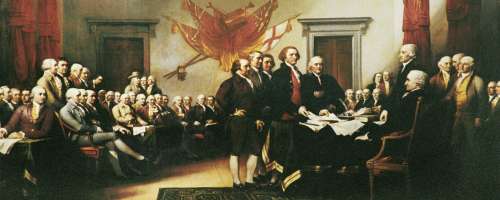
John Trumbull's "Declaration of Independence," in the U.S. Capitol Rotunda, captures not the Fourth of July, but the presentation of the document to the Second Continental Congress on July 2nd, after legal separation from Britain had been achieved. Adams, appropriately, is the delegate in the middle of the picture -- on the left among the five founders who are submitting the Declaration of Independence to the chairman. Jefferson is the tallest of the group, and Franklin is on the right.
3. Ambition  Adams was ambitious to make something of his life. As a young person he thought he might be happy as a farmer. But the more he learned about himself, the more he set his shoulder to the wheel of ambition. His rise from humble beginnings was impressive -- from the Braintree house to scholar at Harvard, to teacher, to law apprentice, to small-town lawyer, to delegate to the Continental Congresses, to diplomat, to constitution maker, to Vice President, to President of the United States, to elder statesman. At each stage in his career he performed his duties with integrity and intensity. In the Continental Congress, for instance, he served on 90 different committees -- more than any other congressman -- and chaired 20 of them. His work on behalf of our country meant long periods of time when he could not be with Abigail and his children, or tending his farm in Braintree. His diligent study and hard work insured that what he said and what he did made genuine contributions to his country. In Paris, his hard work probably saved him from many a temptation [McCullough 236-37]! More, his sense of duty made him stoical in the face of difficulties. He wryly observed that, "No man who ever held the office of president would congratulate a friend on obtaining it."

4. Master stylist  Adams was a serious student of the English language, and his attention to the ancient liberal art of rhetoric helped him become a forceful writer. Writing, he admitted, was a self-imposed discipline. "I have a great Deal of Leisure, which I chiefly employ in Scribbling, that my Mind may not stand still or run back like my Fortune," he once wrote. He became one of the most prolific and quotable of the founding fathers, spitting out quips ready-made for Bartlett's. Some of the best quotations from America's original "greatest generation" came from Adams's quill. A good example: "Facts are stubborn things," uttered by the young attorney when he courageously defended the British soldiers on trial for the Boston Massacre in 1770. Years later, contemplating his frustrations with the do-nothing Continental Congress, he supposedly complained (revealing a wit worthy of comparison with Mark Twain's): "In my many years I have come to a conclusion that one useless man is called a disgrace, two are called a law firm, and three or more are called a congress."

One Great Founding Mother: Abigail Adams
Lasting fame is built on evidence of greatness. Americans are fortunate to have access to two great letter exchanges, both involving John Adams. His writing gives us insight into the most interesting aspect of the human person, the inner life. The letters reveal how his mind worked and how his character responded to challenges. The 1,160 letters he and Abigail exchanged offer a treasure-trove to posterity, yielding rich insights into the politics, mores, and domestic life of the era. These exchanges with his "Dearest Friend" are all the more rewarding to read because of Abigail's insightful observations and powerful intellect, the match of her husband's.

In addition, the famous Adams-Jefferson correspondence, resumed after more than a decade of chilliness between the second and third presidents, offers insights into the religious, philosophical, and historical dimensions of the American founding.

Also notable are the letter exchanges between John Adams and his good friend, Dr. Benjamin Rush. The correspondence of these two minds of the Enlightenment tended to probe the power of the irrational in human affairs [Joseph Ellis, Founding Brothers, 215].

5. Judge of character  Adams also deserves fame because he was an estimable judge of character. He pushed for George Washington to serve as the commander of the Continental army, persuaded Thomas Jefferson to write the Declaration of Independence, and nominated John Marshall to be chief justice of the United States. Not bad calls, these.

6. The American idea  Finally, Adams richly deserves fame as a patriot because he got the American idea right. There is a good reason to call him our greatest philosopher president. For one thing, he was no woolly thinker seduced by the gauzy utopian schemes of French salons. Rather he held to a clear vision of what citizens of the new republic must be to thrive in a hostile world of fallen human beings.

Here it is worth saying a word about Adams's religious beliefs, which were complex and deserve more space than I can here devote to the topic. Privately, Adams was not an orthodox Christian, as we understand the term today. Theologically he was not a Trinitarian. He was a Unitarian who yet called himself a Christian and "followed" Christ. Students are confused by the fluidity of meaning, but I point out that Adams followed Christ in much the same way that Buddhists follow the Buddha (understood to be a man and not a god). In his public life Adams was like a flying buttress: supportive of more orthodoxly Christian churches but content to be outside of them. He believed in Providence, which mostly consisted of the laws under which God had created the world (so the human duty, if the goal was to prosper, was to learn these laws and act in accordance with them). Nor did Adams have any doubt that religion was necessary to the survival of the new republic. As he famously put it, "We have no government armed with power capable of contending with human passions unbridled by morality and religion. Avarice, ambition, revenge, or gallantry, would break the strongest cords of our Constitution as a whale goes through a net. Our Constitution was made only for a moral and religious people. It is wholly inadequate to the government of any other" [Adams to the Military, October 11, 1798].

Adams got the American idea right in other key ways. When we look at the spectrum of ideas among the founders, he took the via media, convinced that the center must hold. On the one hand, he distanced himself from radical revolutionaries like Thomas Paine and his cousin Sam Adams, rejecting anything like pure democracy. "Remember democracy never lasts long," Adams advised John Taylor in 1814. "It soon wastes, exhausts, and murders itself. There never was a democracy yet that did not commit suicide." On the other hand, his energetic temperament as well as his grounding in history and first principles led him away from the more pacific instincts of founders like John Dickinson. When the time came to move decisively for independence, Adams had already thought it through and was able to shape the course of events.

A keen student of history and political theory, Adams also understood the nature of republican government. It was not just anti-monarchical, nor just a democracy expressed through elected representatives. Properly understood, a republic was a form of government that balanced the three historically dominant classes of power: rule by the one (monarchy), rule by the few (aristocracy), and rule by the many (democracy). The tensions among these three groups is what Adams and others exploited to articulate the separation of powers. Thus the monarchic impulse would find expression in the Presidency; the aristocratic impulse, in the Senate and Supreme Court; the democratic impulse, in the House. Power was further attenuated in a federated polity that did not over-concentrate power in the national capital but respected civil society's "little platoons" found at the local level as well as the traditional prerogatives of villages, townships, counties, and states. Above all, power must never accrete to one ruler. Human nature was too corruptible to trust any man or woman with too much power. "They define a republic to be a government of laws, and not of men," wrote Adams in Novanglus No. 7 (March 6, 1775).

Finally, Adams got the American idea right by articulating a wise conception of happiness. He brooded quite a lot on human flourishing. Perhaps his broadest utterance on the topic is found in Thoughts on Government: "We ought to consider what is the end of government before we determine which is the best form," wrote Adams. "Upon this point all speculative politicians will agree that the happiness of society is the end of government, as all divines and moral philosophers will agree that the happiness of the individual is the end of man.... All sober inquirers after truth, ancient and modern, pagan and Christian, have declared that the happiness of man, as well as his dignity, consists in virtue" [Thoughts on Government, 1776].

This statement strikes modern sensibilities as too Puritanical. Nowadays we only think about happiness as a private good. And over time, that private good has tended to degenerate into narcissism, into the calculus of I-me-mine. Today we pursue happiness in power, profit, pleasure, prestige, preeminence, progress, and pride in getting our way.

But Adams held to a deeper understanding of happiness that sought to integrate its public and private dimensions. Although Americans today have lost sight of "public happiness," it was much on the minds of the founders when they deliberated over what qualities of citizenship Americans should possess, and what kind of republic America should be. Allow me to elaborate.

Adams's notion of private happiness was informed by Aristotle and Cicero, who believed that well-being was inseparable from virtue. Most fundamentally, we must obey our informed conscience. If you have a bad conscience, you cannot be happy. If you are a slave to your passions and drives, you cannot be happy. Adams expressed this stern idea when he defined happiness as the ability to do what one ought. Where there is no virtue, there is no happiness. And as we have already seen, virtue for Adams was inseparable from religion. Performing the rituals that are pleasing to God -- being in right relation to God -- is essential to human flourishing.

Adams' notion of public happiness was also informed by ancient traditions of our Western heritage: the civic republican tradition that emphasized duties, and the natural rights tradition that emphasized (what else?) rights. The former stretched back to ancient Greece and Rome, while the latter was traceable to the European Middle Ages. Adams managed to balance both of these living traditions -- the civic republican tradition that stressed each person's duties to community, and the natural rights tradition that underscored the inalienable rights that each person enjoys before the state. If there is too much emphasis on duties, the citizen lives unhappily in an authoritarian state. If there is too much emphasis on rights, the citizen lives unhappily in anarchy or licentiousness, or both. If the proper balance could be struck -- if the behavior and habits of citizens reflected the proper balance of rights and duties, then individuals had the chance to live integrated, and thus relatively happy, lives in community.

In sum, happiness for Adams was inseparable from religion, virtue, education, civic participation, and -- and marrying a good wife. He was fortunate to have a peerless spouse in Abigail. In the end, perhaps it was her excellent influence that helped make John Adams worthy of the fame that he craved, and that posterity has finally bestowed upon him.

*     *     *

This essay is the fifth and last in a series on John Adams. The Adams series served as the basis for my talk accompanying the exhibition, John Adams Unbound, organized by the Boston Public Library and the American Library Association. The talk was given at the Loutit District Library, Grand Haven, Michigan, on June 30, 2011.

This Adams series is posted on July 2 because he thought that was the day our country's independence should be pondered and celebrated.

For more on presidents and leadership, see http://www.allpresidents.org/.


American Founding -- John Adams 4

His Rotundity -- His Own Worst Enemy

Like any public figure who lives into his nineties, Adams experienced his share of setbacks -- more than a few of his own making. Isn't one of the most difficult things any of us learns is how to deal with our own personality and its liabilities? Adams fessed up that he had a difficult personality. He could be his own worst enemy -- ironic given that he once wrote Abigail a letter cataloging all her faults!

Examining the numerous liabilities of his personality, biographer John Ferling observes, "Adams struck many people as vain, irritable, irascible, supercilious, and tactless. He maintained a stiffly formal and aloof demeanor, what one acquaintance called a habitually 'ceremonious' manner.... Abigail once scolded him for his tendency to indulge in 'intolerable forbidding expecting Silence' while in the midst of a conversation; 'tis impossible for a Stranger to be tranquil in your presence'" [Ferling 170].

Moreover, he nursed a tendency toward brooding pessimism. As he revealed to his diary on the eve of the Second Continental Congress -- the Congress that would declare independence -- "I wander alone, and ponder. I muse, I mope, I ruminate. We have not men fit for the times. We are deficient in genius, education, in travel, fortune -- in everything. I feel unutterable anxiety" [McCullough 23].

Adams also had a hot temper. He managed to keep his outbursts confined to private conversations, but there was widespread conjecture that he might be emotionally unstable. One of the most egregious outbursts occurred the only known time Adams demeaned a subordinate to his face. In the presidential mansion one day he dressed down an aide, James McHenry, unjustly accusing him of scheming with Hamilton to bring Adams down. Then came the volley of insults. He frothed that that "foreigner," Hamilton, was "the most restless, impatient, artful, indefatigable, and unprincipled intriguer in the United States, if not the world." "The bastard brat of a Scotch peddler” had a “superabundance of secretions which he could not find whores enough to draw off.” Finally Adams decried “the profligacy of his life; his fornications, adulteries and his incests.” Such a surprising outburst, this, that McHenry later wrote down what happened in letters to friends and family. He ventured that the second president of the United States was "actually insane" [McCullough 538-39].

Besides a penchant for being his own worst enemy, there were situations that arose which Adams thought might do harm to his reputation.

1. At great risk to his young law career, Adams defended the Redcoats who were involved in the Boston Massacre because he believed that the law rather than popular passions should rule Massachusetts.

2. Adams's two terms as Vice President were frustrating for a man of his restlessness, vigor, brilliance, and vanity. Complaining to Abigail, he opined, "My country has in its wisdom contrived for me the most insignificant office that ever the invention of man contrived or his imagination conceived." After eight years of biding his time, a lesser man might have given up and gone home.

3. The four Alien and Sedition Acts as well as the so-called Midnight appointments to the judiciary -- on the eve of Jefferson taking office -- made Adams look thin-skinned, unprincipled, and unpresidential.

Scumbag: James Calender
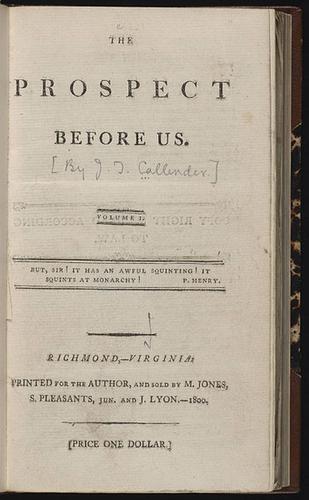
4. Perhaps his most bitter setback was losing the White House to Jefferson in the Election of 1800. Adams despaired that his reputation could ever recover from such an ugly campaign. We think politicking is a dirty business today, but we forget that it was even dirtier in the early republic. In 1800, Jefferson and his allies roused an unprincipled journalist, James Callender, to attack Adams's character in the Richmond Examiner. The sitting president was accused of being a monarchist, a warmonger, and even a hermaphrodite who had "neither the force and firmness of a man, nor the gentleness and sensibility of a woman." Callender especially wanted to drive home the impression that Adams was insane with rage. He spread the unfounded rumor that Adams once became so enraged he ripped off his wig, threw it on the floor, and stomped on it [McCullough 536-37].

It gets worse. Callender, with Jefferson's blessings, accused Adams of importing two mistresses shortly after being elected president in 1796. Ridiculous rumor, of course, but in the battleground state of Pennsylvania, this was a serious allegation. One of the mistresses supposedly was from France, the other from Germany. As Alf Mapp humorously puts it, "While retaining the French charmer ... Adams supposedly had returned her rival to her native Germany. The Pennsylvania Germans were incensed, not so much by reports of sexual immorality as by the thought that the president would reject a fräulein while holding fast to a mademoiselle [Mapp 55]. Because Adams couldn't carry Pennsylvania, he wasn't reelected, and to Adams, this further robbed him of respect.

*     *     *

This essay is the fourth in a series on John Adams. The Adams series served as the basis for my talk accompanying the exhibition, John Adams Unbound, organized by the Boston Public Library and the American Library Association. The talk was given at the Loutit District Library, Grand Haven, Michigan, on June 30, 2011.

This Adams series is posted on July 2 because he thought that was the day our country's independence should be pondered and celebrated.

For more on presidents and leadership, see http://www.allpresidents.org/.
American Founding -- John Adams 3

The Thorn of Fame

John Adams has finally gotten the fame he craved, but it was a long time coming over a rough road. Already as a young man he tortured himself thinking about a future without fame. Historians don't need to speculate on this point because he and his wife Abigail seemed to write down everything. Because of the thousands of letters they left us, we know John Adams's inner life better than the inner life of any other founding father. We know, apropos of this talk, that he thought he should be famous, once declaring that the "Times alone have destined me to Fame" [Ferling 170].

Yet the quest for fame was a thorn in his side. As David McCullough put it, as a young man "John Adams was not a man of the world. He enjoyed no social standing. He was an awkward dancer and poor at cards. He never learned to flatter.... There was no money in his background" [19]. Everything he earned -- from respect in the courtroom, to readership in the newspapers, to leadership in Philadelphia -- he had to work hard at. He knew that fame can be fickle and fleeting. For that reason, he feared posterity would not pay him sufficient homage.

Moreover, he was eaten up with envy when he thought of the more illustrious founders of his own day. Given his Puritan New England heritage, Adams knew envy was one of the seven deadlies, but he seemed helpless before the green-eyed monster. Even when Adams was the runner-up to George Washington in our first national election, he still felt green with envy. One year after that election, in a letter to Benjamin Rush, Adams railed: "The history of our revolution will be one continued lie from one end to the other. The essence of the whole will be that Dr. Franklin's electrical rod smote the earth and out sprang General Washington. That Franklin electrified him with his rod -- and henceforward these two conducted all the policy, negotiations, legislatures, and war."

Adams gold coin
Adams's hunger for fame stands in stark contrast to the easy-going attitude of a later president, Ronald Reagan, who quipped: "There is no limit to what you can accomplish if you don't care who gets the credit." Lacking Reagan's insouciance, Adams yearned for the credit. But here's the good news. If Adams didn't get enough of it in his own time, he perhaps is finally satisfied with the credit he receives today. Looking down on us (for he believed in eternal life), this stubborn man would likely be happy to concede how wrong he was about posterity. Americans have been lionizing him since the Second World War.


*     *     *

This essay is the third in a series on John Adams. The Adams series served as the basis for my talk accompanying the exhibition, John Adams Unbound, organized by the Boston Public Library and the American Library Association. The talk was given at the Loutit District Library, Grand Haven, Michigan, on June 30, 2011.

This Adams series is posted on July 2 because he thought that was the day our country's independence should be pondered and celebrated.

For more on presidents and leadership, see http://www.allpresidents.org/.

American Founding -- John Adams 2

Rising Tide

Tides do rise, and John Adams's reputation started to rise a half century before McCullough's biography. In 1953 Russell Kirk canonized John Adams in his magnum opus, The Conservative Mind, arguing that of all the patriot founders, it was our second president who best understood history, constitutions, and the consequences of ideas. Kirk realized Adams's intellectual achievement was one key to any fame posterity would confer.

Two decades later the musical 1776 came out, and it was not Washington, Jefferson, or Franklin in the limelight, but the brainy delegate from Braintree, Massachusetts, who took center stage. In the movie that followed, Adams's irritability was turned into a clever device to make him more human and approachable than he otherwise would be.

Also during the Bicentennial celebration, PBS aired a 13-part series called the Adams Chronicles that presented 150 years of the family's history and fetched many Emmys.

And then McCullough's masterpiece came out in 2001 and brought about a historiographic revolution, a paradigm shift in the way we regard America's founding fathers. Adams waxes, Jefferson wanes. As of this writing (June 2011), according to amazon.com, McCullough's Pulitzer Prize-winning biography of Adams is the 9th-most-purchased book on the American Revolution, and the 14th-most-purchased book on US presidents. And the HBO production based on McCullough's book is the 4th-most-purchased miniseries on the site.

The book's splash caused more than a ripple. The historian Gordon Wood, who is currently editing a collection of Adams's papers for the Library of America series, observes that Washington and Jefferson got only one volume each of their writings, whereas Adams is getting four volumes.

And the U.S. Treasury has issued a John Adams gold coin honoring the 2nd president, an unwitting double-entendre for his "currency."

*     *     *

This essay is the second in a series on John Adams. The Adams series served as the basis for my talk accompanying the exhibition, John Adams Unbound, organized by the Boston Public Library and the American Library Association. The talk was given at the Loutit District Library, Grand Haven, Michigan, on June 30, 2011.

This Adams series is posted on July 2 because he thought that was the day our country's independence should be pondered and celebrated.

For more on presidents and leadership, see http://www.allpresidents.org/.

American Founding -- John Adams 1

America's greatest philosopher president
Once Forgotten Founding Father and Philosopher President Makes a Comeback.... Why?

Ten years ago, David McCullough told audiences something that still has the capacity to surprise us. The Pulitzer Prize-winning author said that he initially intended to write a joint biography of John Adams and Thomas Jefferson. At first his concern was that Adams could not hold his own next to Jefferson. But the more research he did, the more his concern shifted. At some point he realized that Jefferson could not hold his own next to Adams, so he decided to devote the biography to our second rather than to our third president. As the distingished historian Pauline Maier notes, "McCullough's biography of Adams inevitably has a lot to say about Jefferson, but on virtually all points of comparison between the two men, Jefferson comes in second."

High recommendation, that, and arguably so. John Adams's public life makes for a compelling story. Consider the number of firsts that he is associated with during the early days of the republic. He was:
  • the lead author of the oldest constitution in the world still in use (that of the Commonwealth of Massachusetts, dating from 1780);
  • the first vice president of the United States;
  • the first president who lived in the White House;
  • the first president who was challenged for re-election, indeed, the only president in U.S. history who was challenged by the sitting vice president (Thomas Jefferson);
  • the first one-term president (because he lost to Jefferson);
  • the first commander in chief who had to direct major military operations off U.S. territory (the Quasi War that was fought against the superpower of the day, France, in the Caribbean Sea);
  • adapting Plato's term, "philosopher king," let us also call Adams our first "philosopher president" -- the best we have ever had.
All of these points make Adams worthy of admiration, but the last point makes him worthy of the fame he coveted and that we posthumously confer on him. And yet, from my experience in the classroom, I am not certain that most Americans are aware of his intellectual achievements.

One of the greatest first ladies, Abigail Adams
I will come back to the intellectual achievements of our philosopher president later in these remarks, but first let's remind ourselves that, in the pre-David-McCullough world, John Adams was our "forgotten founding father." If you go to Washington, DC -- the city of great monuments to presidents -- there is not a single statue of John Adams. His absence in Statuary Hall is especially conspicuous in light of the statue of his cousin, Samuel Adams, and the marker where his son, John Quincy Adams, died at his desk. There is not a single statue of him in Philadelphia, even though he was the most ardent defender of independence at the Second Continental Congress. There is not a single statue of him at the U.S. Naval Academy, even though the first vessels of our permanent U.S. Navy were launched during his administration. The most prominent statue of him you'll find is in his hometown of Quincy (Braintree), Massachusetts; yet even this memorial was erected just a few years ago, after McCullough's biography.


"Dearest Friend" -- John to Abigail, September 14, 1774
Adams himself predicted that he would be the forgotten founding father. To Benjamin Rush, he wrote with mock humility, “Mausoleums, statues, monuments will never be erected to me. I wish them not. Panegyrical romances will never be written, nor flattering orations spoken, to transmit me to posterity in brilliant colors. No, nor in true colors. All but the last I loathe” [John Adams to Benjamin Rush, March 23, 1809].

Why the neglect relegating Adams to the founding fathers' back bench? One explanation is that his presidency was shoe-horned between two very dominant figures -- George Washington, the indispensable man who became a legend in his lifetime, and Thomas Jefferson, who was not keen on rehabilitating Adams publicly. Moreover, Jefferson and his party enjoyed longevity in contrast to the Federalists, who would soon die out as a political force. Jeffersonians set the nation's political agenda for more than two decades following the Adams administration. For many decades, the New Englander got lost in a Virginia crowd.

And even though John Adams's son, John Quincy Adams, won the White House in 1825, he also was a one-termer. The Adams name again went into decline because Andrew Jackson booted JQA out of the White House in 1829. The succeeding "Age of Jackson" was not friendly to the Adams brand. As a consequence, the reputations of our 2nd and 6th presidents suffered in the popular imagination.

*     *     *

This essay is the first in a series on John Adams. The Adams series served as the basis for my talk accompanying the exhibition, John Adams Unbound, organized by the Boston Public Library and the American Library Association. The talk was given at the Loutit District Library, Grand Haven, Michigan, on June 30, 2011.

This Adams series is posted on July 2 because he thought that was the day our country's independence should be pondered and celebrated.

For more on presidents and leadership, see http://www.allpresidents.org/.

Thursday, June 30, 2011

Geography, the joy of place

Garden of Eden, by Thomas Cole
An offbeat definition: Geography is more than an academic discipline. A geographic presence of mind disciplines you to live in the present, and to know and enjoy the place where you are. It is thus the source of happiness -- hence the notion of geography instilling the "joy of place." This awareness of place, this awakening to place, is very Buddhist. To be alive to place is the source of great happiness.

Humans have the primordial urge to return to Eden, so they try to see glimpses of Paradise everywhere they are. Beautiful landscapes are a vestibule of the Heaven that awaits them. They thus sanctify place and redeem time. The discipline of geography is a way of "finding" God, not in place, but through place. This primordial urge to return to Eden, to our original home, is very Jewish. To see unexpected beauty in a place -- for example, in a brilliant sunset -- is another source of happiness.

There is often the desire to strike out into the unknown, yet with the confidence that, if we follow the rules of the road, it will lead to a better place, one we've not been to before. Fixing our compass on a better place in the future is a very Christian aspiration. This hope in a better place in the future is another source of happiness.


I. Journeying ... and the joy of geography
A great tradition of literature of travel, sojourneying, combines the joy of geography with the joy of words: Homer's Odyssey, Chaucer's Canterbury Tales, Dante's Divine Comedy, Steinbeck's Travels with Charlie, Pirsig's Zen and the Art of Motorcycle Maintenance, William Least Heat Moon's Blue Highways)

Robert Pirsig in Zen and the Art of Motorcycle Maintenance (pp. 1-2):

"We are in an area of the Central Plains ... heading northwest from Minneapolis toward the Dakotas. This highway is an old concrete two-laner that hasn’t had much traffic since a four-laner went in parallel to it several years ago.... I’m happy to be riding back into this country. It is a kind of nowhere, famous for nothing at all and has an appeal because of just that.
Tensions disappear along old roads like this.... Chris and I are traveling to Montana with some friends riding up ahead, and maybe headed farther than that. Plans are deliberately
indefinite, more to travel than to arrive anywhere. We are just vacationing. Secondary roads are preferred. Paved county roads are the best, state highways are next. Freeways are the worst. We want to make good time, but for us now this is measured with emphasis on 'good' rather than 'time' and when you make that shift in emphasis the whole approach changes."


II. Geographical awareness heightens one's sense of irony, and irony can be a source of joy, producing a wry smile. Geographic irony includes:

Mouth of a river emptying into the Indian Ocean in Mkambati Nature Reserve, Pondoland, South Africa

1. The notion of the "mouth" of a river. It is a bad analogy to the human mouth because it gets it all backwards. We usually associate the mouth with the nourishment that is taken in. But the mouth of a river relentlessly discharges its watery nourishment from its "alimentary canal" -- its system of tributaries -- to an estuary that feeds land and marine life.
The Father of Cool: Willis Haviland Carrier
2. Modern air conditioning. Coolness was invented in the Northeast. Yet it made possible the flight from the region of its birth to the South and West. Houston, Dallas, Atlanta, Phoenix, San Antonio -- these megalopolises would never have grown so large without the New Yorker's invention. The modern air conditioning system that Willis Haviland Carrier (November 26, 1876 – October 7, 1950) invented in Buffalo, New York, on July 17, 1902, in response to a quality problem experienced at the Sackett-Wilhelms Lithographing & Publishing Company of Brooklyn, marked the birth of air conditioning because of the addition of humidity control, which led to the recognition by authorities in the field that air conditioning must perform four basic functions: (1) control temperature, (2) control humidity, (3) control air circulation and ventilation, and (4) cleanse the air.

The United States in the 1860s, during the Civil War
3. The "West" was not so west prior to and during the Civil War. Culturally it was loaded with meaning that had been imported from the North and South. Remarkably, both Abraham Lincoln and Jefferson Davis were born in the western state of Kentucky, less than 50 miles from one another. Missouri had the third most battles of any state involved in the Civil War (after Virginia and Tennessee). Farther west still, Bleeding Kansas was the dress rehearsal for America's bloodiest war. The Civil War was entangled in the question over the expansion of slavery into the West much more than many Americans realize.


American geography combines with American history and politics to equip our minds to deal with complexity, and untangling complexity can be a source of joy:


The joy of complexity: Illinois
 So many places are more complex and interesting than we’ve been taught in school. We take it for granted that a state like California is diverse physically and culturally. But Illinois? It is called the “Prairie State,” whose landscape is often regarded as boring by people zipping across I-80. It is anything but. Waterfalls in the cliffs and rock outcrops above the Illinois River; high bluffs overlooking the Mississippi; hummocky karst landscape around Carbondale -- a little digging and you discover that Illinois is much more than a prairie. True, the Illini prairie peninsula intrudes from the west. But the diverse botany of the state inspired a University of Chicago scholar, Henry Cowles, to pioneer the development of ecology in the 1890s with his studies of plant succession.
  • Geologically, the state's foundation rocks vary from those of the Great Lakes Basin to those of the Gulf Coastal Plain.
  • Geomorphologically, glaciated in the northeast, with moraines, but unglaciated in the northwest, in the driftless area.
  • Ecologically, oak-hickory forests in the north, bald cypress in the south.
  • These physical southern connections are reinforced by a host of other southern links.  LaSalle unites the area to Louisiana in the contest for empire.
  • The Mason-Dixon Line splits the state in two – the line is just five miles south of the state capitol building in Springfield.
  • Illinois is regarded, properly, as a northern state. It was a free state that remained in the Union during the Civil War. After all, it is the “Land of Lincoln,” and Ulysses Grant called it home. Yet the southern third of the state has a southern feel and people speak with a southern accent because immigrants came in from Kentucky, across the Ohio River to the east. 
  • Illinois -- considered "western" in the early 1860s -- was important as a Civil War staging area at Fort Defiance. 
  • Chicago (big, new, modern) and Cahokia (relatively big, ancient, extinct) and places in between that cling to existence, places like Cairo (whose hopes have been dashed, but see the SIU proposal).


Tuesday, June 28, 2011

Great Plains geography 5

The High Plains, where they have escaped the bulldozing effect of continental glaciers, are hardly flat, as this rolling landscape in South Dakota shows.
As I drive from east to west on I-70 from Missouri into western Kansas, or on I-80 from Iowa into western Nebraska, or on I-90 from Minnesota into western South Dakota, here are some three-dozen things that I observe as the road leaves the scattered forests and tall-grass prairie of the Midwest and stretches into the High Plains:
  • Because short grasses replace tall grasses and trees, the horizon seems to stretch farther and farther away.
  • The 360-degree horizon is flat, but the middle ground and foreground are not necessarily so. In South Dakota, for example, north and east of the Missouri River, much of the land has been planed by continental glaciers and is thus flat. South and west of the Missouri River, the land escaped continental glaciation and therefore can be quite rolling. Some think the velvety hummocky landscape looks like a great golf course. The same could be said for the Flint Hills and Smokey Hills of Kansas, and the Sand Hills of Nebraska.
  • Periodically, one encounters fantastic geologic formations like Nebraska's Chimney Rock, or Colorado's Pawnee Buttes, or North and South Dakota's Badlands. These whimsical landforms break the monotony of an otherwise expressionless horizon.
  • 
    James Nedresky's photographs capture the land best.
    
  • There are a surprising number of prairie ponds, sometimes lined with rushes and cattails, sometimes not.
  • In the summer heat you can conjure larger and larger mirages on the highway up ahead.
  • Exits are farther apart; there are more signs warning drivers, "Next Exit __ Miles"
  • At the higher elevations, the August air smells sweeter.
  • My nose and lips begin to crack in the thinner, drier air.
  • The atmosphere is clearer, so I can see the outline of clouds at an impossibly far distance -- more than 100 miles away.
  • In an afternoon summer shower, the sun is apt to shine during a brief cloudburst.
  • Because of blizzards, there are barricades at the on-ramps of highways and in some places across the lanes (e.g., on I-80 at Mile 238 between North Platte and Kearny).
  • Because of drifting snow, there are long stretches of snow fences.
  • There are more signs announcing the conservation district one is in.
  • There seem to be as many John Deere dealerships as car dealerships.
  • In August, the corn becomes noticeably shorter.
  • You can see lots of crop dusters -- often biplanes -- flying low over the corn.
  • There are more center pivot irrigation systems, especially for corn and sugar beets.
  • Wheat and sunflowers replace corn and soybeans as the miles mount. Usually it's winter wheat.
  • Trees are limited to bottomlands and windbreaks around houses and fields. Cottonwoods line streams. There is an occasional Russian olive.
  • There are more and longer barbed-wire fences.
  • There are more windmills of the old-fashioned kind. Nowadays there are huge wind-harvesting machines, and big trucks carry the propellers along interstate highways as "oversized loads."
  • There are more pickups and more drivers wearing cowboy hats. 
  • There are more cowboys and references to cowboys in billboards.
  • There are more saddlery shops.
  • There is a higher percentage of Indian names.
  • There are more black angus cattle and some red angus cattle, too.
  • There are more feedlots.
  • You see more corrals with pretty horses in them.
  • Museums are more apt to display the long-barreled Colt 45.
  • Towns become like tree islands amid a sea of grass. One can make out the boundaries of the town from a fair distance. The skyline provides welcome vertical relief from the unending horizon. Towering over the town are a great white grain elevator, silver silos, a water tower or two, and perhaps a church steeple.
  • You can see long black trains in the distance, usually carrying coal.
  • And there is only one place in the world where you can see all the billboards announcing the approach of Wall Drug Store! 

You can infer a lot from what you observe as you head west. For instance:
  • The greater number of billboards sporting gun and ammo ads tell you that this is Second Amendment country. Don't even think about interfering with the libertarian spirit out West.
  • The homesteads are often far from surface water. Geologically this suggests the existence of great aquifers; legally it suggests the doctrine of prior appropriation of water rights.
  • The tourist tee-pees you see by the side of the road echo the time when they were the indigenous shelter of Plains Indians, who made them from buffalo hides.
Tee-pees made from buffalo hides were the indigenous shelter of High Plains Indians.


What have I failed to observe or forgotten to note?

buffalo in South Dakota