Showing posts with label frontier. Show all posts

Saturday, May 21, 2011

World History - after 1500 everything changes

iPod -- postmodern chic
Around 1500 A.D. the world changed. It began to change in more ways and with more intensity than at any previous time in history. Today in the U.S. most people take it for granted that life and culture are supposed to change, to progress. Americans like the Next Big Thing to come along, eagerly anticipating the medical, technological, and automotive advances that make material life better.

But our modern civilization is not the norm. Change for its own sake was not universally embraced by our ancestors or other civilizations. Most early civilizations were so conservative that their rulers suppressed change. Ancient Egypt's religion, governance, and art remained essentially static for some 3,000 years -- a staggering length of time spanning almost 3/5's of all humankind's experience with civilization. China's worldview, bureaucratic elite, and linguistic continuity allowed dynasty after dynasty to govern relatively unaltered for thousands of years, until 1911 -- a still more staggering stretch that spanned almost 4/5's of all humankind's experience with civilization.
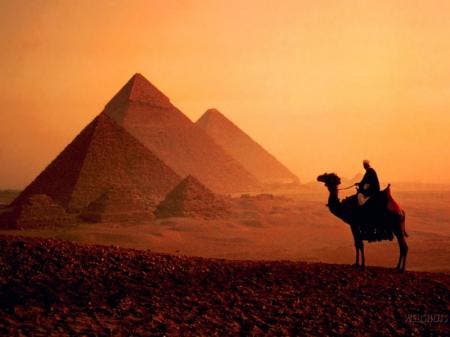
These pyramids at Giza were already "older than dirt" -- 2,200 years old -- when Alexander the Great conquered Egypt and was crowned pharaoh
As civilizations go, Romanesque and Gothic Christendom -- the foundation of modern Western civilization -- developed relatively late. It grew up in the western part of the Eurasian landmass on the ruins of the western Roman Empire. During most of the Middle Ages, Europe's leaders accommodated change, but usually only reluctantly. Century after century, the three social orders wanted life to go on much as it had for their ancestors. In this respect, medieval Europe was not much different from Egypt, China, and other great civilizations of premodern times.

Noteworthy (because it is the exception that proves the rule) is the one ancient civilization that embraced change, classical Greece. From Thales of Miletus to Ptolemy I, the Greek spirit was relatively open to new ideas. Ptolemy I's example is particularly striking because he ruled Egypt -- already a 3,000 year-old civilization when he arrived; the pyramids he toured were more than 2,000 years old. Ptolemy brought an entirely new spirit to the land of the Nile. At Alexandria, this Hellenistic ruler (1) commissioned the world's then-largest library that housed 700,000 papyri and humankind's first think tank; (2) engineered a harbor to hold 1,200 ships, and (3) erected a lighthouse that guided ships from as far away as 30 miles. In all these projects, Ptolemy exuded Hellenism's embrace of the world. That spirit would powerfully reemerge in the European Renaissance some 1,700 years later.

What Made the West Different?
In a word, it was modernity. But the origins of modernity need to be unpacked to make any sense.

The Renaissance is the name we give to an era in Western civilization lasting from the 15th to the 16th centuries, when new winds began to stir. Blowing across the western Eurasian landmass, these winds made Europe ripe for transformation. What happened in the late Middle Ages to make the West diverge in fundamental ways from its own past and from other civilizations? Why was it Europe that initiated the changes that would transform all humankind? Many factors came into play.

1. The most fundamental factor of all was the nature of the civilization itself. Western Christendom was a cultural mix that brought together (a) Judeo-Christian spiritual aspirations; (b) Greco-Roman philosophical quests including the Hellenistic spirit noted above; and (c) Anglo-Saxon-Germanic political arrangements. The rich elements from these diverse civilizations mixed, reacted, clashed, and catalyzed a new cultural chemistry. This new cultural chemistry matured into the seedbed that would nourish the most powerful civilization on earth. Christopher Dawson explores the West's seedbed in Understanding Europe, as does Russell Kirk in The Roots of American Order. Thomas Jefferson celebrated the Saxon ingredient in the remarkable second paragraph of A Summary View of the Rights of British America.
Mont St. Michel -- an organic expression of Gothic civilization

2. The tension and competition that arose within Christendom's numerous nations nurtured societies that tolerated diversity (and as we saw above, classical Greek civilization was a particularly important element in the mix). European society was more tolerant of boundary transgressions and paradigm shifts than societies in the past and in other civilizations had been. Because of history and geography, Europe had more competing states and institutions than any comparable place on earth. If a man's idea did not resonate in the Church, then perhaps it found a home in the state, and vice versa. If the prince of one state did not like an idea, then the prince of a nearby state might. Thus, the freedom to experiment and change became more normative in the West -- more so than anywhere else on the planet. Think of Columbus of Genoa (Italy), whose idea of sailing west he tested with the monarchs of Portugal and England before landing a commitment from the Spanish monarchs of Aragon and Castile. Also think of the Renaissance humanist Erasmus, who was equally at home in Paris, Louvain, Cambridge, and Basel. The social openness to new ideas (even to the point of boundary transgressions and paradigm shifts) explains why so many revolutions -- commercial, religious, scientific, intellectual, industrial, political -- could take root in the West after 1500.

Kuhn's important study of paradigm shifts
3. Frustration can be a source of historical change. A powerful trigger of modernity was Europeans' frustrated desire to trade with the East. In American history classes I bring in a pepper shaker and joke that this is what started it all. Europeans wanted Asian pepper. But in the late Middle Ages, Muslims made overland trade between Europe and Asia increasingly difficult. After centuries of lagging behind Muslims, Europeans weren't going to take it any more. In the fifteenth century they finally had the combination of technology, capital, curiosity, confidence, missionizing zeal, and competitive drive to seek alternative routes to India and the Orient, bypassing Muslim middlemen who had monopolized traditional land routes. Having to sail thousands of miles around Africa to India and back spurred advances in nautical technology. Early successes engendered a can-do spirit. So the voyages of discovery would contribute to the transformation, first in Europe's port cities, banking centers, and dynastic houses, then throughout the broader culture.

4. In the case of Europe's domination of the Western Hemisphere, epidemiology reveals a critical factor. Europeans had numerous herd animals; the Indians did not. Such animals migrated throughout Europe after the retreat of Pleistocene glaciers, finding the climate and food supply amenable to their survival. Europeans followed the animals -- pigs, horses, cattle, sheep, and goats serving as their roving Walmart -- and domesticated them. Because of these herd animals, Europeans built up immunities to the diseases that would ravage large populations of (biologically speaking) defenseless Indians. Using contemporary accounts and historical analysis, historians estimate that 50-90 percent of aboriginal Americans died as a result of smallpox, cholera, typhus, and other diseases that large numbers of Europeans had developed antibodies to. In Guns, Germs, and Steel, Jared Diamond writes persuasively of Europe's grain crops and herd animals making a difference in the rise of human inequality in the modern age.

5. Europe's geography is not often emphasized, but it was another important ingredient in the rise of the West over the Rest. Geographically, Europe was always something apart -- not just apart from Muslims, Indians, and Chinese to the east. Geomorphically, too, Europe was different from the rest of the Eurasian landmass of which it is an extension. To see why, look at the globe. The western fifth of the great Eurasian landmass (from about 30 degrees latitude east to the Prime Meridian) starts to break up into numerous peninsulas and islands that are separated by relatively narrow seas, channels, bays, and straits. Europe has a highly irregular coastline in which sizable bodies of water penetrate well into the interior of the continent. Think of the Aegean, Adriatic, North, and Baltic seas, as well as the English Channel and Dardanelles-Bosporus. Furthermore, large rivers -- the Rhine, Rhone, Danube, etc. -- make communication between the interior and salt water ports easy.
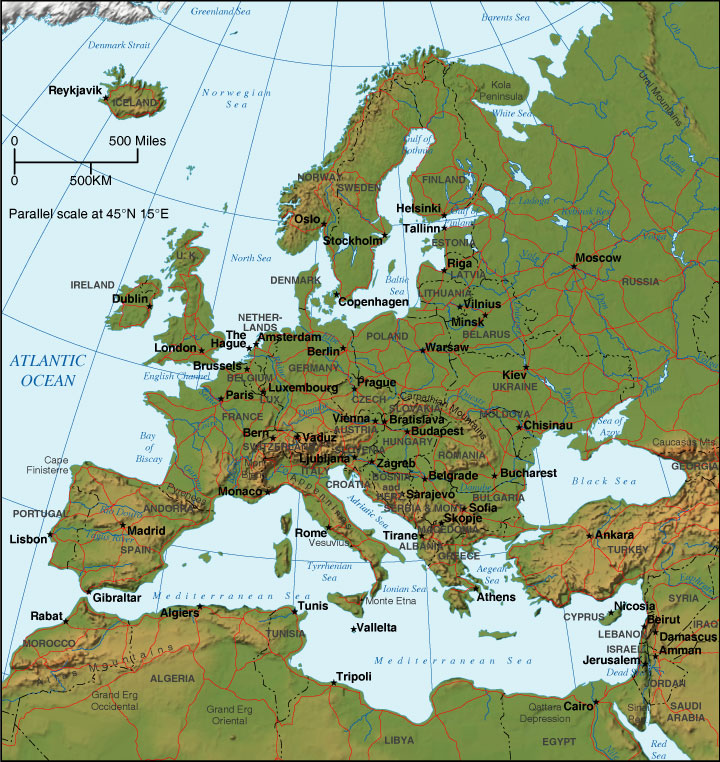
Europe, the westernmost extension of Eurasia, is broken into numerous peninsulas and islands. No comparable landmass on earth is so interpenetrated by water.
European geography with all its peninsulas and islands (not to mention mountain ranges) also encouraged the formation of numerous competing states in relatively close quarters. It's why Italy has a peninsula to itself, as do Greece and Denmark. It's why Spain and Portugal are identified with the Iberian Peninsula. It's why Norway and Sweden are identified with the Scandinavian Peninsula. It's why the United Kingdom is an island unto itself. It's why the Irish aspire to be the sole occupants of their own island. As noted above, these numerous island and peninsular nations also set the stage for leaders to compete with one another in an international arena. The monarchs and princes who tried to outdo one another were another catalyst of change.

I do not subscribe to geographic determinism, but the numerous peninsulas and islands practically guaranteed that Europeans would be a water people. European geography encouraged people to meet their needs by communicating and trading with each other over the narrow bodies of water that separated them.


ancient Greek transport ship

No comparable land mass on earth is so interpenetrated by water as is Europe -- not Africa, not Asia, not Australia, not South America, nor North America -- all of which have smoother coastlines ... though there is one faint comparison in my part of the world. The eastern part of North America presents a geography somewhat similar to that of Europe, with the Chesapeake Bay, Delaware Bay, Hudson River, St. Lawrence River, Great Lakes, and Chicago portage to the Mississippi all affording access deep into the interior of the continent. One hundred years ago, Michigan school children were taught that the Great Lakes amounted to a kind of Mediterranean Sea in the heart of North America.

The Industrial Revolution transformed the West's economy, society, and landscape. Humankind had never experienced any similar transformation. The Industrial Revolution powered the West over the Rest.
6. Risk-taking leaders also played a critical role, for they had the imagination to see new possibilities in the voyages of discovery, accumulation of capital, and advances in technology. Collectively they built up the military capacity of the West to subdue the Rest. Fundamental to the process was the new attitude toward change itself. As the West's leaders embraced the new attitude toward change, they set off a chain of events that would have more far-reaching effects on humankind than anything since the Neolithic Revolution. With explosive energy, the West began increasing its wealth in a commercial revolution, enlarging its understanding of nature in the scientific revolution, empowering its manipulation of physical processes in the Industrial Revolution, retooling its thinking in the Enlightenment, and dominating the rest of the world through westernization. However it spread -- whether by adoption or by force -- westernization led to the globe's transformation. Like it or not, it's the feature story of the modern age. 

7. At this point we arrive at another factor, this one more speculative than the others. It involves the development of the European imagination. All the coastlines in the westernmost part of Eurasia encouraged Europeans to build boats, feed themselves from the riches of the sea, and trade with neighboring lands. But I believe it did more. I believe it accustomed people to look not just inward to the interior but outward on the open water. Gazing out at the open sea, a people's imagination will play on the infinite possibilities of the distant horizon (actually 17 miles out). The broad horizon becomes the basic unit of the imagination. This experience is unlike that of the original riverine civilizations -- Sumer, Egypt, India, China -- where peoples made their living from the earth and looked to a small hinterland for material security.

Psychologically, a distant horizon on the open sea incites wonder and restlessness. What's out there? Who's out there? What are people doing on the other side? Isn't this why we are attracted to sea coasts? We are suspended in wonder before the other, the infinite. Our mind, daydreaming, is mesmerized by the rhythmic surf. Here in the Great Lakes State we have this experience when we go to the sand dunes on Lake Michigan on a clear day and look west toward Chicago and Wisconsin. Looking out over Lake Michigan makes me think about Europeans through the ages. More than any other peoples on earth, Europeans are Homo viator, sojourners.

on a Greek ship, c. 530 B.C.
A geography and a culture that support sojourning will also encourage a people to embrace change. But -- change to what end?

Three Paradigmatic Stories

There are three great stories that Western culture has absorbed to define our restlessness, curiosity, and sense of wonder. One is from a Greek epic poem, one is from a Roman epic poem, and one is from Hebrew sacred scripture.
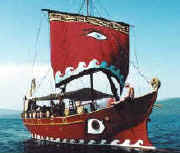
Replica of Odysseus's ship
In Homer's Odyssey, Odysseus cannot rest until he builds a boat to sail back home, to Ithaca, the place that for him is the source of what is true, good, and beautiful.

In Virgil's Aeneid, Aeneas leaves a Troy devastated by war, sails west on the Mediterranean, and founds a new people and a new city, Rome -- in the imagination of many, a symbolically significant home called the "Eternal City."

In the Exodus, Moses leads the Hebrews to the Promised Land, the land of milk and honey -- a journey that in part retraces the steps of Abraham and the Patriarchs, a journey that leads them back toward Eden where the first humans knew perfect truth, goodness, beauty, and love.

Pilgrims sojourn, they seek change -- sometimes with a changeless end in mind.

We Continue to Search for Eden

After 1500 A.D. these three stories became paradigmatic in the Western imagination. They symbolize European restlessness, the quest for something better. I'd allow that the perennial human search is for the true, the good, and the beautiful.
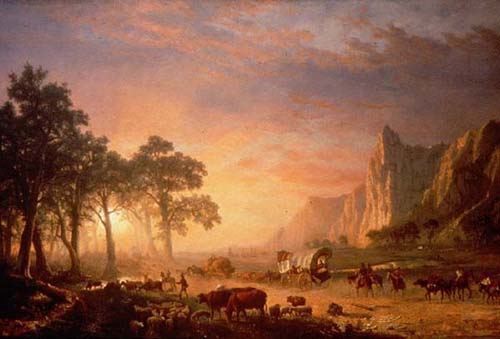
Albert Bierstadt, Oregon Trail
Our American experience with immigrants and on the frontier are latter-day iterations of this ageless impulse to sojourn West to find a better life. As a people we have enshrined our places of natural beauty and sublimity in a peerless collection of parks. We Americans restlessly continue the search for Eden.

Saturday, January 8, 2011

American Founding (3): Roots or Shoots?

Old Roots of Order 

A primer of the American founding that revives mainstream nineteenth-century narratives is Russell Kirk's Roots of American Order. Now in its fourth edition, Roots is "simply one of the finest surveys of the classical, religious, and European influences on American political thought ever composed" (Lee Cheek). In his masterpiece, Kirk traces key cultural elements of four great civilizations and the cities that defined them -- biblical Jerusalem, classical Athens, ancient Rome, and medieval and early-modern London. So:
  • Jerusalem is the seedbed of the West's moral and spiritual roots.
  • Athens is the seedbed of the West's philosophical and ethical roots.
  • Rome is the seedbed of the West's legal and political roots.
  • London -- developing out of ancient German tribes -- is the seedbed of the West's rootedness in liberty and the institutions of self-government.
When I lead seminars on The Roots of American Order, it is easy to prove to American audiences that very few of our most foundational thoughts arise out of American culture. For spiritual comfort and moral guidance, many Americans consult the Bible -- a product of ancient Jerusalem. For methods of sound thinking and right reason, many American college students are taught Plato and Aristotle -- the product of classical Athens. For the concepts of natural law vis-a-vis positive law, as well as oratory, many American legislators still grapple with Cicero and his students -- the product of republican Rome. For an appreciation of representative assemblies, many American citizens still tip their hat to the British Parliament -- the product of feudal London. For understanding free markets and free trade in modern economies, we Americans still refer to Adam Smith -- a product of early modern Glasgow and Edinburgh, which by the late 18th century were intellectual satellites of London.

Is it not remarkable? Not one of these traditions originated in American soil. In all of these basic areas of thought, Americans look to "foreigners" from the distant past to recognize and interpret their world. Even the Federalist Papers, while written by Americans, are thoroughly informed by the political experience of classical Athens, ancient Rome, and early modern London. In significant ways, we Americans stand on the shoulders of giants.

The Tension between Order and Liberty

And yet, these old roots of order are not the whole of the American story. There would be new shoots of freedom throughout the nation's history. This tension between the old shoots of order and the new shoots of freedom is what makes Americans such an interesting people. To embrace this tension is to comprehend the essence of American history.

In the 16th century, the world was thrust into a new era when Europeans encountered the Western hemisphere and began planting their ambitions in its rich soil. On American ground, between the 1490s and the 1790s, various strands of cultural DNA in the West combined to make a remarkable new nation. The creation of the United States was organically related to previous civilizations, to be sure, but not a clone of any of them. Culturally our early republic represented a unique grafting of key elements -- from the monotheistic promise of Jerusalem, to the unfinished philosophical quests of ancient Athens, to the civic republican inheritance of ancient Rome, to the evolving political institutions and common law of London. Politically the Anglo-American errand into the wilderness was producing a new species of polity that began to blossom in Philadelphia in the mid 1770s.

On the one hand, the early republic represented "a revolution not made but prevented," as Burkeans would characterize it. (See Edmund Burke's Appeal from the New to the Old Whigs, in which he discusses the principles of 1688.) On the other hand, as Alexander Hamilton reminds us, the new polity was the result of self-conscious reflection on American resistance to British tyranny. (See his opening to Federalist Paper Number 1.)

So the establishment of the United States was a unique mix of old and new, fulfillment and promise. It did not exactly represent a novus ordo seclorum -- a new order of the ages -- as some American boosters claimed. (The phrase is still on our paper currency.) In reality, each of the four "root cities" provided the cultural stock from which America's founders, framers, farmers, and forward-trekking pioneers would draw sustenance. These early Americans went about their daily lives with their Bible, Aesop, Plutarch, and Blackstone in hand. But on the frontier something new was grafted into their worldview.

New Shoots of Freedom

As the title of his book implies, Kirk emphasizes continuity over change -- old roots over new shoots. And yet, new shoots there were. The first major new shoot appeared, if we are to believe John Adams, in a Boston courtroom in 1761, when James Otis asserted one of the radical ideas of the early modern age -- that human beings are not born to be subjects of a monarch or servants of a dynasty; that there should be a new relationship between the people and their government; that the rulers should be a people's servants. Adams reported being riveted by the speech Otis delivered. Its content was different, revolutionary, even disconcerting. Adams recalled Otis saying that
"every man, merely natural, was an independent sovereign, subject to no law but the law written on his heart, revealed to him by his maker in the constitution of his nature, and the inspiration of his understanding and conscience. His right to his life, his liberty, no created being could rightfully contest; nor was his right to property less incontestable...." Adams added: "Young as I was, and ignorant as I was, I shuddered at the doctrine he taught, and I have all my life shuddered and still shudder at the consequences that may be drawn from such premises."
Looking back, Adams believed that the start of the American Revolution was not at Lexington and Concord, but 14 years earlier in that courtroom. It was not so much on battlefields, as in minds and hearts that the revolution occurred. As Peter Mancall explains, "the change in the sentiments of Americans toward government ... constituted the real Revolution.... As a result of the Revolution, Americans were citizens of a republic, not subjects of a monarch. The people at large had become sovereign, and they created state and national governments to meet their needs.... [Thus] the Revolution ... redefined the nature of politics in the western world."* A new shoot indeed.

So What Changed?

An exciting beginning to a new world order, this -- but it was only a beginning. The hundred years from the 1760s to the 1860s was the first Time of Trial in American history. This Time of Trial saw significant challenges: the American Revolution, War for Independence, birth agony of the new republic, and wars -- a war against aboriginal Americans, against the French, against Barbary Pirates, a second war against Britain, a war against Mexico, and a civil war that brought to a head the unresolved paradoxes at the founding. As a result of these pressures, American politics and culture began to change significantly. They diverged in key ways from European politics and culture. After the tumult of that one hundred years, what had changed?
  • Politically and constitutionally: By the 1780s, a large republic was created in a world of settled monarchies. It took two attempts to get the new republic right -- first in the Articles of Confederation, then in the U.S. Constitution -- but it happened. Sovereignty now resided in citizens, not in monarchs, and politics in the Western world was forever after redefined.  
  • Ecclesiastically: There would be no national church. At the start of the War for Independence, only five states had an established church. A half century later, there were no more state supported or established churches in the land.
  • Socially: Successful revolutions are usually about radical social upheaval. The French, Russian, and Chinese revolutions turned their worlds upside down. The American Revolution did not. As John Willson has argued, the most remarkable thing about the American Revolution is what did not occur, as opposed to what might have occurred. The more radical reformers -- Thomas Paine comes to mind -- were kept in check; social engineering never became part of the program. The relative modesty of our revolution was due in no small part to the fact that there was no entrenched aristocratic order to overthrow. Besides confiscating a few Loyalist estates, revolutionary era governments did not redistribute property. Moreover, to make sure no government-sanctioned aristocracy could arise on American soil, titles of nobility were outlawed in Article I, section 9, of the U.S. Constitution. Socially, formal deference to one's "betters" began disappearing. The literal whipping boys of princes in English courts were unheard of. Equality became an actionable political idea, and the democratic principle would increasingly assert itself.  
  • Culturally: Noah Webster and other chauvinists endeavored to create a distinctively American language, architecture, and culture that reflected their belief in the superiority of the "new world."  
  • Geographically: The presence of a large frontier in the West renewed the possibility, again and again, of equal opportunity and upward mobility (mostly for white males).  
  • Economically: The world's largest, continuous, free-trade zone was coming into existence.
  • Civil society: In the 1830s, Alexis de Tocqueville observed that America's network of voluntary associations was the world's most developed, by far. It was spurred by the fact that pioneers on the frontier outpaced government's reach. People had to solve their own problems.
  • Morally: The U.S. was hardly the first nation to get rid of slavery. In fact, in light of the Declaration of Independence, the founders were embarrassingly slow to rid the nation of its glaring contradiction. But by 1865, as a result of the Civil War and passage of the Thirteenth Amendment, race-based chattel slavery was finally abolished on American soil. It resulted in the largest, uncompensated transfer of private property in human history; four million men and women of African descent were liberated from the shackles of the peculiar institution. This was revolutionary. Yet it is important to remember that social attitudes did not necessarily change with the Thirteenth Amendment. Abraham Lincoln wanted the nation's four million blacks to emigrate and colonize Honduras, Liberia, or other tropical areas -- anyplace away from the U.S. so they would not mix socially with whites.
  • Psychologically: Americans with a physical frontier could also experience something of a psychological frontier. They could choose not to carry forward the burdens of the past. In fact, Americans could be indifferent to the past, and look only toward the future, and reinvent themselves again and again if they wanted. Innovations all, from the perspective of Old Europe's conservatives defending their anciens regimes.

__________

*For John Adams's 1818 retrospective on James Otis in 1761 and the true beginning of the American Revolution, see Peter C. Mancall, Origins and Ideologies of the American Revolution, vol. 4 (Chantilly, VA: Teaching Company, 2005), pp. 194, 206-07.]
To learn more, visit http://www.allpresidents.org/