Showing posts with label Obama. Show all posts

Thursday, August 31, 2017

Tonsor: American History: The South

I.

Jesse Jackson received a surprisingly high
percentage of the white vote when he ran in
Democratic primaries and caucuses in 1988.
In Michigan he easily won the Democratic caucus.
Jesse Jackson made a remarkable run for the presidency in the early months of 1988 -- two decades before America would elect its first black president, Barack Obama. Michigan played a significant role in the ascent of the civil rights leader: After he won the Democratic caucus with 55 percent of the vote, Jackson for a brief time was the Democratic front-runner since he had the most pledged delegates. Whatever their politics, many voters recognized that it was a significant threshold for an African-American to cross.[1]

Tonsor was cynical about this historic moment. When I joined him and Caroline for lunch a few days after the caucus, he dismissed the result: "Jesse Jackson's showing in Michigan is a fluke and he won't win -- he can't win. America is not ready for a black president. To cite that great expert, the comedian Don Rickles: 'Last year we said things can't go on like this, and they didn't -- they got worse.'"

He chuckled, but I was not feeling the vibe. Because of recent conversations among my circle of acquaintances and friends, the topic hit an irritating boil that was ready to pop. In my agitation I hardly noticed that the ever-gracious Caroline set a plate of hot food before me.

"Well," I said, "I was born and raised in Texas and also spent part of my childhood in New Orleans, and I find it interesting how many Northerners think they're experts on the South. Some of our colleagues on campus have expressed dismay that Jackson is racking up primary victories below the Mason-Dixon Line, and not just with the support of black voters. He's winning with significant white support, too.[2] I am starting to think that Northerners don't want to give the South any credit for overcoming the burden of its history." 

My Texas drawl was subtly surfacing in my speech, as it often did when I spoke about my childhood home at any length or with any passion. Tonsor sat squarely in his chair, looking at me through his thick glasses with that sphinx-like expression of his. I had no idea what he was thinking -- maybe he had never heard my Texas accent before -- but I raised the ante in an effort to get him to play his hand.

"I've been surprised by the prejudice against the South on campus," I persisted, "and by the condescension toward Southerners. Yesterday one of our department's star grad students said that a Southern accent knocked ten points off a speaker's IQ. 

"But I'll tell you what I think after living in the North these past several months: When it comes to race relations, I think the North needs the South to be its scapegoat. Look at how Northerners are always calling out the South for being racist. But notice that they bring out their fog machine to obscure the truth and hide their own racist past."

Tonsor, I perceived, began to shake his head but I could not tell whether it was in agreement or disagreement. 

"Don't you think," I repeated with growing heat, "that a lot of Northerners use the South as a scapegoat to deflect attention away from their own legacy of racism -- whether it's Brown University capitalizing on the New England slave trade, or it's Indiana reviving the KKK after World War I, or it's Detroit being the most segregated city in North America? Aren't both sections of the country stained with the blood of America's original sin. It's always easier to look at the splinter in the other fellow's eye than to deal with the splinter in your own. I don't think the North is in any position to lecture the South when it comes to race."


II.

Caroline and Tonsor fussed with their food. They were uncharacteristically quiet. It suddenly occurred to me that I was violating their hospitality. Here I sat at the table of two Northerners who were feeding me and who likely sympathized with my complaint. But I had a burr under my saddle, and my heated and defensive rant was not conducive to friendly conversation. The irony was not lost on me that I was acting in a very un-Southern way; my mother would have been mortified. Apologizing, I looked for a way to change the subject.

"You are just expressing your Southern pride," said Tonsor with understanding. 

"It just shows that you feel comfortable enough with us to say what's on your mind," added Caroline kindly.

"Thank you for saying that," I said. "As you can probably sense, I feel more conflicted than ever. It's not as though I can return to the South and fall into the old conversations. I cannot act as though I haven't learned things. Maybe the Dunning School is not the last word on the subject."

Columbia University historian William Dunning
(1857-1922)
For Caroline's benefit, and for mine too it turned out, Tonsor elaborated, "Mr. Whitney is referring to one of the most influential historians in U.S. history, William Dunning. During the Gay Nineties and early twentieth century he left his mark on the first generation of university-trained doctoral students who wrote on the Reconstruction era, and their work would influence the interpretation of Reconstruction for a hundred years. [3] His intellectual genealogy is also worthy of note. He himself was German trained -- by the extreme nationalist Heinrich von Treitschke, a historian who is best handled with tongs. After returning to the U.S., Dunning established himself at Columbia where he was a teacher of Carlton J. H. Hayes, who was a teacher of Joseph Ward Swain, who was a teacher of mine."[4]

"So your professional genealogy descends from Dunning?" I queried, wondering whether I had just stuck my foot in my mouth.

"I would be a mutation," Tonsor said sarcastically, "for I am much more in Lord Acton's line of descent and have never considered myself part of Dunning's so-called school. But it is important to know who he is. Dunning notched his gun by slaying apologist after Northern apologist of Reconstruction. Not surprisingly his legacy is a mixed bag. On the one hand, the South is quite enthusiastic about him. He and his doctoral students at Columbia did painstaking archival research to demonstrate how much the Radical Republicans hurt the former Confederate States of America. There was much of value in their findings, for they help us understand why the South resents the North to this day. On the other hand -- a stained hand, no doubt -- in retrospect he is considered a racist. People think his work extended the shelf life of Jim Crow and made black disenfranchisement respectable. Today, as you can imagine, his shade is persona non grata at the American Historical Association, which is ironic considering he was one of its founders.

"I also mentioned Lord Acton whose reflections are to the point. It is my considered judgment that Acton was the most knowledgeable foreign observer of American affairs in the nineteenth century. His writings on America are not much read nowadays because he supported the South in the Civil War. Yet I urge you to read his long essay on what he called the Second American Revolution; it's published in his journal The Rambler, and it's misleadingly titled, "Political Causes of the American Revolution." Acton was no defender of chattel slavery -- not at all like Calhoun who wrote of slavery as a 'positive good' -- yet he believed the federal system of states' rights was critically important to upholding freedom and curbing the enlargement of the national government, not to mention the expanding tyranny of the president. The South, Acton believed, was fighting for liberty, for progress, and for civilization.[5] And while he believed that most great men were bad men,[6] he sympathized with the tragic pathos of Robert E. Lee, who felt duty-bound to defend his homeland against invasion. He wrote to Lee following his surrender, 'I mourn for the stake which was lost at Richmond more deeply than I rejoice over that which was saved at Waterloo.'"[7]

I silently noted the irony that Acton wanted to uphold freedom in the states that supported slavery but, feeling that I had been combative enough already, kept the observation to myself. 

"For me," I offered instead, "there's no going home to the same South. I see it differently now. I'll always love my family, of course, and the flavors, smells, and scenes of my childhood, but I've had to rethink what I learned in childhood -- about race, the Civil War, Reconstruction, Jim Crow, all of it. I mean, my generation is probably the last to see Southerners stand when the band strikes up Dixie! Even my view of Lincoln has taken a 180. Several members of my family thought he was a tyrant who ran roughshod over the Constitution. They could never speak his name without gnawing their hand over his invasion of the South. They have a point. But then you travel. You read. You talk. You reconsider. It takes time to come to terms with the South's mixed legacy." 


III.

"You are dealing with a tangle of myth, memory, and the politics of nostalgia. Because the Civil War is the American Iliad,[8] it is constantly being refought in the public memory. Much is at stake, for myths make meaning, meaning makes politics, and politics make myths.[9] It will take time, but you will find a way to come to terms with your Southern legacy," Tonsor said, and added, in a softer register: "Maybe it's harder for Texans because of the pride Texans have in the Lone Star State. But with time and perspective you will sort it out.

"I have a similarly complicated relationship to my home, the Great River Country of south-central Illinois, with its large horizons, its prairie panoramas, and its riparian woodlands. The Land of Lincoln," he added with a mischievous grin. I smiled back at him, for we had reversed roles. In dialogue he was more likely to be the edgy one with the chip on his shoulder; I the patient listener. Today we got to see things from the other side of the fence.


Lincoln Hall, where Illinois's history department once was housed. The
edifice looks like a Roman temple dedicated to a "god," Abraham Lincoln,
whose bust is in the alcove at the end of the lobby.
"I was raised on Lincoln," said Tonsor. "He was everywhere in my childhood. After World War II, when I attended Illinois -- a land-grant university whose founding was owed to Lincoln's support for the Morrill Act -- I encountered his words every day, literally. The history department was then in Lincoln Hall, a building that was designed to look vaguely like a Roman temple to a god, and in this case the god was Abraham Lincoln. As you approach Lincoln Hall from the Main Quad, you can look up at the entablature which girds the top of the building and see a Bartlett's worth of Lincoln quotations."

"The hall is a veritable shrine to Lincoln," added Caroline. She looked at her husband and said, somewhat tentatively: "There must be three dozen quotations of the President, and a bust in the lobby." 

"Yes." Then, turning to me he remarked, "I have mixed feelings when I return home, to south-central Illinois. Caroline and I usually drive back to Jerseyville over the Fourth of July to be with family. But there is always something depressing about going back. So many people there have never reached for more than a very average life. Meaningful conversation can be tough slogging. Most of what they know about the world comes from lowbrow television shows. But these are my people and it's home.

"So I understand your attachment to place, as well as your very complicated relationship to Texas and the South. It's similar to my complicated relationship to south-central Illinois. The irrational attachment to place is one of the things that makes us human. Alas, the importance of place is often overlooked in the cosmopolitan atmosphere of Ann Arbor. Here reign the deracine."


____________


Notes

[1] R. W. Apple Jr., "Jackson Wins Easily in Michigan in Surprising Setback to Dukakis," New York Times, March 27, 1988, at URL "http://www.nytimes.com/1988/03/27/us/jackson-wins-easily-in-michigan-in-surprising-setback-to-dukakis.html?mcubz=0; R. W. Apple Jr., "Jackson Is Seen as Winning a Solid Place in History," New York Times, April 29, 1988, at URL http://www.nytimes.com/1988/04/29/us/jackson-is-seen-as-winning-a-solid-place-in-history.html?pagewanted=all&mcubz=0. 

[2] E. J. Dionne Jr., "Black and White: How Jesse Jackson Made History While Losing Wisconsin, New York Times, April 10, 1988, at URL http://www.nytimes.com/1988/04/10/weekinreview/black-and-white-how-jesse-jackson-made-history-while-losing-wisconsin.html?mcubz=0; E. J. Dionne Jr., "Jackson's Share of Votes by Whites Triples in '88, New York Times, June 13, 1988, at URL http://www.nytimes.com/1988/06/13/us/jackson-share-of-votes-by-whites-triples-in-88.html?mcubz=0.

[3] For a more recent treatment of the state of the historiographic debate over William Dunning and his legacy, see The Dunning School: Historians, Race, and the Meaning of Reconstruction, ed. John David Smith and J. Vincent Lowery, Foreword by Eric Foner (Lexington: University Press of Kentucky, 2013).

[4] Stephen J. Tonsor, "Joseph Ward Swain," Equality, Decadence, and Modernity: The Collected Essays of Stephen J. Tonsor, ed. Gregory L. Schneider (Wilmington, DE: ISI Books, 2005), p. 312.

[5] Stephen J. Tonsor, "Quest for Liberty: America in Acton's Thought," Introduction by James C. Holland (Grand Rapids, MI: Acton Institute for the Study of Religion and Liberty, Occasional Paper No. 1, 1993).

[6] Lord Acton letter to Mandell Creighton, quoted in Gertrude Himmelfarb, Lord Acton: A Study in Conscience and Politics (Grand Rapids, MI: Acton Institute for the Study of Religion and Liberty, Kindle edition), chap. 9, loc. 4880.

[7] Lord Acton letter to Robert E. Lee, November 1866; quoted by Tonsor, "Quest for Liberty."

[8] This expressive allusion was used by the University of Chicago professor Richard Weaver in "Lee the Philosopher," Georgia Review, vol. 2, no. 3 (fall 1948): 297. Previously it was the title of a book that was published when Tonsor was an undergraduate: Otto Eisenschiml and Ralph Newman, The American Iliad: The Epic Story of the Civil War (Indianapolis: Bobbs-Merrill, 1947). 

[9] A similar formulation was offered by the Berkeley historian T. J. Stiles, "We Need a New Museum that Tells Us How We Came to Believe What We Believe," History News Network, August 27, 2017, at URL http://historynewsnetwork.org/article/166765. 

Thursday, May 26, 2011

The Most Dangerous Man in America

On May 26, 2011, WGVU hosted a program on the downtown campus of GVSU. Serving on the panel with me were Dr. Daniel Ellsberg, Congressman Pete Hoekstra, and Cooley Law School Professor Devin Schindler. The audience was first shown a 30-minute excerpt from the documentary film, The Most Dangerous Man in America: Daniel Ellsberg and the Pentagon Papers. I then gave the panel's opening statement, based in part on the following talking points.

1. Bravo to WGVU for hosting this event about the Vietnam War era. Polls today reveal that too many people -- especially younger people who have no memory of the War -- are not in possession of the most basic facts
  • 1/3 of Americans do not know who won the war.
  • 1/5 think we fought on the side of the North Vietnamese.

2. The Most Dangerous Man in America (what Kissinger once called Daniel Ellsberg) is a highly sympathetic portrait of the first person prosecuted under the Espionage Act of 1917 for leaking government secrets to a newspaper. The Obama administration, by the way, has been prosecuting five people under the Espionage Act for leaks to the media -- more than all previous administrations combined.

3. The documentary raises questions about the constitutional duties of public servants and the moral duties of citizens. In this modern-day morality play, Richard Nixon, as usual, is the villain. On college campuses, there are usually snickers when Richard Nixon's words and image come up, and to an extent it is understandable -- the man was his own worst enemy. Yet the historian in me wants to see an honest airing of the issues. Whatever side one takes regarding the Vietnam War and the unrest in the 'Sixties, this evening let's avoid the tendency to demonize and caricature the other side. Let's be open to expanding our awareness and understanding. History that merely ratifies our prejudices or demonizes our opponents does not take us very far.

4. My first reaction to the documentary is to feel more sympathetic to Daniel Ellsberg than my parents did. They wanted him shot for treason. Dr. Ellsberg: Even if I have serious questions about some of your actions, let me assure you that the only shot from me will be out of a good bottle of scotch that we should share.

5. My second reaction to the documentary is to smile at Americans' innocence. In the 'Sixties and early 'Seventies, we still expected our leaders to tell the truth. It's a lovely quality, however naive. I don't think it has been the reality or even the expectation in other world powers. During wartime lying is considered de rigueur. Prime Minister David Lloyd George said in the First World War -- I paraphrase -- We have one set of figures to fool the public, one set of figures to fool the Cabinet, and one set of figures to fool ourselves. During the years leading up to the Second World War, Winston Churchill had it on good authority that Prime Minister Stanley Baldwin was deliberately lying to the British people and to the world when he said that the Luftwaffe was not reaching parity with the RAF [Martin Gilbert, Churchill. A Life, pp. 537–38].

6. My third reaction is that I wanted the documentary to show more context.

6 (a). Take Nixon's popularity. Polls of the American people conducted during the Vietnam War showed substantial support for the Nixon presidency. From mid-1971 to January 1973, Nixon's overall job approval rating went up -- after publication of the Pentagon Papers. According to Gallup polls, by the time of his second inaguration in January 1973 -- 19 months after the public learned of the Pentagon Papers -- Nixon's approval rating hit 66 percent: 2/3 of Americans thought the president was doing a good job. (Of course, over the next year and a half his approval rating would plummet precipitously, and by August 9, 1974, he was forced to vacate the presidency.) Now, as Daniel Ellsberg is quick to point out, the Pentagon Papers cover America's involvement in Vietnam from 1945-1967 -- before Nixon was in the Oval Office. And yet Ellsberg wanted Nixon's lies to be exposed by extrapolation and implication if not outright. It didn't happen by the Election of 1972. 

6 (b). What about the Gallup poll question of Nixon's handling of Vietnam? On the eve of publication of the Pentagon Papers, a little more than 40 percent of respondents approved of Nixon's handling of Vietnam. 19 months after the New York Times and others began publishing the Pentagon Papers, approval of Nixon's handling of Vietnam zig-zagged up and peaked in January 1973 at 58 percent. During the 19 months following publication of the Pentagon Papers, disapproval of Nixon's handling of the Vietnam War zig-zagged down from about 45 percent to 33 percent. Correlation is not causation, but here is the biggest surprise of all. Aggregate polling shows that "Young people were more likely to support the war at the beginning, when it was popular, and more likely to support it at the end, when it was not." Again, the Nixon administration is not in the Pentagon Papers, but any reasonably suspicious citizen would likely assume that he was lying about the war as much as his predecessors did. Ellsberg wanted Nixon to be punished for his lies. It didn't happen by November 1972.

6 (c). As Marvin Gaye famously asked, "What's going on?" Why the support for President Nixon and his handling of Vietnam when the number of casualties mounted, and especially when documents proved that Nixon's four predecessors had been lying to the American people about U.S. involvement in Southeast Asia, and when the inference was that Nixon must be lying too. (Ellsberg knew it.)  A big part of the answer -- and I would have appreciated more in the documentary regarding this context -- is that Americans were worried about the spread of communism. Today we forget how tense the world was during the Cold War. In the 50 years between the Bolshevik Revolution (1917) and Secretary Robert McNamara commissioning the "Pentagon Papers" (1967), many events contributed to tension and insecurity in the West: 
  • Central and Eastern Europe went communist after the Second World War, with liberation movements brutally suppressed in Berlin, Hungary, and Czechoslovakia.
  • China went communist in 1949.
  • Khrushchev bellowed at Western diplomats in 1956: "We will bury you" -- an allusion to Marx's statement at the end of Chapter One of the Communist Manifesto.
  • John F. Kennedy had warned of a growing missile gap between the U.S. and U.S.S.R. during the 1960 presidential campaign.
  • The Berlin Wall went up on August 13, 1961.
  • Cuba in our hemisphere -- off the coast of Florida -- became communist in 1959 through violent revolution.
  • The Cuban Missile Crisis in October 1962 kept tensions high.
  • American children were drilled in the civil defense strategy, Duck and Cover!
  • Middle-class Americans started building bomb shelters.
  • Laos was in danger of going communist from the mid 1950s on, and North Vietnam did, leading to a proxy war between the U.S. on one side, and the U.S.S.R. and "Red" China on the other.
  • If you looked at the spreading red on a world map, the Domino Theory did not seem implausible to many, many Americans.
  • Studies like The Haunted Wood, by historian Allen Weinstein and former KGB agent Alexander Vassiliev, detail the extent to which Soviet spies infiltrated the U.S. government during the early Cold War. It was a real problem that made Americans jittery in a nuclear age.
6 (d). Another context: Go back more than 70 years before the Pentagon Papers were published. Once Presidents William McKinley and Theodore Roosevelt set the U.S. on the path to empire, the national government would take on a 24/7 foreign policy. World War I, World War II, and the Cold War added to the burden and necessarily enlarged the power of the presidency at the expense of the Congress (justified constitutionally since he is the commander-in-chief). Arthur Schlesinger Jr. called it the "imperial presidency." You can trace this development in Congressional debates. As the years passed, a greater percentage of time was taken up with foreign as opposed to domestic affairs.

6 (e). The growth of the "imperial presidency" helps us better understand the Nixon presidency itself. The 37th president and all the president's men leveraged fear of communism into greater executive power. In the documentary, you saw Bud Krogh suggest that Nixon believed that there was an ongoing national security crisis -- it amounted to a rolling Red scare -- and only the "imperial presidency" could keep Americans safe. As a result, according to Krogh, there was "a collapse of integrity of the first order" in an administration that had grown defensive and paranoid.

6 (f). I should mention one final context (although there are numerous others): the American tradition of civil disobedience:
  • Thoreau famously taught us about civil disobedience more than a hundred years before the Nixon administration. He argued that Americans should not pay taxes when the nation's policies aided and abetted evil. Citizens should not permit government to overrule or lull their conscience into acquiescence when moral and constitutional principles are at stake. People have a duty not to cooperate with government when it tries to make them an agent of injustice. Thoreau was motivated by his opposition to slavery and the Mexican-American War. 
  • Gandhi and Martin Luther King tutored us in satyagraha -- Truth Force -- nonviolent resistance to a government that is violating a people's rights.
  • Less heroic is the more orthodox path for somebody working in government. If you develop qualms about a policy, you go through proper channels and try to keep your complaint within the Department by talking to your superiors or to the legal counsel within the Department or perhaps to the Inspector General.
  • A person could also opt to resign and throw himself into the political process to influence the outcome of the next election.
  • Believing that the imperial presidency is a menace to the republic, someone could opt to take the papers to another branch of government. Ellsberg did approach U.S. senators (e.g., Fulbright, McGovern) who ultimately turned him down because they were politicians who wanted strength in numbers. But Alaska Sen. Mike Gravel took the Papers and read them from the floor of the U.S. Senate. As stipulated in Article I, Section 6, of the U.S. Constitution, he was immune to prosecution for what he said on the Senate floor. Gravel made sure what he read was entered into the Congressional Record. Having already "stolen" the Papers, Ellsberg could have stopped there, but he did not.
  • Daniel Ellsberg chose a riskier and more controversial path -- one even he suspected was illegal. He took the Pentagon Papers to the Fourth Estate. He shone a light on what he perceived to be evil, with the hope of shaming people into changing. There are respectable precedents for exercising this option going back to the famous trial of John Peter Zenger in 1735, and principled opposition to the Alien and Sedition Acts. But the problem with using the "fourth branch of government" is: Who elected them? Since when did we entrust national security decisions to journalists and editors? Such an extra-constitutional remedy was tested in Ellsberg's case. His was the first time the Espionage Act of 1917 was brought to bear against someone who leaked government secrets to the press.
    7. Once Daniel Ellsberg secreted a copy of the Pentagon Papers out of the filing cabinets of the Rand Corporation (1969), and gave copies to people in influential positions, several major sectors of American life sprang into action and insured that there would be a public debate:
    • The fourth estate used its front pages and editorial pages -- beginning with the New York Times on June 13, 1971. (But who elected them? We cannot have an ad hoc foreign policy made outside the executive branch and U.S. Senate. Chaos would ensue. Besides, are the media truly competent to judge U.S. foreign policy. Isn't this dicey?)
    • Members of the U.S. Senate took up the gauntlet -- above all, Alaska Senator Mike Gravel -- and insured that many of the Papers would be in the Congressional Record.
    • Lower courts and then the Supreme Court took up the case.
    • The private sector took up the gauntlet when an independent book publisher, Beacon, published parts of the 7,000-page Pentagon Papers.
    • Even conservative opponents of Daniel Ellsberg, like William F. Buckley Jr, who thought he gave aid and comfort to the enemy, nevertheless hosted highly visible debates that gave Daniel Ellsberg a platform to make his case. (See the Firing Line debate that took place on July 25, 1972.)
    8. So the system in a sense "worked." A whistle-blower was exonerated. America's institutions did their job to insure there would be a public debate over the so-called imperial presidency and its unconstitutional acts. Given our tradition of civil disobedience, and given the tense conflict inside American society in the late 'Sixties and early 'Seventies, Ellsberg achieved one of his goals: Citizens were informed of a succession of presidents who had lied to the Congress and to the public, and who had likely acted unconstitutionally.

    9. So in 1971 the nation experienced the tension between two camps. In the one camp was the majority of the American people who, based on the information they had, understandably wanted to defend themselves against what they perceived to be an aggressive enemy; they wanted to stop the spread of communism in the Cold War. In the other camp were war protesters who vehemently opposed what they considered to be an illegal proxy war in Southeast Asia, a war that administration after administration had lied about. They sought greater transparency in government, and the veto power that comes from changing public opinion.

    10. Daniel Ellsberg thought he could force the administration's hand. But in the documentary, you see how disappointed he was that more citizens did not take the Pentagon Papers to heart and turn vigorously against the war after they were published. Au contraire, in the short term, voters re-elected Richard Nixon in the landslide election of 1972. Again: What's going on?
    - a growing fatigue with all the upheaval and unrest?
    - or maybe a majority thought Ellsberg was treasonous?
    I would be interested in knowing how Daniel Ellsberg explains the rising support for Nixon and his handling of the Vietnam War during the 19 months following publication of the Pentagon Papers.

    11. What surprised me as I was preparing for this evening and querying colleagues is the depth of feeling to this day among Americans who remember the early 'Seventies and were politically active then. To some, Daniel Ellsberg is an extraordinarily courageous man, a beacon who four decades later raises critically important questions about the constitutional duties of leaders and the moral duties of citizens. To others he remains a thief and a traitor who betrayed his country by stealing sensitive documents and giving aid and comfort to the enemy.

    12. This episode in U.S. history 40 years ago moves us to ask a host of questions that are central to our civic republican traditions. I would hope that students who see the film explore these questions.
    • Even Ellsberg concedes that there is a need for operational, tactical, and strategic secrets. So to what extent do we permit a closed "society" to operate inside an open government?
    • In a nation with a 24/7 foreign policy, what are the limits of the “imperial presidency”? When is official deception justified? What are the limits of transparency in government when it comes to foreign policy and foreign operations?
    • What are the limits of a free press under the rule of law?
    • What are the limits of our civic republican tradition? If a citizen who has worked on a policy decides that that policy is immoral, when is whistle-blowing defensible? When, by contrast, does whistle-blowing reveal too much in the public square? [At the very least, if people will die as a result.]
    • Is it moral courage or opportunism to choose the form of civil disobedience Daniel Ellsberg did? When is it ethical for a consultant to publish confidential papers that do not belong to that consultant?
    • Ellsberg seemed headed toward conviction. Was he "saved" when Nixon overreacted and created the Plumbers who would break into his psychiatrist's office?
    • What role did Daniel Ellsberg and the Pentagon Papers play in the downfall of Richard Nixon?
    13. Final thought: Winston Churchill observed that, in the end, war doesn't determine who is right -- only who is left to write about it.

    *     *     *

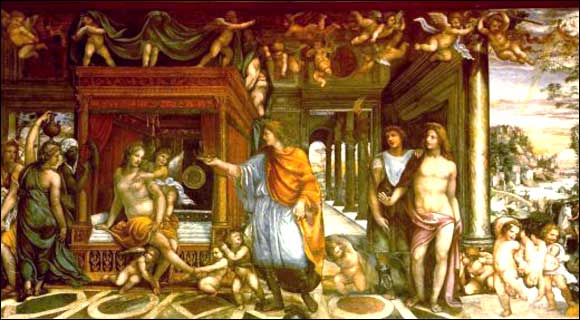
    P.S. -- Toward the end of our panel discussion, Dr. Ellsberg wondered aloud if documents will be leaked that reveal U.S. frustration with the war in Afghanistan. I replied that those documents were leaked long ago. Our libraries are filled with stories of empire after empire that set its sights on Afghanistan but failed to conquer her people -- not the Romans, not the British, not the Soviets. The only conqueror who succeeded in winning the hearts of the Afghan people was Alexander the Great, arguably the most brilliant general who ever lived. But he did not subdue Afghanistan by force of arms. He took Afghanistan by marrying a Bactrian princess, Roxane, the daughter of Oxyartes. Take it from a general who knew what he was doing in Afghanistan. His best strategy ever, as co-panelist Devin Schindler quipped, was to "Make love, not war."

    "The Wedding of Roxane and Alexander the Great," by Sodoma